Two patients can both get a $4,000 quote and have the math behind it look completely different. This guide breaks the black male hair transplant cost into four multipliers (Norwood stage, graft count, per-graft rate, and the hair-type multiplier, the extra time and tooling textured follicles need) so any quote you receive can be validated against your specific Norwood stage. Plus the per-stage cost table and the maintenance-versus-transplant math for younger patients.

Two Black male patients can both walk out of a Turkey consultation with a $4,000 quote and have the math behind it look completely different. One is a Norwood III at age 31 needing 1,800 grafts. The other is a Norwood V at age 47 needing 3,800 grafts. The headline ranges other guides quote ($8,000 – $15,000 in the United States, a few thousand dollars in Turkey) tell you almost nothing about which quote is fair. This guide breaks the black male hair transplant cost down into the four multipliers that actually drive it. Those four are Norwood stage, graft count, per-graft rate, and the hair-type multiplier, the extra time and care afro-textured follicles need to come out intact. You leave with a per-Norwood-stage table to validate any black male hair transplant cost quote you receive, plus the maintenance-versus-transplant math for younger patients deciding whether to wait.
Why does a hair transplant cost more for Black male patients?
The black male hair transplant cost equals Norwood stage (how much you have lost) multiplied by graft count (what restoration requires) multiplied by per-graft rate (what the market charges) multiplied by the hair-type multiplier (the extra time and tooling textured follicles demand). The Norwood stage sets your graft target, graft target plus the local per-graft rate sets your base price, and the hair-type multiplier scales that base price upward for Black male patients because curly and coily follicles require longer extraction and adapted tooling. Together those four levers explain every honest quote you will see.
That decomposition is the practical takeaway. Any black male hair transplant cost quote should state the graft count it assumes and what it includes, because two clinics can hit the same dollar total through different combinations of graft count and per-graft rate, or through packages that cover different things. Practice guidelines leave the fee to each surgeon, charged per follicular unit, per follicle or as a package for a given area[1], so no official per-graft rate exists to check a quote against. The African Hair Transplant program grades your specific case first and quotes from that, not from a headline number.
How Norwood stage drives your black male hair transplant cost
The Norwood scale (II, III, III vertex, IV, V, VI) was originally published in 1975 by Dr. O. T. Norwood after studying 1,000 Caucasian men, and remains the standard map of male-pattern hair loss in the dermatology literature[2]. For Black male patients the scale still applies. The Hair and Scalp Analysis consultation grades your stage against real photographs of your scalp, the starting point for any honest black male hair transplant cost estimate.
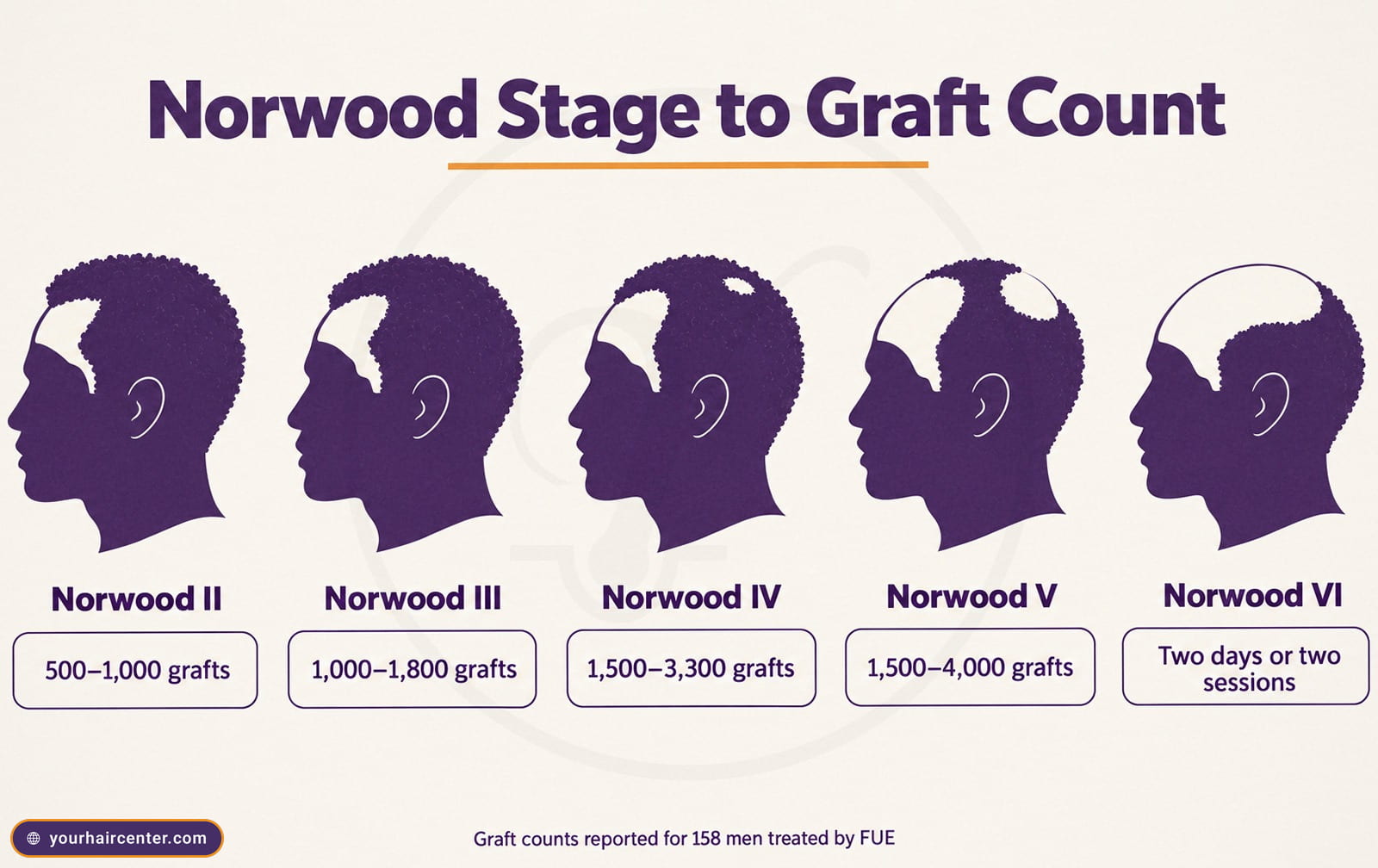
The graft counts by stage below come from a published series of 158 men treated by FUE[3]. Curl gives more visual coverage per graft than straight hair, so a Black patient often needs fewer donor hairs to create the impression of density[4]. The same curl can make the donor area look denser than it is[4:1], which is why the donor assessment matters as much as the stage.
| Norwood stage | Grafts in the published series |
|---|---|
| Norwood II | 500 to 1,000 grafts |
| Norwood III | 1,000 to 1,800 grafts |
| Norwood IV | 1,500 to 3,300 grafts |
| Norwood V | 1,500 to 4,000 grafts |
| Norwood VI | Not in the series, over two days or two sessions |
The financial implication is the most overlooked lever in the whole black male hair transplant cost conversation. Booking at Norwood III rather than waiting until Norwood V can mean roughly half the grafts, which, at a clinic that prices per graft, roughly halves your base price. The per-session ceiling our specialists work to is about 4,000 grafts, against a first-session average of 2,347 grafts among ISHRS member surgeons[5], and a scalp session takes 6 to 8 hours whatever the hair type. Cases beyond that ceiling run over two days under one plan or as a second session months later. The Men’s Hair Transplant service page maps the Norwood progression to the procedure plan in more depth.
What you pay per graft in the US, UK and Turkey
The per-graft rate is the second lever in your black male hair transplant cost calculation, and it is the one that creates the headline gap between markets. United States practices usually charge per graft or per area, and a 2021 study of 90 clinics, cited in a 2023 survey of US patients, put the total cost of a US hair transplant at about $13,610[6]. In the United Kingdom the NHS puts a hair transplant anywhere between £1,000 and £30,000 and does not offer it, because it is cosmetic surgery[7]. In Turkey most centers quote an all-inclusive package rather than a per-graft rate, which is why headline totals diverge so sharply.
Take a 2,500-graft case. Priced per graft in the United States, that black male hair transplant cost lands near the $13,610 average, while our packages for the same case run $1,650 to $4,650 with the hotel and transfers included. The gap is real and not a quote error.
Per-graft pricing inside an all-inclusive package is not directly comparable to itemized United States pricing without first normalizing for what each package covers. A Turkey package usually rolls hotel, airport transfers, medications, post-op support, and follow-up into one black male hair transplant cost number. The US-versus-Turkey itemized cost comparison article walks through every line item side by side so you can normalize a quote rather than comparing headline numbers directly. The All-Inclusive Packages page lists exactly what the Turkey number bundles in.
Why do curved afro follicles cost more to extract?
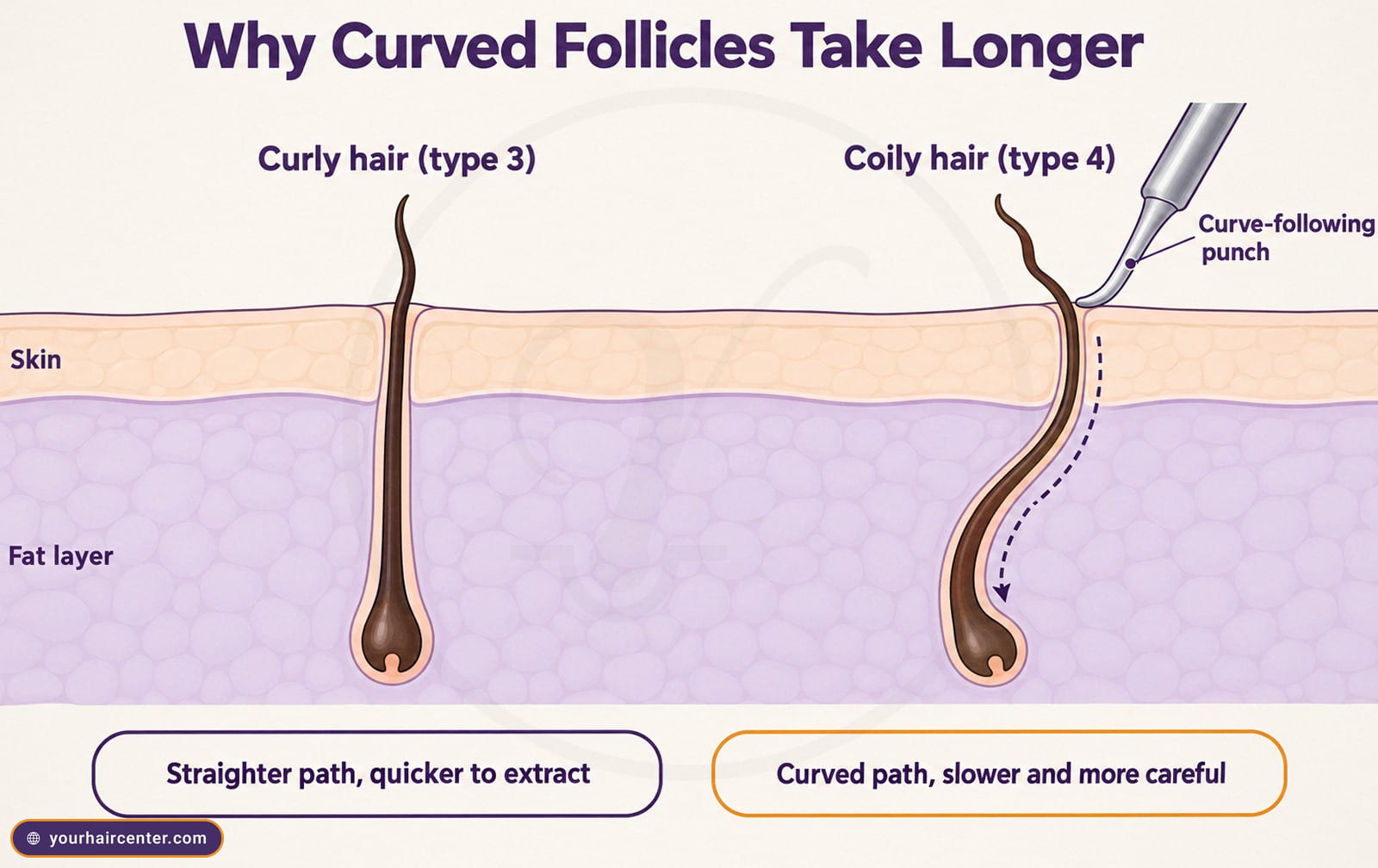
The third lever in any black male hair transplant cost is the hair-type multiplier. Coily hair grows from follicles that follow a curved course beneath the skin, while curly hair runs straight or in a very gentle curve[8], so a straight punch can cut through a coily follicle on its way down. In one multi-provider study of patients of African descent, the highest transection rates recorded with conventional punches ranged from 6 to 80 percent[9], and an earlier test found sharp punches cut about 90 percent of grafts[10]. Punches designed to follow the curve brought transection under 5 percent in the earlier test and to about 3 to 6 percent in the later study, both led by the device’s inventor[10:1][9:1]. A follicle cut through does not grow[11], while FUE series report survival above 90 percent of grafts[3:1]. The hair-type multiplier pays for that gap.
Translated into time, curly and coily hair is harder to treat by FUE[11:1], so each graft takes longer and the same 6 to 8 hour scalp session may yield fewer grafts. That extra time, paired with specialist tooling, is what the hair-type share of a black male hair transplant cost funds.
Three concrete line items the premium covers. Punches sized to the follicular unit, usually 18 or 19 gauge in patients of African descent because their follicular units run wider[9:2]. A punch and extraction motion designed to follow the curve rather than cut across it[10:2]. And high-power loupes, 4x to 6x, so the surgeon can read the follicle direction before the punch ever touches the scalp[11:2].
Paying the straight-hair rate for afro-textured extraction usually means the clinic is not adjusting technique, which surfaces months later as low graft survival in revision territory. For Black male patients shopping a black male hair transplant cost quote, the surgeon’s technique choice matters as much as the punch diameter. Sapphire FUE is the typical choice when the case needs 3,000 or more grafts, DHI with the Choi pen handles focused-density work in the frontal hairline, and both build on the underlying FUE extraction technique.
Which costs does a headline quote leave out?
A black male hair transplant cost quote is honest only if it lists what it excludes, and most quotes do not. Line items routinely left out of headline pricing include pre-op blood work and consultation fees, prescription medications during recovery, time off work (3 to 7 days before office work), travel and accommodation if not bundled, and any post-op PRP sessions the package does not already cover.
Currency conversion and international-card-decline rates are real budgeting lines whenever a black male hair transplant cost is paid abroad. Build a small buffer rather than letting them surprise you on arrival.
The single largest hidden line item in any honest black male hair transplant cost article is corrective surgery. Revision work to fix a failed initial transplant on textured hair is more complex than a primary case, and the cost reflects that. Avoiding the corrective-surgery scenario is the entire purpose of vetting credentials before you book.
Four red flags predict corrective-surgery exposure on a black male hair transplant cost quote. The clinic does not publish a graft-survival rate for afro-textured hair. The surgeon will not name the punch diameter used. The quote does not say who performs the extraction and the implantation, while ISHRS lists unlicensed non-physicians performing surgical procedures as the unauthorized practice of medicine[12]. The before-and-after archive contains zero Type 4 patients. Any one is a yellow flag, two or more is a stop signal. The full credentials checklist for African American hair transplant surgeons walks through the nine verifiable signals to run against any clinic before paying a deposit, and the All-Inclusive Packages page lists exactly which follow-up windows are included.
When does treating hair loss first save you money?
If you are early in your Norwood progression (II or early III) and not certain whether to transplant now, your black male hair transplant cost calculator changes shape entirely. Non-surgical maintenance is real medicine for slowing the underlying loss, and the Hair Loss Treatment framework lays out the full ladder. The maintenance ladder typically pairs in-clinic PRP therapy with newer options like exosome therapy, at-home or in-clinic low-level laser therapy, and adjuncts like mesotherapy for scalp-bed preparation. Topical minoxidil and finasteride, the two medicines the FDA has approved for male pattern hair loss[13], also belong on the ladder for many patients. In May 2026 the UK regulator, the MHRA, strengthened the warnings for finasteride 1 mg, noting that sexual dysfunction may contribute to mood disorders, so go through those side effects with the prescribing doctor first[14]. Maintenance can stabilize what you still have, but it cannot restore what is already gone.
The math is clearest with the maintenance bill and the black male hair transplant cost side by side. In-clinic PRP at Turkey-package pricing, repeated a few times per year, adds up to a meaningful annual cost line that compounds over five years. Over five years, a bundle of PRP, exosome sessions, a laser device and medication can approach the price of a one-time transplant package, so run the comparison against your own numbers.
The clinical caveat matters as much as the math. Maintenance does not work for every patient, and waiting until Norwood V to transplant means roughly double the grafts at full per-graft rate (the saved maintenance dollars partially reverse). ISHRS warns that delaying evaluation lets thinning become more extensive and permanent and can leave less donor hair for a future transplant[15]. For a Norwood II to III patient in their late twenties or early thirties, maintenance first then a transplant later is often the lowest lifetime black male hair transplant cost path. For a Norwood IV plus patient the math has already crossed, and a transplant now is usually the right call. The first step in either direction is the Hair and Scalp Analysis that grades your stage and donor density honestly.
Black male hair transplant cost in Istanbul by Norwood stage
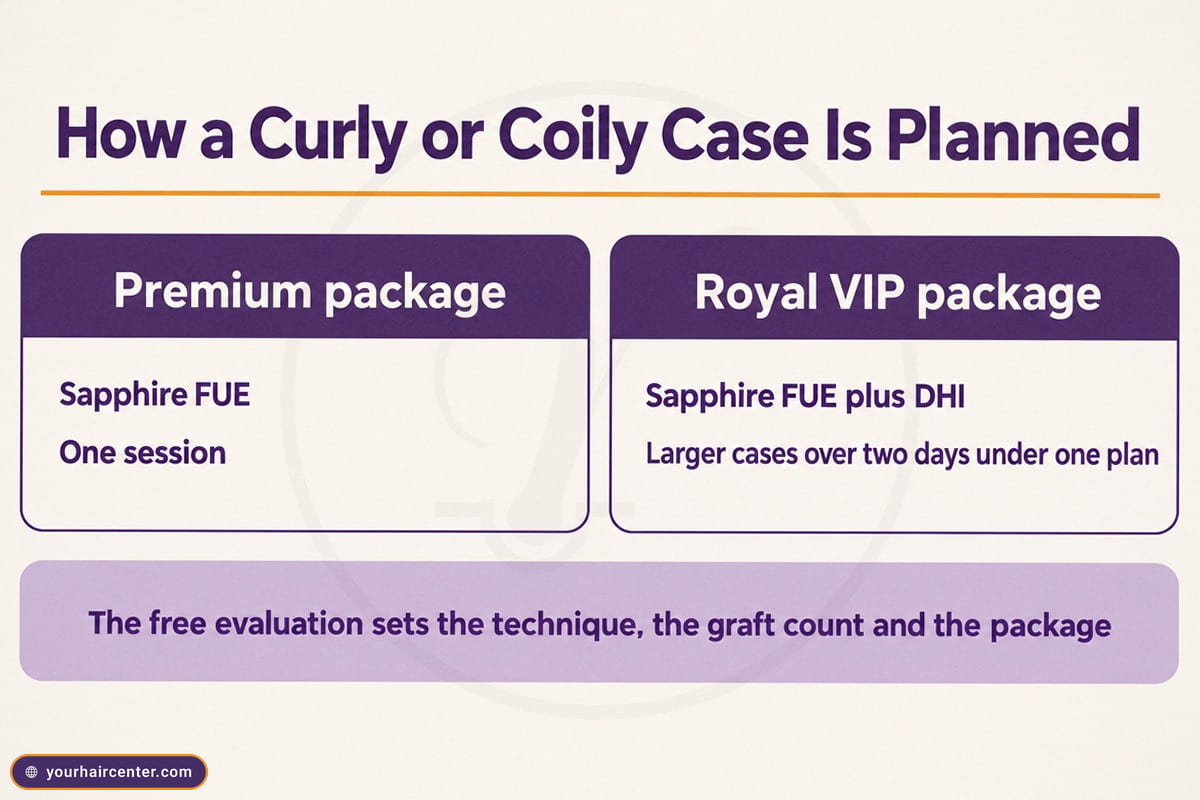
Our all-inclusive packages run $1,650 to $4,650, priced by technique rather than by graft, up to about 4,000 grafts in one session. For curly and coily hair the team plans sapphire FUE or DHI, which sit in the Premium package at $2,650 and the Royal VIP package at $4,650, and the free evaluation confirms the technique and the package. The table maps the per-stage graft counts above to the package and the plan, so the black male hair transplant cost you are likely to see for your Norwood stage is anchored to a concrete number rather than a generic range.
| Norwood stage | Grafts in the published series | Package and plan |
|---|---|---|
| Norwood II | 500 to 1,000 grafts | Premium $2,650 or Royal VIP $4,650, one session |
| Norwood III | 1,000 to 1,800 grafts | Premium $2,650 or Royal VIP $4,650, one session |
| Norwood IV | 1,500 to 3,300 grafts | Premium $2,650 or Royal VIP $4,650, one session |
| Norwood V | 1,500 to 4,000 grafts | Premium or Royal VIP, one session up to about 4,000 grafts |
| Norwood VI | Beyond one session | Royal VIP $4,650 over two days under one plan, or a second session later |
Beyond the surgery itself, a packaged black male hair transplant cost covers the full medical-tourism wraparound. Premium includes a 5-star hotel for 4 nights, VIP airport pickup, post-op medications, a full aftercare kit, one PRP session, an English-speaking patient coordinator and a full year of follow-up. Royal VIP adds the combined sapphire and DHI technique, a 5-star suite for 5 nights, private Mercedes transfers, three PRP sessions and a coordinator available around the clock. The All-Inclusive Packages page lists every inclusion in detail, and the Hair Transplant category pillar puts the afro-hair program in the broader catalog context.
What those packages buy for afro-textured hair is the extraction time and technique described above. Your specific black male hair transplant cost requires your specific Norwood stage and graft estimate. Send your photos for a free cost estimate based on your Norwood stage and you will get the quote inside 24 hours.
Frequently asked questions
How much does a hair transplant cost for Black men?
In the United States the black male hair transplant cost is commonly quoted at $8,000 – $15,000, and one study put the average US total near $13,610[6:1]. Our all-inclusive packages run $1,650 to $4,650, and curly and coily cases usually fall in Premium ($2,650) or Royal VIP ($4,650). The per-stage table above maps each Norwood stage to its graft count and plan so you can cross-check any quote against your own restoration target.
Why are hair transplants more expensive for African American hair?
African American hair transplants often cost more than straight-hair cases because coily follicles curve beneath the skin and need punches and an extraction motion that follow the curve, plus more time per graft. The hair-type multiplier section above lays out what that extra time and tooling fund inside any black male hair transplant cost quote.
How many grafts do Black men typically need?
Graft needs follow the Norwood stage. In a published series of 158 men, Norwood III took 1,000 to 1,800 grafts and Norwood IV 1,500 to 3,300, with Norwood II at 500 to 1,000 and Norwood V up to 4,000[3:2]. Curl lets many Black patients reach a full look with fewer grafts[4:2], and cases beyond about 4,000 grafts run over two days under one plan or as a second session.
What is the difference in graft cost for textured versus straight hair?
Clinics that price per graft often charge more for textured hair, because each graft takes longer to extract and needs punches built for curved follicles. That premium inside a black male hair transplant cost pays for a low transection rate, since a follicle cut through during extraction does not grow[11:3]. Paying the straight-hair rate usually means the surgeon is not adjusting technique, which shows up later as poor graft survival.
Is FUE or FUT cheaper for Black male patients?
The FUE-versus-FUT question is somewhat malformed when calculating a black male hair transplant cost. Keloid scarring is rare after a hair transplant and more often follows the strip method (FUT) than FUE, and people with dark skin carry a higher risk[16], so anyone with a personal or family history of keloids has a small test area watched for a few months first. FUE also leaves no linear scar, which suits men who keep their hair short, so for most Black male patients FUE is the practical option. The real cost-comparison question is between FUE techniques, primarily Sapphire FUE for larger graft counts versus DHI with the Choi pen for focused-density frontal work.
Does insurance cover hair transplant for Black men?
A black male hair transplant cost is generally treated as a cosmetic expense in the United States, which means it is typically not covered by health insurance, HSA, or FSA accounts. The IRS names hair transplants among the procedures you generally cannot count as medical expenses, and allows cosmetic surgery only when it improves a deformity arising from a congenital abnormality, an injury from an accident or trauma, or a disfiguring disease[17]. Verify any exception with your own insurer and tax advisor rather than relying on general claims.
A practical close on the four multipliers
The four multipliers (Norwood stage, graft count, per-graft rate, and the hair-type multiplier) together determine the real black male hair transplant cost for any specific patient. Any quote that does not state the graft count it assumes and what it includes cannot be validated. For Black male patients, the hair-type multiplier inside any black male hair transplant cost number is non-negotiable for graft-survival outcomes. Paying the straight-hair rate usually means the clinic is not adapting technique, and that shows up in the gallery rather than the invoice.
Pinning down your own black male hair transplant cost takes your Norwood stage and graft estimate. Send your photos for a free Norwood-stage assessment and cost estimate on WhatsApp, and you will get a quote inside 24 hours. To compare the Turkey number against United States pricing first, the US-versus-Turkey itemized cost breakdown walks through every line item side by side.
The content and sources of this guide were reviewed on 13 October 2026.
References
-
Mysore V, Kumaresan M, Garg A, et al. "Hair Transplant Practice Guidelines." J Cutan Aesthet Surg. 2021;14(3):265-284. https://pmc.ncbi.nlm.nih.gov/articles/PMC8611706/ (opens in new tab) (accessed October 2026). ︎
-
Wirya CT, Wu W, Wu K. "Classification of Male-pattern Hair Loss." Int J Trichology. 2017;9(3):95-100 (reviews the Norwood-Hamilton classification; original, Norwood OT, "Male pattern baldness, classification and incidence," South Med J. 1975;68(11):1359-65). https://pmc.ncbi.nlm.nih.gov/articles/PMC5596658/ (opens in new tab) (accessed October 2026). ︎
-
Wang F, Chen Y, Yang C, et al. "Using the follicular unit extraction technique in treatment of male androgenetic alopecia." BMC Surg. 2024;24:358. https://pmc.ncbi.nlm.nih.gov/articles/PMC11566358/ (opens in new tab) (accessed October 2026). ︎ ︎ ︎
-
Yates WD, International Society of Hair Restoration Surgery. "Hair Restoration in African-Americans." ishrs.org (opens in new tab), updated 2019. https://ishrs.org/african-american-hair-restoration/ (opens in new tab) (accessed October 2026). ︎ ︎ ︎
-
International Society of Hair Restoration Surgery. "2025 Practice Census Results," procedures performed by ISHRS physician members in 2024. https://ishrs.org/wp-content/uploads/2025/05/report-2025-ishrs-practice-census_05-12-25-final.pdf (opens in new tab) (accessed October 2026). ︎
-
Knoedler L, Ruppel F, Kauke-Navarro M, et al. "Hair Transplantation in the United States, A Population-based Survey of Female and Male Pattern Baldness." Plast Reconstr Surg Glob Open. 2023;11(11):e5386. https://pmc.ncbi.nlm.nih.gov/articles/PMC10642908/ (opens in new tab) (accessed October 2026). ︎ ︎
-
NHS. "Hair transplant." nhs.uk (opens in new tab), page last reviewed 29 September 2023. https://www.nhs.uk/tests-and-treatments/cosmetic-procedures/cosmetic-surgery/hair-transplant/ (opens in new tab) (accessed October 2026). ︎
-
Umar S, Shitabata P, Rose P, et al. "A New Universal Follicular Unit Excision Classification System for Hair Transplantation Difficulty and Patient Outcome." Clin Cosmet Investig Dermatol. 2022;15:1133-1147. https://pmc.ncbi.nlm.nih.gov/articles/PMC9249093/ (opens in new tab) (accessed October 2026). ︎
-
Umar S, Khanna R, Lohlun B, et al. "Follicular Unit Excision in Patients of African Descent, A Skin-Responsive Technique." Dermatol Surg. 2023;49(10):949-955 (the first author declares patents on the device studied). https://pmc.ncbi.nlm.nih.gov/articles/PMC10521773/ (opens in new tab) (accessed October 2026). ︎ ︎ ︎
-
Umar S. "Comparative Study of a Novel Tool for Follicular Unit Extraction for Individuals with Afro-textured Hair." Plast Reconstr Surg Glob Open. 2016;4(9):e1069. https://pmc.ncbi.nlm.nih.gov/articles/PMC5055031/ (opens in new tab) (accessed October 2026). ︎ ︎ ︎
-
Kumaresan M, Mysore V. "Controversies in Hair Transplantation." J Cutan Aesthet Surg. 2018;11(4):173-181. https://pmc.ncbi.nlm.nih.gov/articles/PMC6371731/ (opens in new tab) (accessed October 2026). ︎ ︎ ︎ ︎
-
International Society of Hair Restoration Surgery (ISHRS). Position Statement on Misleading and Inappropriate Messaging, revised by the Board of Governors on 11 July 2026, listing "Unlicensed, non-physicians performing surgical procedures" as unauthorized practice of medicine. https://ishrs.org/red-flags-misleading-inappropriate-messaging/ (opens in new tab) (accessed October 2026). ︎
-
American Academy of Dermatology. "Male pattern hair loss, Treatment." aad.org (opens in new tab). https://www.aad.org/public/diseases/hair-loss/treatment/male-pattern-hair-loss-treatment (opens in new tab) (accessed October 2026). ︎
-
Medicines and Healthcare products Regulatory Agency. "MHRA strengthens safety warnings for finasteride and dutasteride," press release, 11 May 2026. https://www.gov.uk/government/news/mhra-strengthens-safety-warnings-for-finasteride-and-dutasteride (opens in new tab) (accessed October 2026). ︎
-
International Society of Hair Restoration Surgery. "Addressing the Root Cause of Hair Loss is Key to Successful Treatment," news release, 11 August 2026. https://ishrs.org/root-cause-of-hair-loss/ (opens in new tab) (accessed October 2026). ︎
-
Alhamzawi NK. "Keloid Scars Arising after Follicular Unit Extraction Hair Transplantation." J Cutan Aesthet Surg. 2020;13(3):237-239. https://pmc.ncbi.nlm.nih.gov/articles/PMC7646428/ (opens in new tab) (accessed October 2026). ︎
-
Internal Revenue Service. "Publication 502 (2025), Medical and Dental Expenses," Cosmetic Surgery. https://www.irs.gov/publications/p502 (opens in new tab) (accessed October 2026). ︎
