The hair transplant cost US vs Turkey gap is real, but the headline numbers hide what your dollar actually buys. We itemize twelve cost categories side by side, from consultation and surgeon fee to flights, hotel, and the corrective-surgery scenario nobody publishes. ISHRS-baseline US figures, the $2,500 to $4,500 Istanbul all-inclusive band, and the honest accounting that turns a comparison into a decision.

Patrick has spent six months watching the same numbers blink on a comparison spreadsheet. A US clinic quoted him about $15,300 all-in for a 2,500-graft FUE. An Istanbul clinic quoted him $3,500, all-inclusive. The hair transplant cost US vs Turkey gap is too wide to ignore and too wide to trust, and every article he reads either shouts "Turkey is dangerous" or "Turkey is great" without ever itemizing what either price actually buys. This guide does the math, twelve real line items at a time, from consultation and anesthesia to flights, hotel, translator, and the corrective-surgery scenario nobody likes to publish. We anchor the US per-graft baseline to commonly published surgeon rate cards and name what a Turkey package realistically covers.
Why is a hair transplant cheaper in Turkey than in the US?
The hair transplant cost US vs Turkey gap exists for three structural reasons. First, the loaded labor and overhead cost of running a surgical day in Istanbul is materially lower than in any major US metro. Second, Istanbul programs amortize a single operating room across far more cases per week, which compresses per-patient overhead. Third, Turkish medical-tourism packages bundle services that US clinics bill as separate line items, which makes the headline number look smaller for comparable underlying work.
The US per-graft baseline for FUE published in surgeon rate cards is consistent across major metros, with clinics commonly publishing in the $5 to $10 per graft band. A 2,500-graft case at that rate lands the headline number in the $12,500 to $25,000 window before any of the wraparound items appear. Istanbul’s $2,500 to $4,500 all-inclusive band for the same graft count is roughly a quarter of that window for the same biology of the same follicle.
Cheaper is not the same as lower quality, and cheaper is not the same as safe by default. The rest of this hair transplant cost US vs Turkey breakdown exists because that distinction matters. The line-item table in the next section names what your dollar buys on each side, category by category. For the broader hair-restoration category context, see the Hair Transplant pillar, and for the African and textured-hair specialism that anchors the YHC pricing band, see the African hair transplant service.
The twelve-line cost of hair transplant in US vs Turkey
This is the part most comparison articles avoid. They quote a headline gap and stop. The table below is a representative hair transplant cost US vs Turkey breakdown, not a binding quote, for a 2,500-graft FUE on a Norwood IV head. Every Turkey "included" cell is what the YHC all-inclusive package and analogous Istanbul packages roll into the headline number. Every US dollar range is what a typical surgeon rate card in a major metro would itemize as a separate charge.
| # | Line item | US column (USD) | Turkey column (USD) |
|---|---|---|---|
| 1 | Initial consultation | $200 to $500 | Included |
| 2 | Local anesthesia | $300 to $500 | Included |
| 3 | Surgeon fee, FUE per graft | $5 to $10 per graft, totaling $12,500 to $25,000 | Included in the all-inclusive number |
| 4 | Technician fee | Bundled into surgeon fee | Included |
| 5 | Operating-room or facility fee | $800 to $1,500 | Included |
| 6 | One post-op PRP session | $400 to $1,200, varies widely | One session included at YHC, varies widely at other Istanbul providers |
| 7 | Prescribed medications and aftercare kit | $150 to $400 | Included |
| 8 | Twelve months of follow-up visits | $300 to $900 | Included via medical follow-up |
| 9 | Hotel for the procedure window | Patient pays separately, $150 to $300 per night | Three nights included via reception and accommodation |
| 10 | Airport transfers | Patient pays separately, $80 to $200 | Both ways included |
| 11 | Translator or English-speaking coordinator | Not applicable, English is the operating language | Dedicated coordinator included throughout the trip |
| 12 | Complication or revision policy | Quoted case by case, varies widely | Varies widely by Istanbul provider, verify in writing |
Summing the US column for the same 2,500-graft FUE on a Norwood IV head lands the patient roughly in the $14,000 to $28,000 window once consultation, OR fee, PRP, meds, follow-up, hotel, and transfers are added back. The Istanbul all-inclusive equivalent in our packages runs $1,650 to $4,650, with most of items 1 through 11 already inside that number, and the All-Inclusive Packages page lists which package holds which. The hair transplant cost US vs Turkey delta is a range, not a single figure, and your Norwood stage will shift the graft count, which shifts everything above it. For the patient-specific math on that shift, see the black male hair transplant cost breakdown.
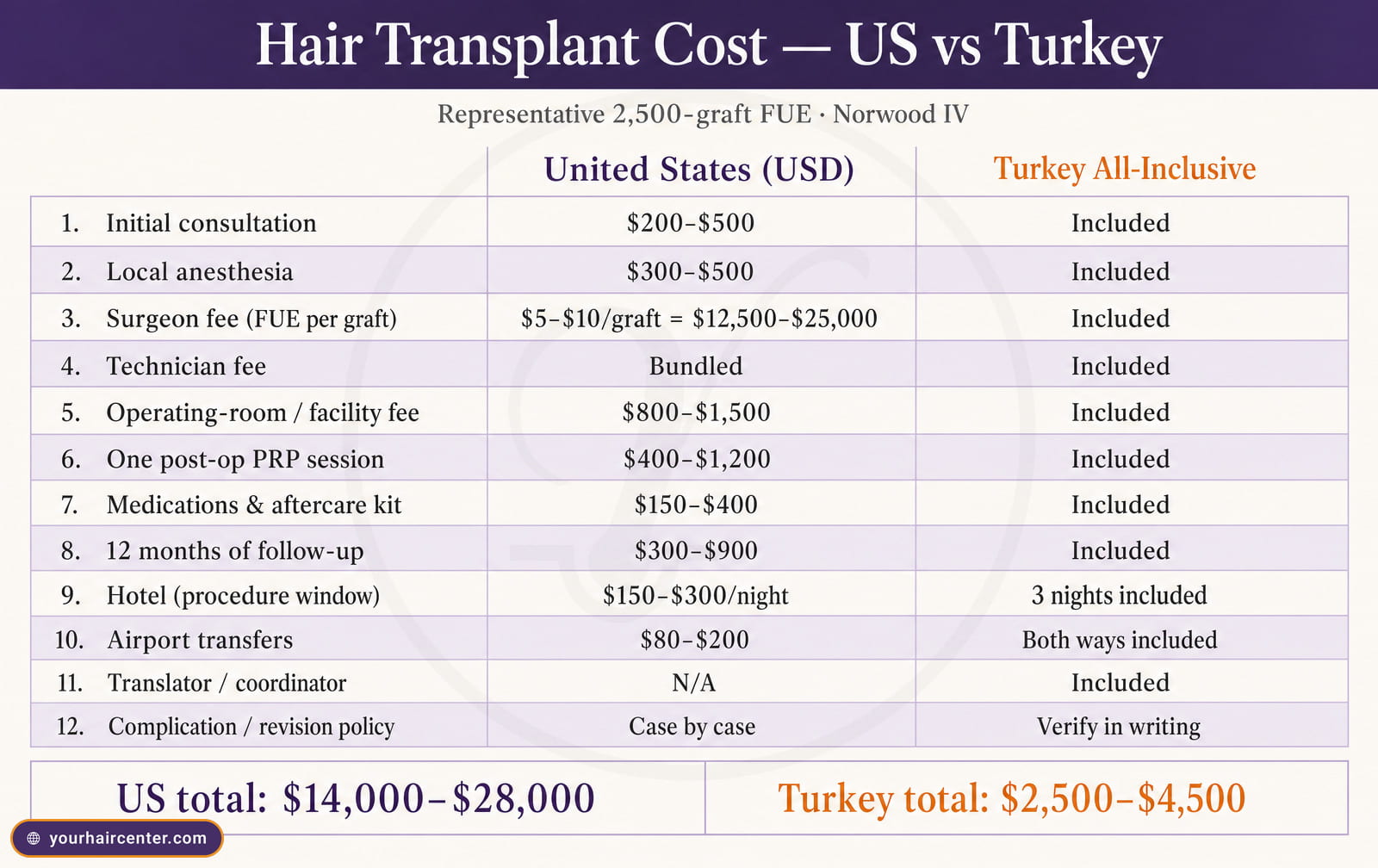
Two rows deserve a second look before you sign anything, because they are the lines where the hair transplant cost US vs Turkey delta is most volatile inside the Turkey column itself. Row 6, post-op PRP, sits inside the YHC package but is the line Istanbul providers vary on most, with some surcharging every session after the first and others bundling none. Row 12, complication or revision policy, is where Istanbul packages diverge most sharply from each other, and any provider should be able to send you the revision policy in writing before you wire a deposit.
What actually drives the gap, the three structural cost categories
The gap survives the line-item table. It is not an accounting illusion. Three structural drivers explain it.
The first driver of the hair transplant cost US vs Turkey gap is the labor cost differential. A US surgical technician carries a loaded hourly cost that is several multiples of an Istanbul technician’s. The same wage compression flows through the surgeon fee in a market where Istanbul programs run multiple cases per day under one operating umbrella.
The second driver is fixed-cost amortization. A US clinic that runs four FUE cases a week amortizes its facility, equipment, and reception overhead across four patients. An Istanbul program that runs twenty cases a week amortizes the same overhead across twenty. Same operating room, same equipment generation, very different per-patient overhead.
The third driver of the hair transplant cost US vs Turkey gap is package bundling. US billing unbundles on purpose to maximize line-item revenue capture and to give insurers a granular structure to negotiate against. Turkish medical-tourism billing bundles on purpose to compete on a single transparent number against domestic alternatives in markets where the patient pays out of pocket. Both are rational business choices, and either side can quote a defensible hair transplant cost US vs Turkey figure once you know which billing model you are looking at.
It helps to name what does not explain the hair transplant cost US vs Turkey gap. Surgeon training caliber does not, because the ISHRS is an international body and Turkish-Health-Ministry-licensed surgeons sit on the same membership lists their US counterparts do. Equipment generation does not, because the same FUE micropunch tooling, Choi pen implanters, and sapphire blade systems are sold to both markets at similar wholesale prices. Graft survival biology does not, because the follicle does not know what country its donor area sits in. The 2018 Josephitis and Shapiro same-patient study on FUT versus FUE survival found no meaningful technique-driven survival difference [1], and the broader FUE literature treats the procedure as a globally standardized minimally invasive surgery [2]. The hair transplant cost US vs Turkey question is about where the operating room sits and how the billing is packaged, not about what is done inside it.
The hidden costs Turkey clinics do not always print on the package page
An honest hair transplant cost US vs Turkey accounting has to itemize the friction the Turkey side of the column does not advertise. None of these items invalidate the Istanbul comparison, but each one belongs on your spreadsheet before you sign.
International payment friction is real. Cross-border medical charges can trigger card declines, so a common precaution is to call your issuing bank before travel and budget for a wire transfer as the fallback. Currency conversion spreads at the point of sale and at the ATM eat a few percent on a $3,500 charge.
Roundtrip flights are not in the Turkey clinic’s all-inclusive band. A US east-coast hub to Istanbul roundtrip varies broadly by season and routing, a west-coast origin runs higher, a UK origin runs lower. Budget the flight separately against the date window the clinic gives you.
The procedure-window meal budget is the small line that surprises people. Most Istanbul packages include hotel breakfast but not dinner. Budget separately for dinners across the three-night window, plus any meals on travel days.
Optional add-ons are not in the headline. Extra PRP rounds beyond the included session, exosome adjuncts, mesotherapy series, sapphire blade selection, and a no-shave technique surcharge are all line items some clinics promote inside the package and others surcharge for. Ask in writing which side of the line each one sits on.
The visa fee is small with a real exception. US passport holders currently travel to Turkey under passport-only entry for tourism stays under ninety days, and medical tourism falls inside that window. Some other passports require a Turkey e-visa at a flat charge per applicant.
The CDC’s medical-tourism guidance closes the friction list. The CDC recommends a pretravel consultation four to six weeks before the trip, an explicit credential check on the clinician and facility, and carrying copies of your medical records both ways [3]. The seven questions you should email any Istanbul clinic before depositing follow from that list, namely who performs the extraction physically, what the revision policy is in writing, what graft-survival rate is published, what the surgeon’s board status is, what the hospital’s accreditation is, what items in the package are guaranteed versus optional, and what the twelve-month follow-up protocol looks like. The all-inclusive packages page itemizes the YHC answer for cross-reference.
When the cheaper number becomes the more expensive number
The failure mode is real and worth naming plainly. A first transplant performed by an under-trained team can deliver poor graft survival, an unnatural hairline design, or a high transection rate that leaves the patient with thin coverage and visible donor depletion. When that happens, a second corrective procedure becomes necessary. This is where the hair transplant cost US vs Turkey conversation gets its sharpest teeth.
A US corrective procedure typically runs $5,000 to $15,000, the same $5 to $10 per-graft band that primary FUE uses, applied to a smaller, more carefully placed graft count. In Istanbul a corrective procedure is often comparable in headline cost to a primary one, but scar tissue from the first surgery makes donor capacity smaller and per-graft success harder, which is a clinical penalty the headline number does not capture.
What causes corrective need is the same in both markets. Surgeon substitution mid-procedure, unverified credentials, excessive case loads per day, megasession overreach without donor capacity, and hairline design done by a non-specialist all show up in the corrective-surgery population. None of these failure modes are country-specific. They are clinic-specific, which is why the hair transplant cost US vs Turkey verification list is identical on both sides of the Atlantic.
The way to de-risk the cheaper number is to verify the team. Check the surgeon’s board credentials individually, demand a published graft-survival rate as a number, and ask who performs the extraction physically. The full credentials checklist walks the framework end to end. The African hair transplant program at YHC publishes a 95% graft-survival rate for afro-textured patients, supported by 0.6 to 0.7 mm adapted micropunch tooling, bidirectional rotation extraction, and 4.5x surgical loupes. For textured-hair cases the matching transection rate at non-specialist clinics reaches 30%, so verification is not optional. A hair and scalp analysis is the entry point that runs that check on your specific case.
The take-home matters. The way to make $3,500 actually cost $3,500 is to verify the team. Skipping verification is how $3,500 turns into $3,500 plus $10,000 plus a year of lost recovery time, which is how the hair transplant cost US vs Turkey calculation inverts in practice.

What a Turkey all-inclusive package actually includes
The inclusion-side answer to the hair transplant cost US vs Turkey question is fairly stable across reputable Istanbul providers in the $2,500 to $4,500 band. The package covers pre-op evaluation, local anesthesia, the surgical procedure, one post-op PRP session, the medication and aftercare kit, three nights of hotel, airport transfers both ways, an English-speaking coordinator across the trip, and twelve months of medical follow-up. That answers the cost of hair transplant in Turkey vs US question on the inclusion side, and the comparable US column would surcharge most of those line items individually.
The items that sometimes sit inside the package and sometimes outside it depend on the Istanbul provider, and the hair transplant cost US vs Turkey comparison lives or dies on which row each one lands in. Sapphire blade selection, no-shave extraction technique, extra PRP rounds, exosome adjuncts, a hotel star-tier upgrade, a room-versus-suite tier choice, and a single-versus-shared airport transfer are the seven add-ons that vary the most across reputable Istanbul packages.
The items that are almost never inside a Turkey package, and that you should budget for separately, are the roundtrip flights to Istanbul, meals beyond hotel breakfast, optional sightseeing days, and the specifics of the complication-coverage policy that governs revisions. The YHC African hair transplant program rolls the first list into its band and is explicit about the second. For the named-example inclusion set see the all-inclusive packages page paired with reception and accommodation and medical follow-up.
Is a Turkey hair transplant safe? Separating the headline from the underwriting
The safety question separates cleanly into two layers, and conflating them is how most articles get the hair transplant cost US vs Turkey conversation wrong.
The country-and-system layer is the first. Turkey runs a regulated medical-tourism infrastructure under Ministry of Health oversight, with internationally accredited hospitals available through the Joint Commission International program [4]. Istanbul’s procedure volume is large enough that the country-level clinical-outcomes record on hair transplant is well documented. The meaningful question is not "is Turkey safe" but "is the specific clinic I am about to pay safe for my specific case."
The specific-clinic layer is what actually answers your decision. The four-item verification list that catches an under-qualified clinic in either country is straightforward. Verify the hospital accreditation. Verify the surgeon’s board status individually. Verify the published graft-survival rate as a number rather than an adjective. Verify the named-patient before-and-after archive depth at twelve months. The same list reveals US clinics that fail too, so credentials matter more than geography for the safety answer.
Hair transplant is a cosmetic procedure with a meaningful but not life-threatening complication profile. The named complications across the literature are infection, folliculitis, suboptimal density, and graft transection. The CDC medical-tourism guidance for any procedure abroad recommends a pretravel consultation four to six weeks ahead, an explicit credential check on the clinician and facility, and carrying copies of your medical records home for any follow-up care that may be needed [3:1]. The credentials checklist walks the verification layer end to end, and the Hair Transplant pillar and the African hair transplant program are the YHC anchors against which you can run the four-item list. That underwriting layer is what makes the hair transplant cost US vs Turkey decision honest rather than headline-driven.
Why this comparison runs the YHC numbers, and not a generic Turkey number
The hair transplant cost US vs Turkey numbers in this article are not abstract. They run against a specific Istanbul provider, which keeps the table from drifting into a generic-Turkey-versus-generic-US comparison nobody can act on. A defensible hair transplant cost US vs Turkey answer has to be tethered to a real package and a real graft-survival number, not to a marketing brochure.
The YHC African hair transplant program publishes a 95% graft-survival rate for afro-textured patients, supported by 0.6 to 0.7 mm adapted micropunch tooling, bidirectional rotation extraction, and 4.5x surgical loupes that protect the curved follicle path defining Type 3 and Type 4 hair. The matching transection rate at non-specialist clinics reaches 30%, while the YHC rate stays under 5%. That specialism is why the table numbers hold up when you ask "$3,500 for what, exactly."
The $2,500 to $4,500 all-inclusive package band aligns precisely with the Turkey column in the twelve-line table. Three nights of hotel via reception and accommodation, airport transfers both ways, the medication kit, one post-op PRP, an English-speaking coordinator across the trip, and twelve months of medical follow-up. The photo gallery supplies the named-patient archive that satisfies criterion four of the verification list.
Patrick’s next step is short. Send your photos for a free evaluation, get a custom quote against your actual Norwood stage and graft count, and run the seven-question verification list against the answer. Start the WhatsApp evaluation, or use the contact page for a form route.

Frequently Asked Questions
Why are hair transplants so much cheaper in Turkey?
Hair transplants are cheaper in Turkey because labor and overhead costs in Istanbul are materially lower than in any US metro, because Istanbul programs amortize a single operating room across far more weekly cases, and because Turkish packages bundle items US clinics bill separately. US surgeon rate cards publish the per-graft FUE rate band that drives the headline hair transplant cost US vs Turkey gap, and all-inclusive bundling closes the rest of it.
Is it safe to get a hair transplant in Turkey?
The hair transplant in US vs Turkey safety question depends more on the specific clinic than on the country. Turkey runs a regulated medical-tourism infrastructure with internationally accredited hospital options. The CDC recommends checking the operating clinician’s credentials and the facility’s accreditation directly before booking [3:2]. The full credentials checklist walks that verification step by step.
How much does a hair transplant cost in the US?
US clinics publish FUE rate cards in the $5 to $10 per graft band that is the consistent US market baseline. A representative 2,500-graft FUE on a Norwood IV head lands the US patient roughly in the $14,000 to $28,000 window once consultation, anesthesia, operating-room fee, PRP, medications, follow-up visits, and the procedure-week hotel and transfers are summed. That is the US half of the hair transplant cost US vs Turkey table further up this page.
What is the average cost of a hair transplant in Turkey?
Reputable Istanbul providers commonly publish all-inclusive packages in the $2,500 to $4,500 band for a 2,500-graft FUE, the same band the YHC African hair transplant program operates within. The package typically covers the procedure, three nights of hotel, transfers, medications, one PRP session, an English-speaking coordinator, and twelve months of follow-up. That is the Turkey half of the hair transplant cost US vs Turkey table further up this page.
Are Turkey hair transplants worth it?
The honest answer is that Turkey hair transplants are worth it when the cheaper provider passes the same credential, outcome, and inclusion checks a US clinic would. The hair transplant cost US vs Turkey gap is real and structural, but it collapses if the team fails the verification list and a corrective procedure becomes necessary.
What is included in a Turkey hair transplant package?
A standard Istanbul package in the $2,500 to $4,500 band includes pre-op evaluation, local anesthesia, the surgical procedure, one post-op PRP session, the medication and aftercare kit, three nights of hotel, airport transfers both ways, an English-speaking coordinator across the trip, and twelve months of medical follow-up. Flights, dinners beyond hotel breakfast, and optional add-ons such as extra PRP rounds or sapphire upgrades typically sit outside the package and should be priced separately. The full hair transplant cost US vs Turkey breakdown above itemizes both columns line by line.
Closing thought
The hair transplant cost US vs Turkey question is not really about which country to choose. It is about which line items your dollar buys, and which team holds the scalpel. The headline gap exists for documented structural reasons, and the cheaper number can be the right choice, but only when the cheaper provider passes the same credential, outcome, and inclusion checks a US clinic would. Get a free, line-item quote for your case from the African hair transplant program, or send your photos for a free WhatsApp evaluation.
References
-
Josephitis, D. and Shapiro, R., "FUT vs. FUE Graft Survival, A Side-by-Side Study of 3 Patients Undergoing a Routine 2,000+ Graft Hair Transplantation," Hair Transplant Forum International, Vol. 28, Issue 5, 2018. https://www.ishrs-htforum.org/content/28/5/179/tab-figures-data (opens in new tab) ︎
-
Mysore, V. et al., "Follicular Unit Extraction [FUE], One Procedure, Many Uses," Indian Dermatology Online Journal, 2021. https://pmc.ncbi.nlm.nih.gov/articles/PMC8202483/ (opens in new tab) ︎
-
Centers for Disease Control and Prevention, "Medical Tourism," CDC Yellow Book 2024. https://wwwnc.cdc.gov/travel/yellowbook/2024/health-care-abroad/medical-tourism (opens in new tab) ︎ ︎ ︎
-
Joint Commission International, "Accreditation," JCI. https://www.jointcommissioninternational.org/ (opens in new tab) ︎
