Finding the best African American hair transplant surgeons is not about picking a name from a ranking list. It is about running a 9-credential checklist against every clinic on your shortlist, in the United States, the United Kingdom, or Turkey. ISHRS membership, ABHRS board certification, AAD dermatology board, JCI hospital accreditation, Turkish Health Ministry licensing, an afro-hair case volume disclosure, published transection rates, named-patient evidence, and active continuing education separate verifiable expertise from marketing.

A search for the best African American hair transplant surgeons surfaces ranking lists from clinics promoting themselves and aggregator listicles that accept payment from the clinics they rank. None of those pages publish the credentials a patient should actually verify before booking. This article reframes the query. Instead of telling you which name is best, it gives you the 9 credentials any qualified afro hair transplant surgeon should be able to produce on request, with the issuing body’s verification URL beside each one. Run the checklist against every clinic you are considering, whether in the United States, the United Kingdom, or Turkey. The credentials that matter most for textured-hair restoration are not the ones that appear in marketing pages, and that gap is why advanced-Norwood afro hair transplants handled by an under-qualified team can produce visible donor-site scarring or poor graft survival. Use it to vet a surgeon before you send photos for an evaluation.
The 9 credentials the best African American hair transplant surgeons hold
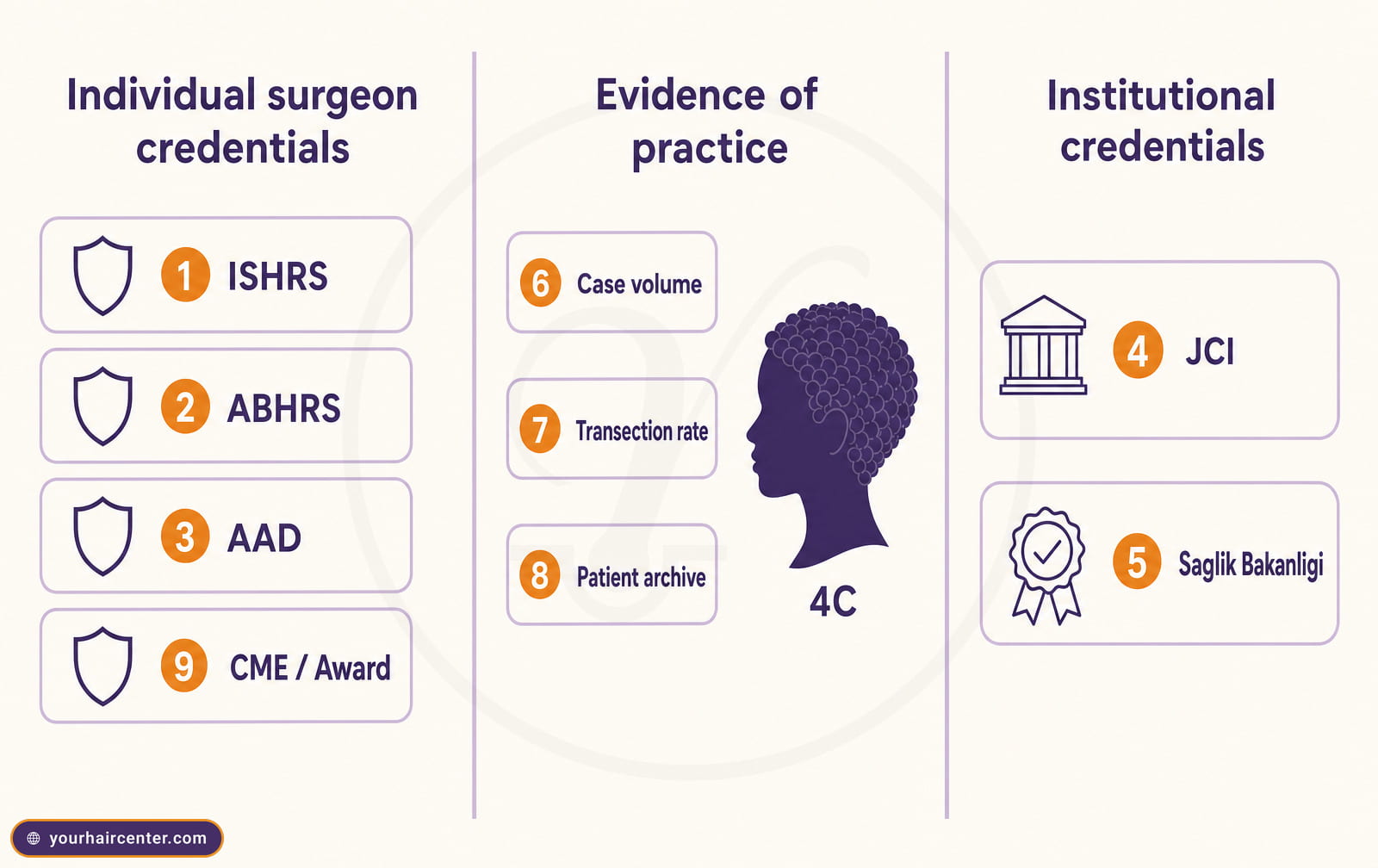
A qualified afro hair transplant surgeon should be able to produce evidence under three columns, individual credentials they hold personally, institutional credentials of the hospital or clinic where they operate, and practice-evidence credentials proving they have done the work on textured hair specifically. The 9-item list below is the minimum bar. The best African American hair transplant surgeons publish each item voluntarily; the rest expect you to take their word for it.
- ISHRS membership, verifiable on the International Society of Hair Restoration Surgery directory at ISHRS Find a Doctor directory (opens in new tab).
- ABHRS board certification, verifiable on the American Board of Hair Restoration Surgery certification page at ABHRS Certification page (opens in new tab).
- AAD or equivalent national dermatology board certification, verifiable on the American Academy of Dermatology directory at AAD Find a Dermatologist tool (opens in new tab).
- JCI hospital accreditation for the operating facility, verifiable on the Joint Commission International accredited-organization search (opens in new tab).
- Turkish Health Ministry HTFC license for any Turkey-based facility, verifiable on the Saglik Bakanligi registry at Saglik Bakanligi licensed-facility registry (opens in new tab).
- Documented afro-hair case volume with a per-Walker-type breakdown across the six sub-types from 3A to 4C, disclosed by the surgeon on request.
- Published transection-rate or graft-survival data for afro-textured hair specifically, not blended into an all-hair-types average.
- A before and after archive of named patients with month-stamped checkpoint photos, not stock imagery and not AI-generated composites.
- An active continuing-medical-education log, or a recognized ISHRS honor such as the Golden or Platinum Follicle Award, disclosed voluntarily.
Credentials 1, 2, 3, and 9 attach to the individual surgeon. Credentials 4 and 5 attach to the institution. Credentials 6, 7, and 8 are evidence-of-practice credentials, the ones the top ranking-list pages do not publish because publishing them would expose the gap between marketing language and case-volume reality. The next four sections walk through each grouping. The same audit identifies the best African American hair transplant surgeons no matter which country they operate in, since the issuing bodies are global.
Which credentials should the surgeon hold personally?
The first three credentials are the individual-surgeon credentials that you will see, or fail to see, on any clinic’s About page. The best African American hair transplant surgeons publish all three; the marketing-led ones publish two and gesture at the third.
Here is how each one is documented and how to verify it.
ISHRS membership is membership in the International Society of Hair Restoration Surgery, the global professional body for hair restoration physicians. ISHRS publishes a public directory at ISHRS Find a Doctor directory (opens in new tab), and as of January 2020 only full Member and Fellow Member physicians appear in that lookup tool. A surgeon who claims "ISHRS affiliation" without the word Member or Fellow is communicating something. The Fellow tier (FISHRS) sits above standard Member and reflects additional contribution to the field. Look up the name; if it does not surface in the public directory, the credential does not exist in the form claimed.
ABHRS board certification is the only board certification specifically for hair restoration surgery, and the best African American hair transplant surgeons typically carry it. The American Board of Hair Restoration Surgery requires written and oral examinations on the entire scope of the specialty, plus documented case logs, peer-reviewed operative reports, and reference letters from existing diplomates. Verify a Diplomate status on ABHRS Certification page (opens in new tab). Important to know, ABHRS is independent of the American Board of Medical Specialties (ABMS); some surgeons hold ABHRS without ABMS-sanctioned dermatology or plastic-surgery boards. That is a meaningful distinction. ABHRS alone tells you the surgeon has been examined on hair restoration; it does not by itself tell you they trained in dermatology or surgery.
AAD certification, or the equivalent national dermatology board in the United Kingdom (BAD) or Turkey (Turkish Dermatology Society), signals scalp-pathology competence. That competence is decisive for afro hair work because a credentialed dermatologist can distinguish androgenetic alopecia from central centrifugal cicatricial alopecia (opens in new tab) and traction alopecia before grafting. Grafting onto an undiagnosed scarring alopecia destroys the grafts. Verify board-certified dermatologists with the FAAD designation through the public AAD tool at AAD Find a Dermatologist tool (opens in new tab).
A rare double credential to look for, only two surgeons globally have served as President of both ISHRS and ABHRS. The double is meaningful because it signals depth across both the society and the board, and it is the kind of credential that ranking-list aggregators rarely flag. The best African American hair transplant surgeons working anywhere in the world will list ISHRS membership, ABHRS Diplomate status, and a dermatology or surgical board on their public profile. Failure-mode test, if a surgeon lists "board certified" without naming the board, treat the credential as absent. The Hair Transplant category on the Your Hair Center site lists the procedure variants its specialists perform, including Sapphire FUE, DHI, and standard FUE.
How to check JCI accreditation and Turkish Health Ministry licensing
Credentials 4 and 5 attach to the facility, not the individual. The best African American hair transplant surgeons in any country operate inside facilities that pass an institutional accreditation check, so one check covers the institution and another covers the named surgeon. Both checks are necessary, and they cover different failure modes.
JCI accreditation is the Joint Commission International gold standard for hospital quality, and it is one of the institutional credentials the best African American hair transplant surgeons working outside the United States typically operate under. JCI audits patient safety, infection control, surgical protocols, medication management, and emergency-response readiness. Verify on the Joint Commission International accredited-organization search (opens in new tab). Note that JCI is the international arm of The Joint Commission; in the United States the domestic Joint Commission accreditation applies to most hospitals, which means most US standalone hair-transplant clinics are structurally absent from the JCI list. That is not necessarily a negative for a US clinic, but it does mean the JCI criterion is one a Turkey-based facility can meet that a US clinic ordinarily cannot. The criterion routes the patient outside the US-domestic frame without favoring any specific provider.
Turkish Health Ministry licensing is the institutional floor every Turkish hair-transplant clinic must meet to operate legally. The Ministry, Saglik Bakanligi, maintains a registry of licensed facilities at Saglik Bakanligi licensed-facility registry (opens in new tab) where you can select a province and search the licensed clinics. If the facility name does not appear on that registry, the facility is not operating legally as a hair-transplant center under Turkish law. In May 2023 the Ministry introduced the world’s first dedicated legal framework specifically governing hair-transplantation procedures, with strict requirements on licensing, staff qualifications, hygiene protocols, patient rights, and transparency. The best African American hair transplant surgeons working in Turkey operate inside a registry-listed facility; the registry check is a 60-second action and it is non-optional.
The institutional-vs-individual distinction matters. A JCI-accredited hospital can host a non-ABHRS surgeon; an ABHRS-certified surgeon can be working in a non-accredited clinic. Both patterns are common, and the best African American hair transplant surgeons typically have the institutional credential and the individual credential aligned in the same place. The About Us page lists Your Hair Center’s partner clinics and hospitals, alongside the individual-surgeon credentials, as an example of how both columns surface in practice. You can route from the credential check directly to the African hair transplant service page once the institution passes.
How many afro-hair cases has the surgeon done?
Credential 6 is the single most-important evidence-of-practice credential and the one no top-ranking page in this query publishes. The best African American hair transplant surgeons disclose their afro-hair case volume voluntarily, broken down by Andre Walker hair-type. The marketing-led ones write "we treat all hair types" and stop.
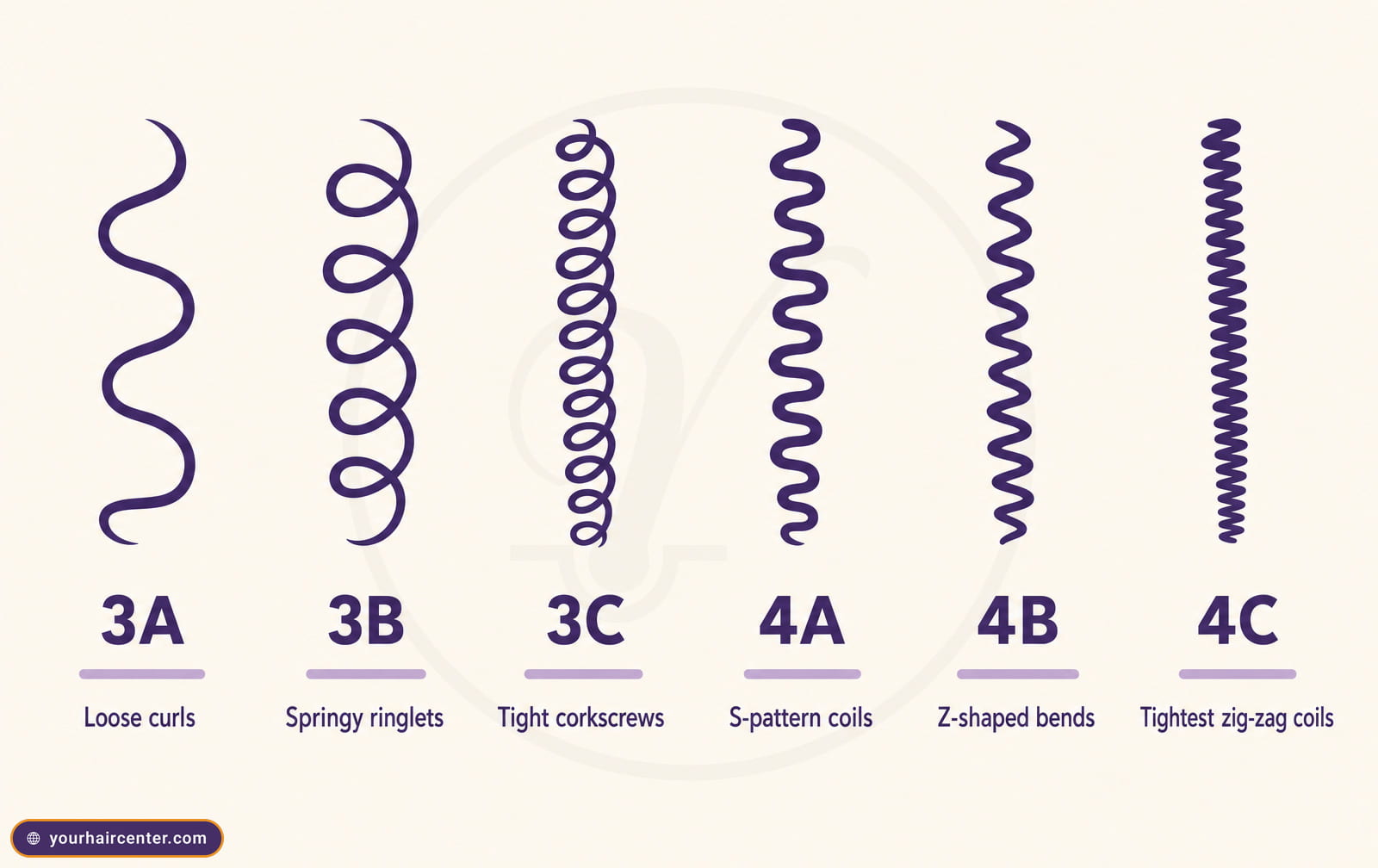
The Andre Walker system classifies curly and coily hair into 6 sub-types, 3A through 4C. The extraction challenges are dramatically different across the range, and the best African American hair transplant surgeons publish case-volume figures broken out at the sub-type level rather than aggregated. Type 3A is loose curls where extraction needs a slightly adjusted angle. Type 3C is tight corkscrew curls where subsurface follicle curvature becomes pronounced. Type 4B is a Z-shaped follicle path beneath the skin and is the hardest texture for standard extraction. Type 4C is the tightest coil pattern and needs a trained team and dedicated micropunch tools. A surgeon with high Type 3A and 3B volume but zero Type 4 cases is not the same as a surgeon with full Type 4 volume; treating them as equivalent is the mistake that produces poor results in the most demanding cases.
A credible disclosure from the best African American hair transplant surgeons carries three components, an absolute number of cases performed, a date range, and a breakdown by Walker sub-type. A statement of the shape "we have performed X afro-textured cases across a defined date range, of which Y were Type 4B or 4C," is a credible disclosure. A single percentage with no absolute count and no type-by-type split, such as a vague "the majority of our patients have textured hair," is not.
If the surgeon will not publish a number on the website, three on-the-record requests narrow the answer. This is the test that filters the best African American hair transplant surgeons from clinics whose marketing simply paraphrases other clinics’ marketing. Ask for redacted operative notes for any 5 recent afro-hair cases. Request a video consultation that classifies your hair type on the Walker scale and names the technique the surgeon would choose for your specific sub-type. Ask which texture sub-type the surgeon has the lowest experience with. An honest surgeon answers; a marketing-led surgeon deflects to a sales coordinator.
This credential is the structural gap the top-ranking pages fail. Every US-clinic page in the surgeon-ranking SERP claims afro-hair expertise; none publishes the case-volume number that would let you verify it. The best African American hair transplant surgeons close that gap by publishing the Walker-type breakdown openly. The Your Hair Center African hair transplant service page publishes a 95% graft survival rate for afro-textured hair specifically, not blended into an all-hair-types average. The Hair and Scalp Analysis consultation is where the surgeon classifies your hair type during evaluation, so the case-volume disclosure can be compared against your specific sub-type before any decision.
Does the surgeon publish transection and graft-survival rates?
Credential 7 is the technical-outcome credential, and it is the credential that most cleanly separates the best African American hair transplant surgeons from the marketing-led majority. The number to ask for is the transection rate for afro-textured hair specifically, then the 12-month graft-survival rate. Both numbers exist for any surgeon who measures outcomes; the question is whether they publish.
Transection rate is the share of grafts destroyed during extraction because the punch tool cut through the curved follicle on its way out, and asking for it on the record is how readers separate the best African American hair transplant surgeons from clinics with no measurement discipline at all. For afro-textured hair, non-specialist transection rates reach 30%, while specialist programs working with curved nonrotary punches and bidirectional rotation techniques report rates typically under 5%[1]. The difference is a multiple of six or more. The curved, sometimes spiraled subsurface path of afro-textured follicles is what makes their extraction transection-prone[1:1], a difficulty the broader follicular-unit-extraction literature also documents[2], and the tooling that drives the lower number is well documented, adapted micropunch heads at 0.6 to 0.7 mm diameter, dual-direction rotation tracking the follicle path subsurface, and 4.5x surgical loupes so the surgeon reads the follicle direction before the punch touches the scalp.
Graft survival rate is the share of implanted grafts that produce living hair at the 12-month mark, and it is the headline outcome the best African American hair transplant surgeons report on their public pages. The number is determined by extraction technique, recipient-site design, and post-op care combined. A specialist afro-hair program publishing 95% for textured hair specifically, as Your Hair Center does on the African hair transplant page, is a different claim than a general clinic publishing an all-hair-types blended average. The best African American hair transplant surgeons publish the afro-specific figure; if the surgeon only quotes an aggregate, that is the rate they will average to your case.
The load-bearing word is "published." A surgeon with the data on file but unwilling to share it is structurally indistinguishable from one who does not measure outcomes. The best African American hair transplant surgeons publish the number on the public site rather than offering it only on consultation request. The credential is the publication, not the existence of the data. There is a cost-of-failure framing here also; a sub-5% transection-rate program priced higher will often be cheaper over the lifetime of the result than a 30% transection-rate program priced lower, because failed grafts mean a second procedure. Reading this section against a US vs Turkey cost comparison gives the math directly. Similarly, traction alopecia restoration sits in the same case-volume bucket and the transection-rate question applies to it identically.
How to check before and after photos and continuing education
Credentials 8 and 9 are the two soft-but-decisive credentials, and they are the credentials where the best African American hair transplant surgeons separate from competently-marketed-but-shallow practices. Use them to vet the clinic after the individual and institutional credentials pass. Both are quick to check and both filter out a meaningful share of marketing-led providers.
Credential 8 is a before and after archive of named patients with month-stamped checkpoint photos, and the best African American hair transplant surgeons treat this archive as a public asset rather than a confidential one. An evidence-grade archive carries dozens of afro-textured cases at minimum, photographed at the same intervals across cases, typically at 3 months, 6 months, and 12 months, with the patient’s Walker sub-type labeled. The archive uses real first names with the patient’s country or city when consent allows. Stock photography disqualifies the credential immediately. AI-generated patient imagery disqualifies it more so, because AI cannot fabricate clinical evidence regardless of how realistic the output reads.
How to spot fabricated patient evidence. Reverse-image-search any photo you suspect; if the same patient appears across multiple clinic sites the gallery is a marketing-aggregator product, not the clinic’s own work, and the surgeon is not among the best African American hair transplant surgeons no matter how prominent the page placement. Check for consent and date metadata in the disclosed gallery. Look for the patient’s Walker sub-type beside the image, since archives that aggregate textures without labeling them rarely have the type-by-type case volume the credential 6 disclosure requires. The Your Hair Center Photo Gallery is one example of a Walker-labeled and date-stamped archive; the afro hair transplant before and after timeline walks through the month-by-month checkpoints.
Credential 9 is an active continuing-medical-education log, a recognized ISHRS honor such as the Golden or Platinum Follicle Award, or equivalent disclosure that the surgeon is still engaged with the field. The best African American hair transplant surgeons treat continuing education as a public statement, not an internal record. The afro-hair field has advanced meaningfully on punch design and bidirectional-rotation technique since the late 2010s, and a surgeon who stopped learning at the technique they trained on a decade ago is missing the tooling that drives the under-5% transection rate the literature now considers achievable. The disclosure-quality test is whether the clinic publishes the CME log voluntarily, or whether you have to ask. Voluntary publication signals the credential is real and current.
These two credentials feel softer than the formal society-and-board credentials at the top of the list. They are not. Stock imagery and an outdated CME log are how a marketing-led clinic conceals weakness in the practice-evidence credentials. The best African American hair transplant surgeons publish both voluntarily.

What to do if your prospective surgeon will not share these credentials
If the credentials above are missing or vague on a clinic’s website, the question becomes how to extract them in writing. The best African American hair transplant surgeons make this easy; the rest make it difficult, and the difficulty itself is a data point. Run the checklist by email or WhatsApp message so the response is on the record. Three escalating-pressure questions cover the ground.
First, "Please send the surgeon’s ABHRS Diplomate certificate number or confirm the surgeon is listed in the public ISHRS directory." A credible response sends the number or a direct link to the ISHRS lookup, which is how the best African American hair transplant surgeons handle a first inquiry. A non-response sends marketing language about experience and awards. Second, "Please send the surgeon’s afro-hair case volume by Walker sub-type for the past three years." A credible response sends a number breakdown. A non-response says "extensive experience" without numbers. Third, "Please send the published transection rate for textured hair." A credible response sends the rate or a link to where it is published. A non-response sends a generic graft-survival aggregate.
The 24-hour rule. A clinic that will not produce credential documentation within 24 business hours of a written request is communicating something about how the rest of the patient relationship will run. The best African American hair transplant surgeons answer credential requests in a single business day, with the certificate scans or directory links attached, because they have already prepared them. The same coordinator who deflects on credentials before booking is the one who will deflect on complication follow-up after surgery.
When the credentials check out at one clinic but not another, route the next step to a credential-aligned consultation with one of the best African American hair transplant surgeons your shortlist surfaces. The Hair and Scalp Analysis entry point at Your Hair Center is the typical first step, with the surgeon classifying the hair type on the Walker scale and naming the technique recommended for your sub-type before any pricing conversation. The Contact page covers email and phone routes for the same request. Readers whose filter is primarily cost rather than credentials will often find more useful framing in the black male hair transplant cost article, which walks through what the dollar number is actually paying for at each Norwood stage.
Frequently asked questions
How do I find a qualified African American hair transplant surgeon?
Run the 9-credentials checklist above against every clinic on your shortlist. The non-negotiable filters are ISHRS membership, ABHRS Diplomate status, dermatology-board certification, and a documented afro-hair case-volume disclosure with a Walker-type breakdown. Verify each item on the issuing body’s own directory rather than taking the clinic’s word for it. The best African American hair transplant surgeons publish all four voluntarily.
What credentials should a hair transplant surgeon have?
At minimum, the best African American hair transplant surgeons hold ISHRS membership, ABHRS Diplomate status, and a dermatology or surgical board such as AAD. For institutional credentials, JCI accreditation if the facility is international, or Turkish Health Ministry HTFC licensing if the facility operates in Turkey. For practice evidence, a published transection-rate or graft-survival figure for textured hair specifically, an afro-hair case-volume disclosure broken down by Walker sub-type, and a named-patient before and after archive with month-stamped checkpoints.
Is ABHRS board certification important?
Yes. The American Board of Hair Restoration Surgery is the only board specifically for hair restoration surgery, and the best African American hair transplant surgeons typically hold Diplomate status. Certification requires written and oral examinations on the whole specialty, plus documented case logs and operative reports reviewed by existing diplomates. A surgeon who lists "board certified" without naming the board is signaling something. ABHRS alone does not confirm dermatology or surgical training, so look for it alongside a dermatology or surgical board.
How do I verify a hair transplant surgeon's ISHRS membership?
Visit the public directory at ISHRS Find a Doctor directory (opens in new tab) and search by name or location. Only full Member and Fellow Member physicians appear in that lookup tool, so a surgeon who claims "ISHRS affiliation" but does not surface there is using phrasing that does not reflect formal membership. The Fellow tier (FISHRS) sits above standard Member. The best African American hair transplant surgeons hold at least Member status and are findable by name.
What is the difference between ISHRS, ABHRS, and AAD?
ISHRS is the international professional society for hair restoration physicians; membership signals affiliation with the global community. ABHRS is a board certification specifically for hair restoration surgery; Diplomate status signals examined technical competence. AAD is the American Academy of Dermatology; its board certification signals scalp-pathology competence and the ability to distinguish androgenetic alopecia from scarring conditions such as CCCA before any surgical decision. The best African American hair transplant surgeons hold credentials across all three.
Are Turkey hair transplant surgeons board certified?
It varies by surgeon; the best African American hair transplant surgeons working in Turkey are typically the ones who can produce a US-recognized board credential alongside the local license. The Turkish Health Ministry HTFC license is the institutional floor every Turkish clinic must meet, verifiable at Saglik Bakanligi licensed-facility registry (opens in new tab). ABHRS Diplomate status is rare among Turkish surgeons but not absent; verify per-surgeon through the ABHRS directory. ISHRS membership is more common and verifiable through the same ISHRS lookup.
Choosing among the best African American hair transplant surgeons
The 9-credentials checklist works the same way in Turkey as it does in the United States or the United Kingdom. Run it against any clinic, in any country, before you send photos for an evaluation. Restating the framework rather than the answer is the point of the article. The best African American hair transplant surgeons can produce all 9 credentials on request, with the issuing body’s verification URL beside each one. The ones who cannot are telling you something about the rest of the patient relationship before you have committed to it.
References
-
Umar, S. "Comparative Study of a Novel Tool for Follicular Unit Extraction for Individuals with Afro-textured Hair." PMC, 2016. https://pmc.ncbi.nlm.nih.gov/articles/PMC5055031/ (opens in new tab) ︎ ︎
-
Marwah, M. K., Singh, M., Aggarwal, R. R., et al. "Follicular Unit Extraction (FUE) Hair Transplant, Curves Ahead." PMC, 2019. https://pmc.ncbi.nlm.nih.gov/articles/PMC6795649/ (opens in new tab) ︎
