Does mesotherapy hair regrowth actually work? A 2024 systematic review pooled 11 studies and 576 patients and found statistically significant gains, but the size of the benefit depends entirely on the cocktail. This guide grades the evidence by formula, from vitamin-only blends with the weakest base to the PRP combination with the strongest, and sets realistic 3 to 6 month timelines against an honest US cost band of $2,000 to $7,200 so you can decide which formula is worth the spend.

If you have spent a few nights deep in hair-loss community threads, you have probably met the blunt refrain that vitamin cocktails are placebo and that mesotherapy only works when it smuggles minoxidil or dutasteride into the syringe. Clinic pages say the opposite, promising visible density by the second session. Both cannot be right, and the honest answer to whether mesotherapy hair regrowth is real sits somewhere the marketing never goes. This guide reads the controlled literature on mesotherapy hair regrowth, anchored by a 2024 systematic review that pooled the published trials, and grades the evidence by what is actually in the cocktail.[1] Vitamin-only formulas earn one grade, minoxidil mesotherapy another, dutasteride mesotherapy a third, and the combined PRP protocol a fourth. We name what the published cohorts found, what realistic time-to-result looks like, and whether a course at the US price band of $250 to $600 per session is the right place for a $2,000 to $7,200 decision.
Does mesotherapy work for hair regrowth? The evidence-graded answer
Yes, but with a critical qualifier. A 2024 systematic review of the controlled literature concluded that mesotherapy is a promising and effective alternative to minoxidil for androgenetic alopecia, with fewer systemic side effects, while cautioning that larger randomized trials are still needed.[1:1] The effect direction is positive, yet its strength depends almost entirely on what is dissolved in the injection, so mesotherapy hair regrowth is a family of treatments, not one verdict.
That qualifier is the whole story. The mesotherapy hair regrowth label covers vitamin-only formulas, minoxidil-loaded variants, dutasteride-loaded variants, and PRP-mesotherapy combinations, and pooling them together hides which patient received which mix. A review that reports an average across all four can look encouraging while masking the fact that one formula carried most of the signal and another carried almost none.
So the rest of this guide grades the evidence by cocktail family. Each of the four formulations gets its own grade in its own section, because asking whether mesotherapy hair regrowth works without naming the cocktail is like asking whether a pill works without naming the drug inside it. For calibration, it helps to set the 2024 review beside an older critical commentary from 2010 that examined a much thinner evidence base and reached a deliberately skeptical conclusion about routine use.[2] Reading the optimistic recent pool against the cautious older verdict is exactly the kind of balance a careful researcher wants. Before grading anything, though, it is worth understanding what the patients in those trials were actually measured for. To explore the treatment itself, see the mesotherapy program at Your Hair Center and the broader menu of non-surgical hair loss treatment options.
What the controlled studies actually measured
A systematic review is a pooled re-analysis of many separate primary studies, each with its own protocol, combined to produce a stronger signal than any single paper could on its own. It is the opposite of a clinic blog that cites one favorable trial and stops there. The 2024 review that anchors this article gathered the controlled studies on mesotherapy hair regrowth into one analysis, which is why it carries more weight than the individual cohorts beneath it.[1:2]
The studies inside that pool were mostly small. Cohort sizes ran from roughly fifteen to eighty patients, only a minority were randomized controlled trials, and the remainder were prospective open-label or before-after designs.[1:3] Most measured androgenetic alopecia, the common pattern hair loss driven by hormones and genetics, while a minority looked at alopecia areata and telogen effluvium. That spread matters, because a formula that helps one pattern may do nothing for another.
What did they actually measure? Four things, mostly. Hair density counted as follicles per square centimeter on trichoscopy, hair shaft thickness, reduction in the pull test, and patient-reported satisfaction. Density on trichoscopy is the most objective endpoint and the one that genuinely backs a regrowth claim. Satisfaction scores and photograph review lean softer and are easier to flatter. When you see mesotherapy hair regrowth results quoted, it is worth knowing which of these endpoints moved.
The review was honest about its own weaknesses, and so should any guide that uses it. The included studies used heterogeneous cocktails, ran anywhere from four to twelve sessions, followed patients for windows ranging from three to twelve months, and applied placebo controls inconsistently.[1:4] Those are real limits on certainty. A study that has no placebo arm cannot fully separate the mesotherapy hair regrowth effect from the natural waxing and waning of a shedding cycle, and a study that follows patients for only three months may miss both the slow responders and the patients whose early gain fades. When you stack the controlled studies with those mixed designs on top of one another, the pooled signal is more trustworthy than any single arm, but it is still a signal read through noise.
Even so, the headline finding held. Across the patients in those trials, mesotherapy injections for hair loss produced measurable gains in hair density against baseline, with the size of the gain varying widely by cocktail and by hair-loss pattern.[1:5] That last clause is the one to underline. A statistically significant average across a mixed pool does not promise that every formula in that pool works, only that the pool as a whole moved in the right direction. The job of an honest guide is to open that average back up and show which formula carried it. Now that you know what was measured, the four sections that follow grade mesotherapy hair regrowth per cocktail type. A proper diagnostic scalp analysis is what tells you which pattern you actually have, and therefore which grade applies to you.
Evidence grade by cocktail type, the part nobody else publishes
Asking whether mesotherapy works without naming the cocktail is like asking whether a pill works without naming the molecule. The grade lives in the syringe, not in the procedure. Every clinic top-five page treats mesotherapy as one monolithic treatment, which is exactly why their readers come away thinking the science is either more settled or more flimsy than it is. Grading mesotherapy hair regrowth by formula is the one move that turns a vague verdict into a usable one.
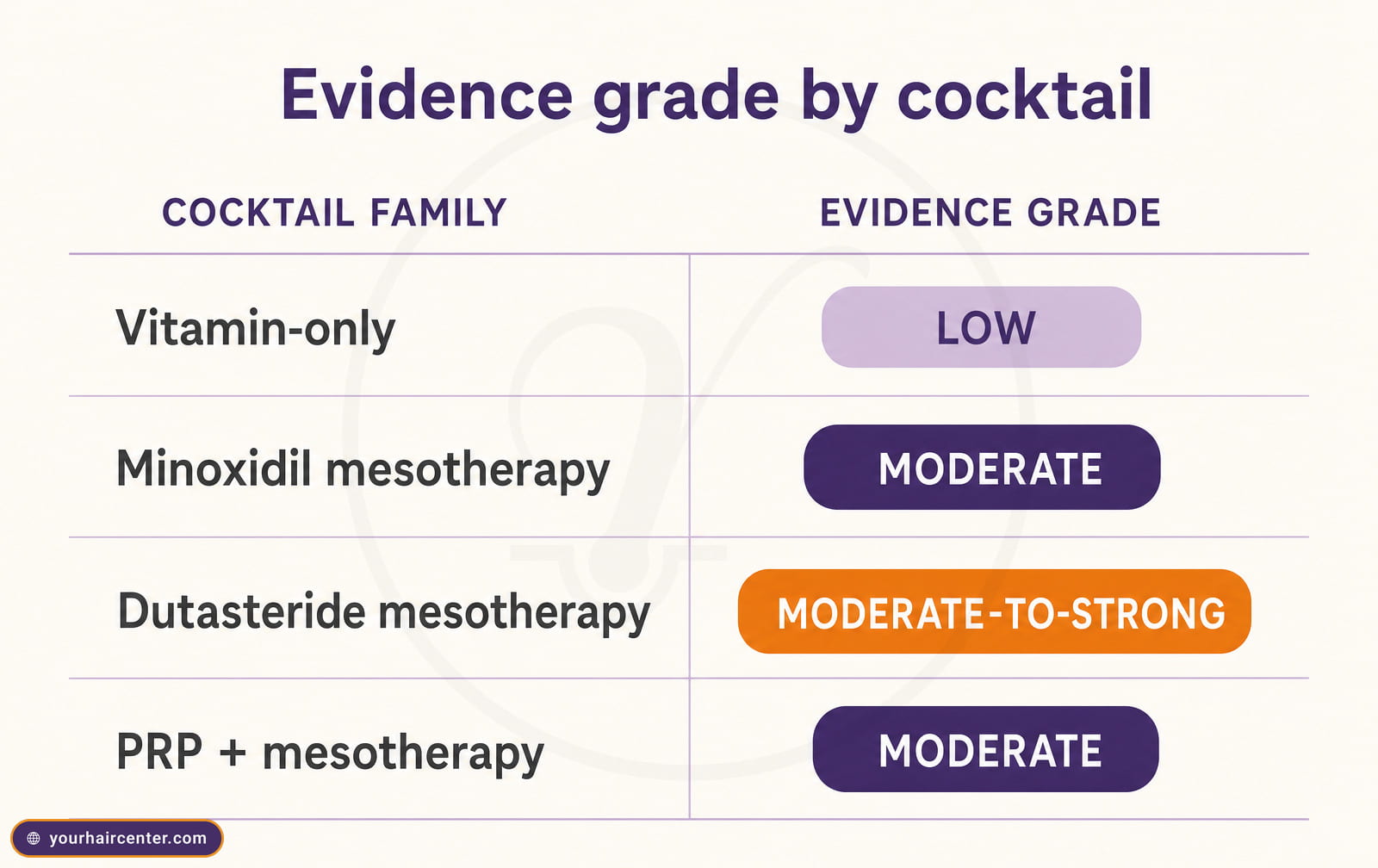
There are four cocktail families to grade. Vitamin-only formulas, minoxidil-loaded formulas, dutasteride-loaded formulas, and the PRP-mesotherapy combination. Each gets its own grade below, on a four-step scale. LOW means small or underpowered studies, mostly before-after design, effect uncertain. MODERATE means several controlled studies, clear effect direction, moderate effect size. MODERATE-TO-STRONG means multiple controlled studies including randomized trials, a meaningful effect size, but some conflicting findings. STRONG means a deep base of randomized controlled trials with an effect that is large and consistent, a bar no single mesotherapy hair regrowth cocktail clears yet on the published evidence.
This grading is not academic. The price band is broadly similar across cocktail types, roughly $250 to $600 per session in the US and lower inside an Istanbul package, yet the expected benefit varies by close to an order of magnitude between a vitamin-only mix and a dutasteride or PRP-combined formula. A decision to spend $2,000 to $7,200 on a full course should anchor on which formula the clinic is actually administering, not on the word “mesotherapy” alone. The same logic governs every non-surgical hair loss treatment you will compare.
Vitamin-only cocktails, evidence grade LOW
The vitamin-only formula is the standard cocktail most clinics describe. It blends B-complex vitamins including B5 and biotin, vitamin C, vitamin E, zinc, copper, amino acids, and hyaluronic acid, with no active pharmaceutical, meaning no minoxidil, no dutasteride, and no finasteride. It is nourishment delivered to the follicle bed rather than a drug aimed at the hormonal cause of pattern loss.
The evidence here is the weakest of the four. The 2024 review included several vitamin-only cohorts, and most were underpowered with fewer than thirty patients, most lacked a placebo control, and most leaned on patient-reported satisfaction rather than objective trichoscopy density.[1:6] The pooled mesotherapy hair regrowth effect was positive but small, and the review flagged the vitamin-only studies as the softest part of its dataset.[1:7]
The community skepticism that calls vitamin-only mesotherapy expensive placebo is not unreasonable given that evidence weakness, and it would be dishonest to wave it away. The reasonable refinement is narrower than either camp states. Vitamin-only formulas have the most plausibility in patients with a documented nutritional deficiency confirmed on serum testing, and the least plausibility in patients whose loss is androgenetic and DHT-driven, where no amount of vitamin delivery addresses the hormonal cause. So when someone asks whether mesotherapy hair regrowth works with a vitamin-only cocktail, the honest answer is that it depends on whether a deficiency is driving the shedding in the first place. A diagnostic scalp analysis is what separates those two groups before any money changes hands.
Minoxidil mesotherapy, evidence grade MODERATE
Minoxidil mesotherapy is the standard cocktail with 0.5 percent to 5 percent minoxidil dissolved into the injection mix. Same vitamins, same delivery route, but now carrying an FDA-approved hair-loss active. That single addition changes the evidence grade for mesotherapy hair regrowth.
Several controlled studies in the pooled review compared injected minoxidil mesotherapy against topical minoxidil, and the head-to-head reading is that the injected route produced comparable, not superior, density gains over six months.[1:8] The effect direction is confirmed and the effect size is moderate, which is a meaningful step up from the vitamin-only grade. This is the formula where the case stops being a question of whether it works and becomes a question of whether the injected route beats a cream you could use at home.
Practically, this makes minoxidil mesotherapy largely a delivery-route question. If you already respond well to topical minoxidil at home, the injected version offers no clear additional gain. If you cannot tolerate topical minoxidil because of scalp irritation, or the twice-daily routine simply does not fit your life, the injected route is a defensible alternative with similar published efficacy. The dose-limiting concerns people associate with oral DHT blockers, particularly sexual side effects, are not the dominant issue with minoxidil. The familiar minoxidil cautions are the initial shed at the start of treatment and, at high oral doses, cardiovascular effects, neither of which is the typical profile of a scalp injection course.
Dutasteride mesotherapy, evidence grade MODERATE-TO-STRONG with conflict
Dutasteride mesotherapy adds 0.01 percent to 0.05 percent dutasteride, the most potent published DHT blocker, to the standard cocktail. It is the advanced active a service page usually mentions in a single bullet, and it is where the evidence gets both stronger and messier at the same time.
Here the honesty matters. A 2017 study found significant density gains in androgenetic-alopecia patients on a quarterly dutasteride mesotherapy protocol.[3] A 2024 case series in a peer-reviewed dermatology journal reported less favorable outcomes and cautioned that the protocol may not produce significant improvements in every cohort.[4] Both papers are real, both are recent, and both reach different conclusions. The defensible reading is that the mesotherapy hair regrowth effect direction is positive and the effect size is meaningful for responders, but the responder population is not yet well characterized. Anyone who tells you dutasteride mesotherapy is settled in either direction is overstating the literature.
The dose protocols, the side-effect comparison against oral dutasteride, and the US-versus-Istanbul pricing picture are a longer conversation than this section can carry, and Your Hair Center treats them in a dedicated dutasteride mesotherapy guide. The eligibility filter is the part to fix in your mind now. Dutasteride mesotherapy is the route for DHT-driven androgenetic alopecia in patients who want to avoid the sexual-side-effect risk of oral dutasteride. It is not the right cocktail for alopecia areata, telogen effluvium, or pure nutritional shedding.
PRP-mesotherapy combination, evidence grade MODERATE
The combination protocol runs two co-administered treatments. PRP draws autologous growth factors from a small sample of your own blood, while mesotherapy delivers the vitamin and active cocktail. At Your Hair Center the two are run together as a single program rather than sold as competing choices.
This is where the regenerative case for mesotherapy hair regrowth is most often made in clinical practice. A 2024 retrospective compared PRP and mesotherapy as monotherapies over six months and found that both significantly improved trichoscopic androgenetic-alopecia parameters, with the degree of improvement varying by product and no clear single winner between the two routes.[5] What that study establishes is that both regenerative routes move the needle on measured density, which is why combining the vitamin-and-active cocktail with PRP is a reasonable protocol rather than a redundant one. The cocktails that perform best in the pooled literature are the ones carrying either an active drug or PRP, so running mesotherapy in a program that also includes PRP stacks two routes that each carry their own positive signal.[5:1][1:9]
The dimension-by-dimension case for combining the two rather than picking one is covered in depth in the mesotherapy versus PRP comparison. What this section establishes is narrower and load-bearing. Because PRP and mesotherapy each carry their own positive density signal, pairing them in the combined PRP and mesotherapy protocol is a defensible way to stack two regenerative routes rather than betting on a single-syringe formula.

Realistic time to visible regrowth, what 3 to 6 months actually looks like
This is where clinic timelines and published timelines for mesotherapy hair regrowth part ways. Across the studies pooled in the 2024 review, measurable density change appeared at three to six months from the start of the course, not at the second session.[1:10] Shedding reduction, which is a different and earlier endpoint, sometimes showed up sooner, around weeks four to eight, but visible new density takes the longer window. Knowing this is the difference between sound expectations and disappointment.
The two endpoints are easy to confuse and the confusion is profitable for whoever blurs it. Shedding reduction means less hair on the pillow and in the shower drain. It is real and measurable, and it is genuinely encouraging, but it is not new growth. Density gain means trichoscopy-measurable follicle counts rising per square centimeter, and that is the endpoint that earns a mesotherapy hair regrowth claim. When a clinic promises visible results from the second session, it is almost always describing shedding reduction, while the reader hears it as visible new density. Being clear about which endpoint moves when is the trust differentiator no marketing page bothers with.
It helps to understand why the biology behind mesotherapy hair regrowth takes that long. A hair follicle does not switch from resting to growing on command. It cycles through a resting phase, a shedding phase, and a growth phase, and a treatment that nudges resting follicles back toward growth still has to wait for those follicles to push a visible shaft up through the scalp. That emergence takes months, not weeks, no matter how good the cocktail is. Anyone promising mesotherapy hair regrowth on a two-session timeline is either describing a different endpoint or selling against the biology.
A typical course of mesotherapy for hair regrowth at Your Hair Center runs eight sessions over roughly eight to twelve weeks, with the first density-change assessment at three months, a six-month re-trichoscopy, and a twelve-month durability check. Maintenance sessions every two to three months after the course preserve the gain rather than chasing fresh growth. The progression is deliberately slow because the biology is slow, and a clinic that re-measures on this schedule is one that intends to verify results rather than assert them. If you want to see what realistic mesotherapy hair loss before and after change looks like, ask to see documented trichoscopy comparisons at the three and six-month marks rather than a single flattering photograph. That re-measurement cadence is exactly what the medical follow-up program exists to run.
Set expectations for the no-response scenario as well. A subset of mesotherapy hair regrowth patients shows no measurable change at six months. The 2024 review does not specify the non-responder fraction precisely, and a careful guide should not invent one, so the figure here is a clinical-practice estimate rather than a study number. In practice that estimate falls in the 15 to 30 percent range. Identifying who is likely to fall into that group is the entire point of a diagnostic scalp analysis before the deposit, not after the disappointment. To weigh the whole picture, revisit the mesotherapy program details.

The honest reading from the research community and what it gets right
The hair-loss research community, the people who congregate on forums and community-evidence aggregators, has converged on a skeptical reading, and that reading deserves to be met head-on rather than dismissed. Their rough consensus is that vitamin-only mesotherapy is placebo, that minoxidil mesotherapy is at best equivalent to topical, that dutasteride mesotherapy is the only single formulation with a serious evidence base, and that PRP adds real but variable benefit. As a starting position on mesotherapy hair regrowth, that is more accurate than most clinic copy.
Held against the 2024 review and the comparison data, each mesotherapy hair regrowth claim refines rather than collapses. On vitamin-only formulas the community is approximately right about the strength of evidence, and the modest pooled effect may reflect documented-deficiency patients more than a general scalp benefit.[1:11] On minoxidil mesotherapy the community position is supported, since the injected route is comparable, not superior, to topical.[1:12] On dutasteride mesotherapy the community is partially right, but the 2024 cautionary case series means the picture is less settled than the forums have decided.[3:1][4:1] On PRP the community is approximately right that it adds real but variable benefit, since the 2024 retrospective found both PRP and mesotherapy improved trichoscopic parameters over six months with no clear single winner.[5:2]
Your Hair Center’s clinical stance on mesotherapy hair regrowth is worth stating plainly rather than hiding behind brochure language. Vitamin-only formulas are offered to patients with documented nutritional deficiency on serum testing. The standard course adds the cocktail upgrade for DHT-driven patterns where the evidence is strongest, and combines mesotherapy with PRP scalp treatment for patients whose pattern and budget support the combined protocol. As for the forums themselves, they are a fine place to orient yourself and a poor place to source a medical number. Every numerical claim in this guide anchors to peer-reviewed primary literature, not to community aggregation, and that is the line worth holding when you read anything about mesotherapy treatment for hair.
The cost-vs-effect tradeoff, is the evidence strong enough to justify the spend
If you can write the check, the real question is whether it is the right check. A standalone single mesotherapy hair regrowth session at US clinics typically falls in the $250 to $600 range, which puts an eight-session course at $2,000 to $4,800, and with maintenance across the first year the total approaches $5,000 to $7,200. Those figures track the pricing that telehealth platforms and US clinic surveys publish, and they hold regardless of which clinic name sits on the invoice.
Inside an Istanbul package the structure is different. Your Hair Center offers mesotherapy for hair regrowth as a course within an all-inclusive arrangement, so the useful move before booking anywhere is to ask for the per-session breakdown and confirm what the package actually includes, meaning the number of sessions, the cocktail composition, the scalp analysis, and the maintenance sessions. A headline package price means little until those four lines are itemized, which is precisely what the all-inclusive package structure is built to make transparent.
The cost-per-cocktail framing is the part that changes the math, and it is the framing that turns the decision from a yes-or-no question into a value question. The same $2,000 to $7,200 looks very different depending on the formula. For a vitamin-only course in a patient with no documented nutritional deficiency, the evidence is weak enough that the spend is genuinely questionable. For a dutasteride mesotherapy course in a documented androgenetic-alopecia patient who cannot tolerate oral dutasteride, the spend is defensible. For a PRP-mesotherapy combination in a moderate-stage androgenetic-alopecia patient, the spend stacks two regenerative routes that each carry their own positive density signal.
It also helps to know the alternatives in dollar terms. Topical minoxidil at home runs roughly $200 to $400 per year, and prescription oral finasteride or dutasteride, used off-label, runs about $20 to $80 per month. A mesotherapy hair regrowth course costs several times the annual price of those first-line routes, so the honest case for mesotherapy is that it adds delivery-route advantages and combination synergy, not that it replaces cheaper proven options.
This is also where the mesotherapy pros and cons net out in plain terms. On the pro side, the delivery route puts actives directly at the follicle bed, pairing mesotherapy with PRP stacks two routes that each show a positive density signal, and there is no surgery and no downtime. On the con side, the vitamin-only version has a weak evidence base, the cost recurs because the gains need maintenance, and a meaningful minority of patients see no measurable change. Weighing those honestly is more useful than any single before-after image. Your Hair Center does not recommend mesotherapy for hair regrowth as a first move for someone who has never tried a topical or oral route. It fits as an add-on, as an alternative for patients who cannot tolerate the standard routes, or as a combination protocol for patients who want to stack two regenerative routes among non-surgical hair loss treatments.
Who benefits most by hair-loss type
Mesotherapy is not equally appropriate for every shedding pattern, and lumping them together is one of the biggest credibility gaps in the clinic content out there. Matching the treatment to the diagnosis is what makes mesotherapy hair regrowth a reasonable bet rather than a hopeful one.
Early-stage androgenetic alopecia, in the Hamilton-Norwood I to III range for men or Ludwig I for women, is the strongest fit. This group dominates the 2024 review’s patient pool, and it is where dutasteride mesotherapy and the PRP combination show their best mesotherapy hair regrowth gains.[1:13] Advanced androgenetic alopecia, Norwood V to VII or Ludwig III, is a weaker fit, because density gains cannot restore follicles that are no longer present. The realistic role there is preserving remaining hair and supporting a transplant rather than driving primary regrowth, which is why patients at this stage are usually routed toward a men’s hair transplant or a women’s hair transplant as the primary plan.
Alopecia areata has a real but more variable role. Mesotherapy has been used as an adjunct alongside steroid injections, and the response depends on the affected area, the duration, and the immune-driver pattern. It is an adjunct here, not a first-line answer. Telogen effluvium, the diffuse shedding that follows childbirth, illness, or major stress, often resolves on its own over six to twelve months once the trigger clears. Mesotherapy for hair regrowth can shorten the recovery window in selected cases, but nutritional correction is the first move and the evidence is thinner than for pattern loss.
Post-shock loss, the kind seen after a transplant or a medication change, is a genuine use case for the cocktail in supporting native-hair preservation around the affected zones, and the timing and protocol for that scenario are covered in the mesotherapy after hair transplant guide. For diffuse thinning of unclear cause, the gating step is diagnosis. Without a clear cause the cocktail choice cannot be calibrated, so this group runs through a trichoscopy-based scalp assessment first. Where the pattern points toward other regenerative routes, options such as exosome therapy and low-level laser therapy enter the same comparison.
The thread running through all of these patterns is that mesotherapy hair regrowth is a diagnosis-led decision, not a default. The same eight-session course can be a sensible investment for an early-stage androgenetic-alopecia patient on the right cocktail and a poor one for an advanced-stage patient whose follicles are already gone. Whether mesotherapy works for hair loss in your specific case is a question the scalp analysis answers, and it answers it before you commit rather than after. That is the difference between matching a treatment to evidence and matching a treatment to a sales target.
Frequently asked questions
Does mesotherapy work for hair regrowth?
Yes, with the size of the benefit set by the cocktail. A 2024 systematic review of the controlled literature concluded that mesotherapy is a promising and effective alternative to minoxidil for androgenetic alopecia, with fewer systemic side effects, while flagging that larger randomized trials are still needed.[1:14] The takeaway is that vitamin-only formulas carry the weakest evidence, while dutasteride-loaded and PRP-combined protocols carry the strongest, so for mesotherapy hair regrowth the formula in the syringe matters more than the procedure name.
What did Elon Musk use to regrow his hair?
What did Elon Musk use to regrow his hair? His visible change was widely speculated to involve a hair transplant rather than any specific injection protocol, and this guide does not endorse named-celebrity claims because none of them rest on published evidence. The more useful question is what controlled studies support for non-surgical mesotherapy hair regrowth, and that points back to the cocktail-graded evidence above rather than to any one famous case.
How long does mesotherapy last for hair?
How long does mesotherapy last for hair? The gains from a course are maintained, not permanent, which is why maintenance sessions every two to three months are recommended after the initial eight-session course. Durability is condition-dependent, since DHT-driven pattern loss keeps exerting pressure on the follicles, so ongoing maintenance and an accurate diagnosis both shape how long mesotherapy hair regrowth results hold.
What is the downside of mesotherapy?
What is the downside of mesotherapy? The realistic mesotherapy hair regrowth downsides are a modest evidence base for vitamin-only formulas, the recurring cost of a course plus maintenance, the time investment of eight sessions, and a non-responder share estimated in clinical practice at 15 to 30 percent. Clinical adverse events are uncommon at a properly run clinic and are covered in the mesotherapy side-effects guide.
The bottom line on mesotherapy hair regrowth
The honest answer here is that the controlled studies to date say yes, with the size of the yes set by what is in the cocktail.[1:15] Vitamin-only formulas have a modest evidence base and suit documented nutritional deficiency best, minoxidil and dutasteride variants have moderate to strong evidence in the populations they were built for, and the PRP-mesotherapy combination pairs two regenerative routes that each carry a positive density signal. The mesotherapy hair regrowth decision worth $2,000 to $7,200 is never simply yes or no. It is which cocktail fits your scalp, and whether the team injecting it is the team that ran the diagnostic first. Ask the doctor whether mesotherapy fits your case, or start with a diagnostic scalp analysis that matches the treatment to the cause.
References
- Aledani et al. (2024). Mesotherapy as a Promising Alternative to Minoxidil for Androgenetic Alopecia: A Systematic Review. PubMed Central. https://pmc.ncbi.nlm.nih.gov/articles/PMC11152360/ (opens in new tab) ︎ ︎ ︎ ︎ ︎ ︎ ︎ ︎ ︎ ︎ ︎ ︎ ︎ ︎ ︎ ︎
- Mysore V. (2010). Mesotherapy in management of hair loss, is it of any use? PubMed Central. https://pmc.ncbi.nlm.nih.gov/articles/PMC3002412/ (opens in new tab) ︎
- Saceda-Corralo et al. (2017). Mesotherapy with dutasteride for androgenetic alopecia. PubMed Central. https://pmc.ncbi.nlm.nih.gov/articles/PMC5596657/ (opens in new tab) ︎ ︎
- Nohria et al. (2024). Outcomes of androgenetic alopecia treated with dutasteride mesotherapy. JAAD Case Reports. https://www.jaadcasereports.org/article/S2352-5126(24)00398-9/fulltext (opens in new tab) ︎ ︎
- Stefanis AJ, et al. (2024). Efficacy of Platelet-Rich Plasma versus Mesotherapy with Recombinant Growth Factors and Stem Cell-Conditioned Media in Androgenetic Alopecia: A Retrospective Study. Skin Appendage Disorders. PubMed. https://pubmed.ncbi.nlm.nih.gov/39386300/ (opens in new tab) ︎ ︎ ︎
