Dutasteride mesotherapy injects a low-concentration DHT-blocker straight into the scalp instead of swallowing a daily pill, and the research is more nuanced than clinic marketing suggests. This guide reads the two studies that point in opposite directions, compares the side-effect profile against oral dutasteride, explains how many sessions a course actually takes, and frames US single-session pricing against an all-inclusive Istanbul package, so you can decide with evidence instead of certainty you have not earned.
A US patient typing dutasteride mesotherapy into a search bar is usually two years into a hair-loss research arc. Oral finasteride either worked, stalled, or was abandoned over side-effect worry, the hair-loss forums keep arguing about persistent sexual symptoms, and somewhere along the way a video mentioned that the same DHT-blocking molecule can be injected straight into the scalp instead of swallowed daily. The questions that follow are predictable. Does it actually work. Is the systemic risk really lower than a pill. How many sessions does it take, and what does one cost in a US clinic versus a course bundled into a treatment package abroad. This guide reads the published evidence on dutasteride mesotherapy the way a careful patient reads it, two studies that point in different directions, a few dose protocols that disagree on cadence, and a cost gap that quietly decides whether the protocol is realistic for a household budget. The goal is a useful picture, not marketing certainty and not a forum shrug.
Does dutasteride mesotherapy work, and what does the evidence actually say
The treatment injects a low-concentration DHT-blocker into the scalp instead of using a daily pill. A 2017 study reported density gains in every treated patient, while a 2024 case series found the benefit inconsistent and called it non-first-line. The honest answer is that the approach shows promise but the evidence is not yet settled.
That two-sided reading is the part most pages skip. The positive anchor for dutasteride mesotherapy is a 2017 study by Saceda-Corralo and colleagues, a small prospective series of six patients (five men, one woman, mean age in the mid-thirties) treated with a 0.01% dutasteride solution, 1 mL per session, given once every three months over six months.[1] The authors reported an improvement in androgenetic alopecia in all cases on trichoscopy, and, importantly for the safety question, found no difference between serum hormone levels before and after treatment.[1:1] It is a genuinely encouraging signal, but six patients is a small cohort, and the study design does not carry the weight of a large randomized trial.
The cautionary anchor for dutasteride mesotherapy is a 2024 case series by Nohria and colleagues, a retrospective analysis of ten patients in which dutasteride was compounded at a higher 0.1% strength and injected roughly every three months.[2] The authors concluded that the approach "warrants further prospective research before concluding that it is a consistently beneficial treatment modality for androgenetic alopecia" and that it "should be reserved as a nonfirst line therapy."[2:1] The cohort was small, follow-up was short, and not every patient received more than one treatment, so this is cautionary rather than damning. There is also a 2020 letter describing a radiofrequency-assisted variant of dutasteride mesotherapy, an alternative delivery route that hints the way the drug is administered may matter as much as the drug itself.[3]
The 2020 letter is also useful because it gathers the older evidence that sits behind dutasteride mesotherapy. It cites an earlier controlled trial in which increased hair density was reported in 92.9% of the dutasteride-treated group versus 7.1% of the placebo group, and a later study combining intradermal dutasteride with vitamins that found improvement in 62.8% of treated women against 17.5% of controls.[3:1] Those are encouraging directional signals, but they come from small studies with different cocktails and cadences, which is precisely why the picture stays unsettled rather than conclusive.
Put together, the prospective evidence leans positive on one specific protocol, the case-series evidence cautions against assuming every administration recipe reproduces that result, and the realistic take-home is that the protocol details matter as much as the molecule. A community-consensus reading of dutasteride mesotherapy as "promising but not settled" is closer to the truth than the one-sided certainty that clinic marketing tends to publish. If you want the broader picture first, the full mesotherapy program sits inside YHC’s wider set of non-surgical hair loss treatment options, and a diagnostic scalp analysis is what matches any of them to the actual cause of your shedding.
Dose, frequency, and protocol, where the published recipes disagree
The single most useful thing a researcher can take from the dutasteride mesotherapy literature is that the three published approaches do not agree on how the drug is delivered, and that disagreement probably explains the divergent results.
The Saceda-Corralo protocol used a 0.01% dutasteride solution at 1 mL per session, one session every three months.[1:2] In plain calendar terms that is roughly four sessions a year. The Nohria series used a markedly higher 0.1% compounded concentration on a similar quarterly cadence, and reported a less consistent benefit.[2:2] The radiofrequency-assisted variant adds an energy device to drive the solution into the scalp, and although some clinics market the radiofrequency add-on as faster, the published evidence is a single early report and does not yet justify charging a premium for it.[3:2]
YHC anchors its dutasteride-enhanced cocktail on the conservative, evidence-backed end of that range rather than the radiofrequency variant. The base mesotherapy program runs as eight sessions of about thirty minutes each, one session weekly or every two weeks, with maintenance sessions every two to three months after the course. For eligible patients the standard cocktail of vitamins, minerals, amino acids, and growth factors can be enhanced with advanced actives such as dutasteride to address DHT-driven loss, decided case by case rather than applied to everyone.
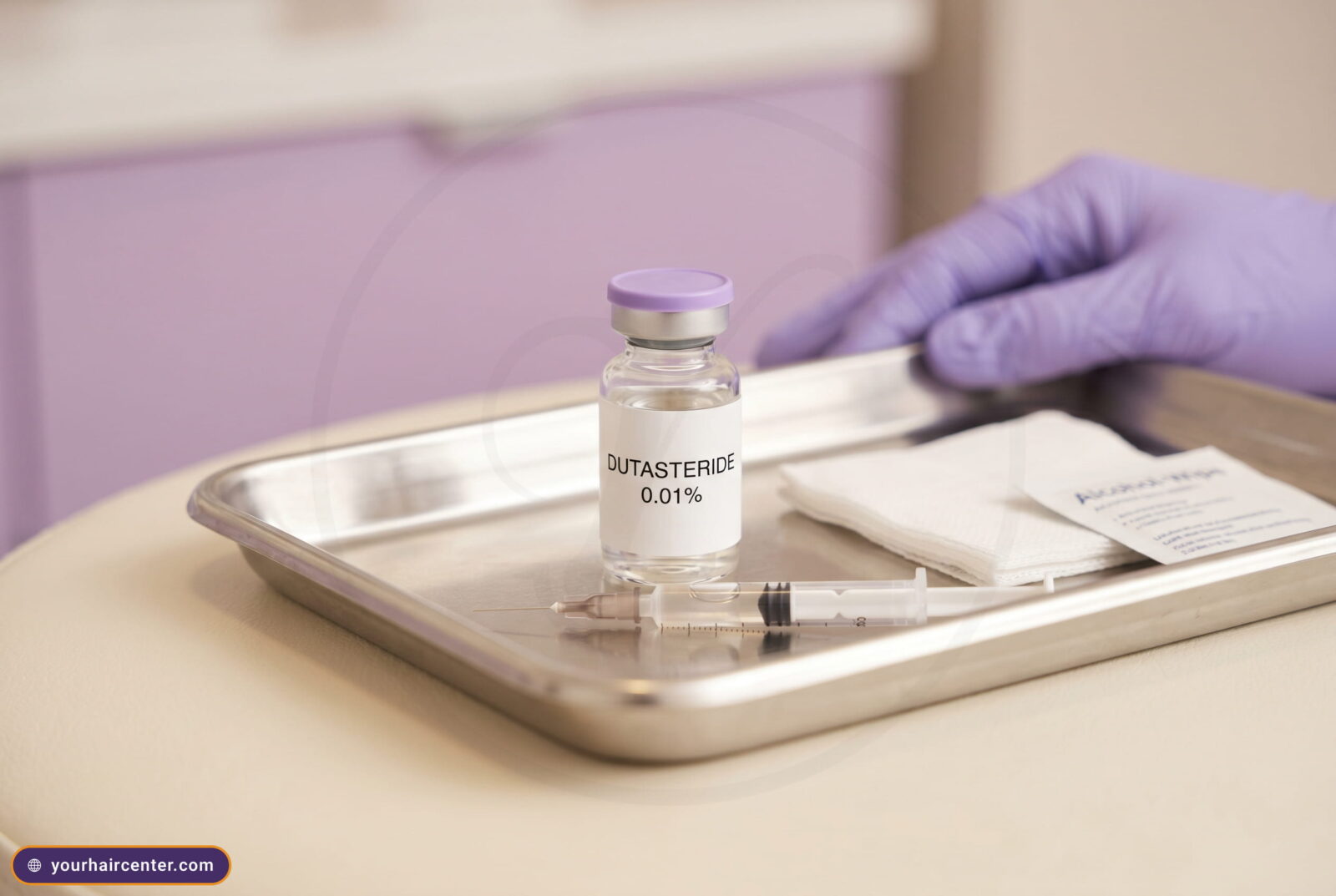
If you are vetting any clinic that offers dutasteride mesotherapy, four questions separate a protocol-driven practice from one improvising. What concentration of dutasteride is in the solution. What volume goes in per session. How often are sessions spaced. What else is in the cocktail. A clinic that can answer those four cleanly is following a published recipe; a clinic that waves them away is not. The same diagnostic rigor that drives the diagnostic scalp analysis applies here, and the dutasteride add-on sits inside the broader full mesotherapy program that anchors this whole hair treatments category.
How dutasteride mesotherapy works, translated for patients
In androgenetic alopecia, the hormone dihydrotestosterone, or DHT, gradually miniaturizes genetically susceptible follicles until the hairs they produce grow thinner, shorter, and eventually stop. Anything that meaningfully slows that process has to reduce DHT’s effect at the follicle.
Dutasteride does that by inhibiting 5-alpha-reductase, the enzyme that converts testosterone into DHT. What distinguishes it from finasteride is that dutasteride blocks both the type 1 and type 2 forms of the enzyme, whereas finasteride blocks only type 2.[4][5] That dual action is the reason dutasteride is a more complete DHT suppressor, and also the reason its systemic side-effect conversation is taken seriously.
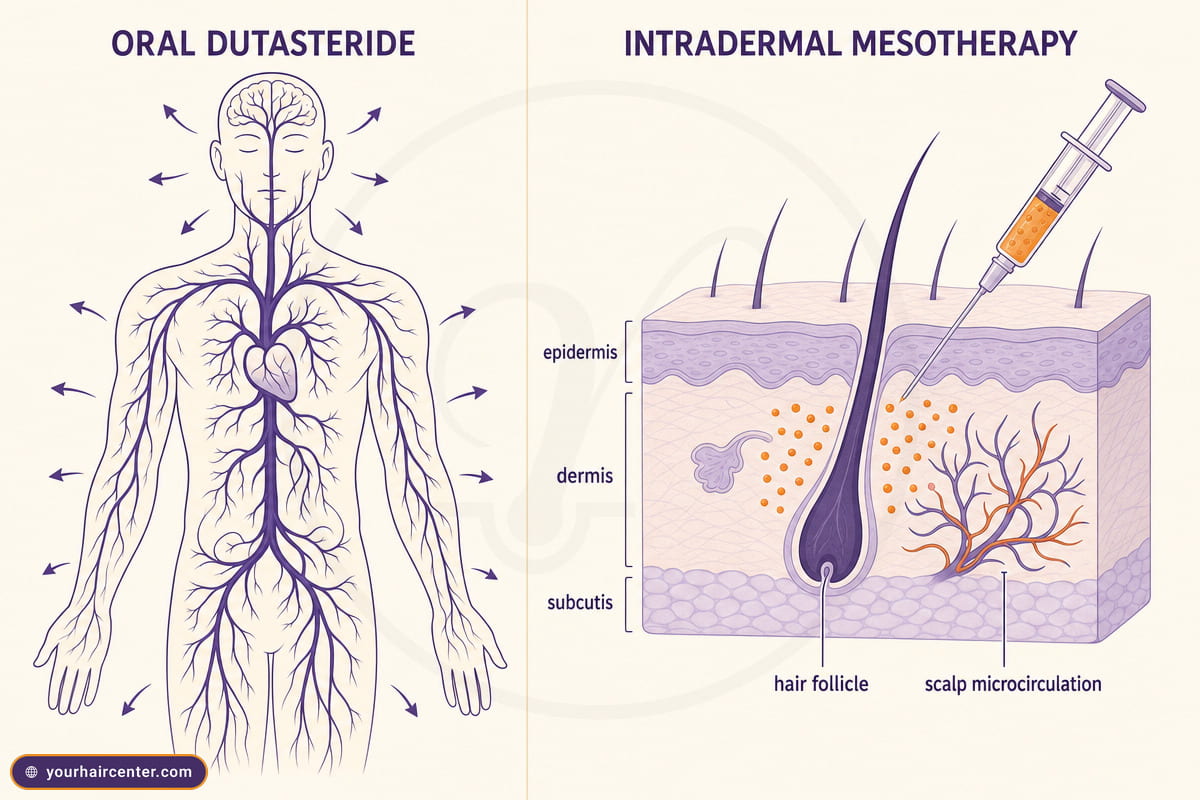
The dutasteride mesotherapy route changes the delivery, not the molecule. An oral dose distributes through the bloodstream and reaches DHT-sensitive tissue throughout the body. The injection places the active into the scalp, the layer where the follicles actually sit, with the aim of acting locally and limiting how much circulates.[5:1] This is the heart of the "does it go systemic" question patients ask. The most relevant data point is that the Saceda-Corralo cohort showed no measurable change in serum hormone levels after treatment, which is reassuring, but it comes from six patients and does not prove plasma exposure is zero.[1:3] The fair statement is that intradermal delivery is designed to reduce systemic exposure compared with a daily pill, not to eliminate it entirely.
Crucially, the dutasteride is added on top of the standard formulation, not in place of it. The base cocktail still carries the vitamins, minerals, amino acids, and growth factors that define hair mesotherapy, and the active is layered in only for candidates who clear the eligibility screen. You can see how that base sits within the wider menu of non-surgical hair loss treatment options and the full mesotherapy program itself.
Side effects compared to oral dutasteride, what most patients want quantified
This is the section most men are really reading for, because the fear that drove them away from a daily pill is the fear of persistent sexual side effects.
Start with the documented baseline for oral dutasteride. In the placebo-controlled trials behind its FDA label, the adverse-event rates in the first six months of treatment were impotence in 4.7% of men on dutasteride versus 1.7% on placebo, decreased libido in 3.0% versus 1.4%, ejaculation disorders in 1.4% versus 0.5%, and breast disorders such as tenderness or enlargement in 0.5% versus 0.2%.[4:1] Those rates come from men taking a daily oral dose for an enlarged prostate, which is the indication dutasteride is actually approved for, and they are the numbers worth knowing before any DHT-blocker decision.[4:2]
The case for dutasteride mesotherapy is one of biological plausibility. If most of the drug stays in the scalp, less reaches the tissues where those systemic effects originate. The Saceda-Corralo cohort’s unchanged serum hormone levels support that logic, and the general rationale for mesotherapy is local delivery into the dermis to concentrate effect where it is needed.[1:4][5:2] But plausibility is not proof at the population scale, and no large trial has yet measured sexual-side-effect rates for injected dutasteride against the oral numbers above. A community that has read the same literature treats the injection as a possible workaround for men who could not tolerate an oral DHT-blocker, while staying skeptical of any clinic promising "zero systemic side effects." That skepticism is well placed.
Regulators have tightened the wording on this drug class. On 11 May 2026 the UK Medicines and Healthcare products Regulatory Agency (MHRA) published a drug safety update stating that finasteride is associated with depression, suicidal ideation, and sexual dysfunction that may persist after treatment is stopped, and adding a precautionary warning to dutasteride’s product information that depressed mood, depression, or suicidal ideation has been reported with finasteride, a medicine in the same class, because the data for dutasteride itself were very limited.[6] Patients on dutasteride are advised to contact their healthcare professional as soon as possible if they develop suicidal thoughts or depression, or experience sexual dysfunction.[6:1] The update covers the licensed oral medicines, but the molecule in a dutasteride mesotherapy cocktail is the same one.
Post-finasteride syndrome, the controversy around symptoms that persist after stopping a 5-alpha-reductase inhibitor, deserves a candid word. Switching to an injected route is not a guaranteed escape from it, because the same molecule is involved, and the FDA label itself notes that dutasteride’s sexual adverse reactions may persist after treatment is stopped, with the drug’s role in that persistence unknown.[4:3] That is exactly why a patch test before the first session and a frank informed-consent conversation matter, rather than a reassuring sales pitch. The side effects specific to dutasteride mesotherapy are mostly local and short-lived, mild scalp tenderness and transient redness that typically clears within hours. They are not always trivial, though. A 2026 systematic review of scalp injectables for androgenetic alopecia found adverse events generally mild but also recorded paradoxical hair loss, scarring, and acute dermatitis,[7] and a 2026 case series described three women whose patchy hair loss at dutasteride injection sites never fully regrew.[8] Such events are uncommon, but they are why concentration, technique, and follow-up matter as much as the drug. For men who reach this point and decide a DHT-blocker is not for them at all, the autologous PRP scalp protocol is the non-hormonal alternative, and the safest next move is simply to ask the doctor on WhatsApp about your specific risk profile against the non-surgical hair loss treatment options on the table.
Dutasteride mesotherapy versus oral dutasteride, choosing between them
For a man weighing the injection route against the oral pill, the trade-off is not a simple better-or-worse. It is a trade between proven potency and a delivery route designed to spare the rest of the body.
Oral dutasteride has the stronger efficacy evidence by a wide margin. It is studied in large cohorts, it suppresses DHT more completely than finasteride because it inhibits both forms of 5-alpha-reductase rather than only one,[4:4][5:3] and for a man with advancing loss and good tolerance it is the more predictable choice. Its weakness is exactly what brings most researchers to this page, the systemic side-effect profile documented on its FDA label and the worry about symptoms that persist after stopping.
Dutasteride mesotherapy makes the opposite trade. Its efficacy evidence is thinner, built from small series rather than large trials,[1:5][2:3] but its delivery is local by design, aiming to concentrate the drug where the follicles are and reduce the whole-body exposure that drives the side effects men fear most.[5:4] In practice that makes dutasteride mesotherapy most interesting for a specific patient, someone with early-to-mid-stage loss who could not tolerate the oral version, or who is risk-averse about systemic effects and willing to accept that the efficacy evidence is less mature. It is a poorer fit for a man with aggressive late-stage loss who tolerates the pill fine, because for him the stronger oral evidence usually wins. The right answer is rarely universal, which is why it belongs in a consultation rather than a comparison chart, and why a diagnostic scalp analysis precedes any recommendation among the non-surgical hair loss treatment options.
Who is a candidate for dutasteride mesotherapy
The honest version of "is this for me" starts with a diagnosis, not a price.
The first step before any dutasteride mesotherapy is a hair and scalp analysis to confirm that the shedding is androgenetic alopecia and not another pattern, because DHT blocking only helps when DHT is the problem. Within AGA, early-to-mid-stage thinning generally responds better to any DHT-blocker, including the injected form, than late-stage loss where the follicles are largely gone. Patients well past that point are usually better served by a transplant conversation than by chasing density with dutasteride mesotherapy.
Tolerance history matters next. If you previously tried oral finasteride or oral dutasteride, what happened on it tells the clinic a great deal about whether a local route is worth attempting. On top of that sit the standard mesotherapy contraindications, an allergy to any cocktail ingredient, an active scalp infection or open wound, pregnancy or breastfeeding, blood-thinner use, and severe autoimmune conditions. Dutasteride adds its own caution, because it carries pregnancy-related handling warnings on its FDA label, so planned conception and any interaction with existing prostate medication belong in the screening conversation.[4:5] None of this skips the patch test, which is run before a first session to confirm every ingredient is safe for you individually, and a dutasteride-enhanced cocktail does not get a pass on it. The diagnostic scalp analysis is where this screen happens, and it decides whether the full mesotherapy program or another of the non-surgical hair loss treatment options is the right starting point.
What a single dutasteride mesotherapy session actually looks like
For a patient who has only read about the procedure online, the session itself is reassuringly ordinary.
A dutasteride mesotherapy session opens with a short assessment that confirms the cocktail composition for that day, because the dutasteride percentage and the supporting actives are not fixed for life, they are adjusted based on how the scalp is responding. Then the target area is cleaned and disinfected to create a fully sterile working field, a step that carries more weight for an active-ingredient injection than for a vitamins-only one. The cocktail is delivered into the scalp with ultrafine needles across a grid covering the thinning zone, in a session that runs about thirty minutes and produces, at most, a mild tingling.
Afterward there is no recovery period, you walk out and return to normal activity the same day. The only real housekeeping is leaving the hair unwashed for the first twelve to twenty-four hours, avoiding swimming pools and saunas for two days, and skipping chemical treatments like dyes for about a week. For someone traveling for a course, that zero-downtime exit is what makes a clustered dutasteride mesotherapy schedule practical. Cadence is the one thing to settle in advance, the Saceda-Corralo evidence runs on a three-month spacing,[1:6] while YHC’s dutasteride-enhanced course follows the eight-session base rhythm, and which one applies depends on the candidate profile worked out at the diagnostic scalp analysis before booking the full mesotherapy program.
Cost framing, US single-session pricing versus an Istanbul package
Cost is usually the line where the dutasteride mesotherapy decision actually gets made, and it is where the US and Istanbul math diverge sharply.
In US clinics, single-session dutasteride mesotherapy pricing reported across dermatology and hair-restoration practices generally falls in the $400 to $900 range, with the spread driven by metro location, clinic positioning, and whether PRP is bundled into the session. Run that against an evidence-aligned cadence of roughly four sessions a year and a US patient is planning for a meaningful annual out-of-pocket cost, before any maintenance. The Istanbul alternative reframes the same dutasteride mesotherapy protocol as part of an all-inclusive program that bundles the consultation, scalp analysis, the course of sessions, and, for international patients, accommodation and transfers, which is generally more affordable than comparable Western care at equivalent clinical quality.
Two financial realities deserve plain statements. First, mesotherapy is generally not eligible for HSA or FSA spending, because US insurers classify it as cosmetic, and dutasteride used off-label for hair is rarely covered, so any clinic claiming HSA eligibility is overpromising and the only reliable check is your own plan administrator. Second, on regulatory status, dutasteride is FDA-approved for benign prostatic hyperplasia, not for hair loss, and is used off-label for androgenetic alopecia even in its oral form, with dutasteride mesotherapy off-label in both indications.[4:6] Off-label use is legal and common, but the cosmetic-and-off-label classification is exactly why coverage does not follow. The package math tends to favor the Istanbul route once a patient would otherwise be paying for four or more sessions a year domestically, particularly if they are also considering combining the course with other treatments. The honest cost conversation belongs in the same channel as the clinical one, so it is worth using the full mesotherapy program details and the surrounding non-surgical hair loss treatment options as the basis to ask the doctor on WhatsApp for a quote built around your case.
Frequently asked questions
Does mesotherapy dutasteride work?
The published evidence is genuinely mixed. A 2017 prospective series of six patients reported improvement in every case on a 0.01% protocol given quarterly,[1:7] while a 2024 case series of ten patients found the benefit inconsistent and labeled it non-first-line therapy pending more research.[2:4] Dutasteride mesotherapy is promising on the conservative protocol, not yet proven at scale.
How many sessions of dutasteride mesotherapy are needed?
It depends on the protocol. The evidence-backed Saceda-Corralo cadence is a session once every three months, roughly four a year.[1:8] YHC’s dutasteride-enhanced cocktail instead follows the eight-session base course at one session weekly or every two weeks, with maintenance every two to three months afterward. The candidate profile decides which rhythm fits.
How much does dutasteride injections cost?
In US clinics, single dutasteride mesotherapy sessions generally run between $400 and $900, varying by city, clinic, and whether PRP is added. An Istanbul all-inclusive package frames the same course differently, bundling consultation, scalp analysis, the sessions, and travel logistics for international patients, which usually undercuts repeated US single-session pricing across a full year.
Does dutasteride mesotherapy go systemic?
Some absorption is expected, but the intent of the injection route is to keep the drug local and reduce whole-body exposure compared with a daily pill.[5:5] The Saceda-Corralo cohort showed no change in serum hormone levels after treatment, which is reassuring, though six patients cannot prove plasma exposure is zero.[1:9] The fair statement is reduced, not necessarily nil. Local reactions are usually mild, although patches of hair loss at injection sites have also been reported.[7:1][8:1]
The realistic next step
The published evidence on dutasteride mesotherapy reads as promising but not settled, and the protocol details, the concentration, the cadence, and the cocktail composition, decide the outcome more than the molecule alone. The systemic side-effect risk is designed to be lower than a daily oral dose but is not guaranteed to be zero, and the US single-session economics of dutasteride mesotherapy push most patients toward a structured package course rather than paying a la carte. None of that matters, though, until the diagnosis is right. The genuine next step is a scalp analysis that confirms whether DHT blocking is even the correct mechanism for your shedding pattern in the first place, so when you are ready, send your photos for a free eligibility evaluation.
The content and sources of this guide were reviewed on 28 September 2026.
References
-
Saceda-Corralo D, et al. Mesotherapy with Dutasteride in the Treatment of Androgenetic Alopecia. International Journal of Trichology, 2017. https://pmc.ncbi.nlm.nih.gov/articles/PMC5596657/ (opens in new tab) ︎ ︎ ︎ ︎ ︎ ︎ ︎ ︎ ︎ ︎
-
Nohria A, et al. Outcomes of androgenetic alopecia treated with dutasteride mesotherapy: A case series. JAAD Case Reports, 2024. https://pmc.ncbi.nlm.nih.gov/articles/PMC11647129/ (opens in new tab) ︎ ︎ ︎ ︎ ︎
-
Reguero-del Cura L, et al. RF-Mesotherapy With Dutasteride: A Future Alternative Treatment for Androgenetic Alopecia. Actas Dermo-Sifiliográficas, 2020. https://www.actasdermo.org/en-rf-mesotherapy-with-dutasteride-a-future-articulo-S1578219020301396 (opens in new tab) ︎ ︎ ︎
-
AVODART (dutasteride) Prescribing Information, revised January 2020. U.S. Food and Drug Administration. https://www.accessdata.fda.gov/drugsatfda_docs/label/2020/021319s032lbl.pdf (opens in new tab) ︎ ︎ ︎ ︎ ︎ ︎ ︎
-
Ding Y, et al. Dutasteride for the Treatment of Androgenetic Alopecia: An Updated Review. Dermatology, 2024. https://pubmed.ncbi.nlm.nih.gov/39278205/ (opens in new tab) ︎ ︎ ︎ ︎ ︎ ︎
-
Finasteride and Dutasteride, updated safety warnings for psychiatric side effects and sexual dysfunction. Drug Safety Update, Medicines and Healthcare products Regulatory Agency, 11 May 2026. https://www.gov.uk/drug-safety-update/finasteride-and-dutasteride-updated-safety-warnings-for-psychiatric-side-effects-and-sexual-dysfunction (opens in new tab) ︎ ︎
-
Beer J, et al. Injectable Therapy for Androgenetic Alopecia: A Systematic Review. Dermatologic Surgery, 2026. https://pubmed.ncbi.nlm.nih.gov/41603616/ (opens in new tab) ︎ ︎
-
Nogueira CM, Osório F. Persistent Alopecic Patches Following Dutasteride Mesotherapy for Female Androgenetic Alopecia: A Case Series. Journal of Drugs in Dermatology, 2026. https://pubmed.ncbi.nlm.nih.gov/41779759/ (opens in new tab) ︎ ︎
