A crown hair transplant restores the vertex whorl at the back of the scalp, and it follows different rules from the hairline. This guide walks a Norwood IV to VI man through the decisions that matter, whether your donor area has the capacity to spend on the crown, whether the hairline should come first, what graft count a crown needs, and why the regrowth runs longer than the front. It also explains how Turkey all-inclusive packages absorb the higher graft volume a crown demands.

If you are a man at Norwood IV through VI watching the spot at the back of your head widen, the first real question is not which clinic to pick. It is whether a crown hair transplant is worth your budget right now, or whether that budget belongs on your hairline first. The crown, the vertex whorl at the top-back of the scalp, behaves differently from the front in almost every way that matters to surgical planning. It carries its own coverage math, its own slower regrowth pattern, and its own donor-budget cost. This guide walks you through the crown hair transplant decision the way our men’s hair transplant program would in a consultation, so you arrive at your free evaluation already knowing the right questions to ask.
What a crown hair transplant actually is, and why the vertex is surgically distinct
A crown hair transplant is the surgical implantation of follicular grafts into the vertex region of the scalp, the area where male pattern baldness shows up as a circular, whorl-shaped thinning that radiates outward from a central point.[1] It differs from hairline work because the crown grows in a spiral, which changes how grafts are angled.
That spiral geometry is why a crown hair transplant carries its own coverage math, its own technique trade-offs, and its own slower regrowth pattern, all of which this section unpacks before the donor-budget and timeline decisions later in the guide.
The whorl, and why crown anatomy is not the hairline
At the hairline, hair grows forward in roughly one direction, so a surgeon opens recipient sites on a single tilting plane. The crown is built around a whorl, a central point from which hair spirals outward clockwise or counter-clockwise. Implanting into that geometry means planning graft angle on a continuously rotating axis, and the accepted technical standard is to keep the implant angle at 45 degrees or less so the hair lies flat rather than standing up.[2] Get one quadrant of the spiral wrong and the eye reads it immediately, which is why the crown is widely treated as the most technically demanding region on the scalp.
Why the crown looks thinner, and grows in more slowly
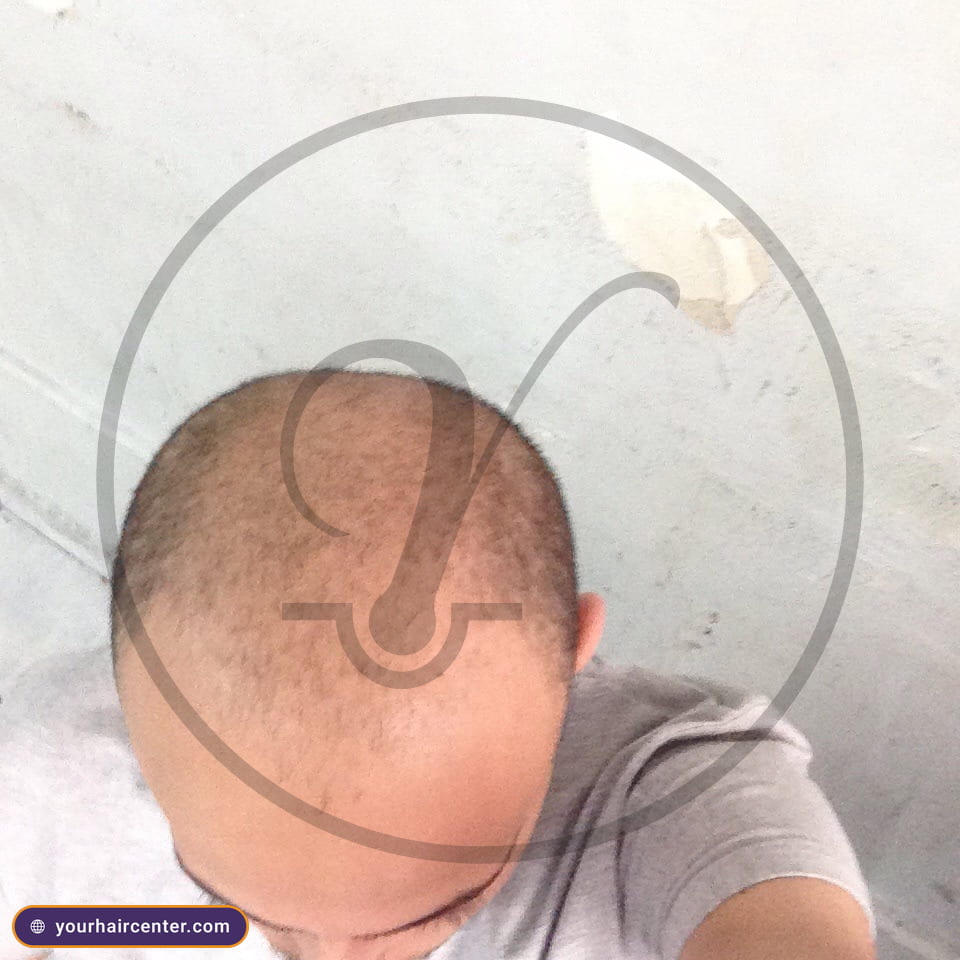
The whorl has an open center. Light passes through it and reflects off the scalp, so the same number of grafts that reads as full at the front can read as sparse at the vertex. Surgeons compensate not by chasing an extreme density number but by planting in the whorl direction and using crosshatching to create the illusion of fullness.[2:1] Recovery also runs long. Transplanted follicles shed, then re-emerge over several months, and the grafts continue maturing across the first 6 to 12 months before the result is fully in.[3] On the vertex, that maturation tail tends to run on the longer end, which is the single fact most crown transplant patients underestimate. A well-matched FUE technique plan accounts for all three of these from the first session.
Why the crown is the hardest region to transplant naturally
Every short competitor page repeats that a crown hair transplant is harder without explaining the mechanism. The difficulty is not mystery, it is geometry plus time, and understanding both is what lets you set a realistic expectation before you commit.
The illusion-of-density problem
Because the whorl center is open, coverage from a crown hair transplant is a perception problem as much as a follicle-count problem. The literature describes vertex implantation as following the whorl direction and using crosshatching specifically to give the illusion of higher density, rather than simply packing more grafts into the same space.[2:2] For comparison, frontal work is planned around a transition zone of roughly 25 grafts per square centimeter rising to 40 to 45 in the central tuft, with a general recipient target near 30 follicular units per square centimeter.[2:3][3:1] The crown’s challenge is that raw density alone does not buy the same visible coverage, so directional artistry carries more of the load.
The whorl reconstruction problem
Recreating a natural spiral means planning implant direction across multiple angles around a single center point. This is where surgeon experience separates a natural crown from a tell-tale one. A team that does most of its volume on hairlines, without deliberate crown transplant planning, tends to under-perform at the vertex. When you interview any clinic, ask directly how they plan the whorl direction. The answer tells you whether crown work is a routine part of their practice or an afterthought. The Sapphire technique is one tool here, but technique matters less than whether the plan respects the spiral.
The month-6 anxiety, why crown patients ask "is something wrong"
The crown’s slower visible payoff collides with human psychology. Hairline patients often cross an obvious-progress threshold while crown patients at the same point still look largely unchanged, because grafts are maturing on a longer schedule.[3:2] This is normal, and it is the single hardest stretch to wait through. Reviewing month-by-month documentation in the photo gallery before you book resets your expectations to the real timeline rather than the optimistic one.
Why the parent service page treats the scalp as one region
The men’s hair transplant service page presents one Norwood-stage graft-band table for the whole scalp rather than splitting hairline from crown. That is correct for a planning overview. This guide goes deeper precisely because a crown hair transplant deserves its own math, which is the reason it exists as a separate read rather than a restatement of the parent page.

The Norwood IV to VI decision, should you treat the hairline before a crown hair transplant
You have a budget-allocation problem. Two regions are visibly affected, your donor area is finite, and you cannot spend every graft at once without consequences. Here is how to sequence it.
The default for most patients, hairline first
For most men, the hairline comes first. It frames the face, drives the most noticeable cosmetic change, and matures faster than the crown.[3:3] A Norwood IV man with a clearly receded front and a partially intact crown gets the highest visible return per graft by restoring the hairline inside the first year, then reassessing the crown. Starting medical treatment early also matters, because results are better when treatment begins soon after loss is noticed.[4]
When crown-first is the right call
Three profiles flip the order toward a crown hair transplant first. First, the Norwood VI man with an obvious vertex sink whose hairline has already been restored or is acceptable. Second, the man whose hairline is psychologically tolerable but whose crown is the daily exposure, common for anyone photographed from above in athletic or work settings. Third, the man with aggressive vertex progression who needs to stop the perception of getting worse before the front becomes the next concern. Each is a legitimate reason to lead with the crown.
The both-at-once plan
One plan can sometimes address both. The parent service page publishes a 4,500+ graft tier for Norwood V to VII cases, and since one session places up to about 4,000 grafts, a plan of that size runs over two days, which is how a surgeon can split coverage between the frontal third and the crown in one trip rather than staging two. Whether your case fits depends on donor capacity, which is the next section, and on a proper assessment through our All-Inclusive Packages planning. If you are still placing yourself on the scale, the Norwood Scale Explained guide is the companion read.
The donor area capacity sanity check, your lifetime graft budget
This is the section no short competitor page covers, and the one that should shape every decision above. You do not have unlimited grafts. You have a finite, lifetime supply, and a crown hair transplant is an expensive place to spend it.
Where the ceiling comes from
Before any crown hair transplant, the safe donor zone has to be assessed. It sits at the back and sides of the scalp, the occipital and parietal regions that stay stable through pattern loss. Mapping studies of that zone put total follicular-unit availability at roughly 8,000 in a limited safe zone, around 12,000 in a standard zone, and up to roughly 14,500 in an extended zone, against a mean donor density near 78 follicular units per square centimeter.[5] That is not the number you can harvest. It is the number that exists.
The extraction ceiling, not the follicle count
What you can safely remove is far smaller. The evidence recommends keeping first-session extraction under about 35 percent of donor density, with smaller percentages in later sessions, and warns that taking around 50 percent of donor density reaches the watershed line where thinning becomes visibly detectable.[6][5:1] In plain terms, over-harvesting to fill a large crown can leave the donor area itself looking thin, which trades one bald spot for another.
Why the crown is the heavy drawdown
Because the open whorl needs directional artistry and a substantial graft volume to read as covered, a crown transplant pulls a large share of your safe-extraction budget into a single region. Spend it carefully. A man who empties his reserve on the crown at a young age has nothing left for the inevitable later recession, since donor density itself also declines with age.[6:1]
The future-loss reserve for men under 35
A Norwood IV at 32 has not finished losing native hair. A responsible surgeon reserves donor capacity for the recession that is still coming, rather than maximizing today’s result. This is why an early-stage man at Norwood II to III is usually not yet a crown hair transplant candidate, and why stabilizing with medication first often makes more sense than operating. Our Hair Loss Treatment program exists for exactly that stage. The honest cross-walk against the parent page’s Norwood band is simple. A Norwood III plan near 1,500 to 2,000 grafts leaves most of your budget in reserve, while a Norwood VII plan at 5,000+ runs over two sessions, since one session tops out at about 4,000 grafts and a first session averages 2,347 among ISHRS member surgeons,[7] and together those sessions approach the lifetime ceiling and foreclose later options. A free Hair & Scalp Analysis measures your actual donor density before any of this becomes a number.
The crown hair transplant regrowth timeline, month by month
This timeline is the procedure’s defining feature, and setting the right expectation here is what separates a satisfied patient from an anxious one. The verifiable clinical pattern below is anchored to surgical follow-up evidence, with the understanding that the crown’s final maturation tends to sit at the longer end of every window.
Month 1, shock loss and the deceptive bald patch
Within the first weeks, transplanted follicles shed. The crown can look emptier than it did the day after surgery. This is the universally experienced, transient phase, the follicles themselves remain in place and will regrow.[3:4] Do not measure anything here. If the shedding worries you, the dedicated shock loss guide covers it in full.
Month 3 to 6, the slow phase that defines the crown
New hairs typically begin emerging around 3 to 6 months, often fine and lightly pigmented at first.[3:5] Through month 6 the crown can still look largely unchanged even as the follicles are alive and cycling, which is exactly when hairline patients are already seeing obvious change. This is the psychologically hardest stretch, and it is where remote support matters most.
Month 6 to 12, maturation
Grafts continue maturing across the first 6 to 12 months until the result is substantially in.[3:6] Most patients photograph real density here. The crown, however, tends to keep thickening past the point where a hairline would have finished, so the final vertex result can take meaningfully longer than the front. Our team checks in remotely at month 1, month 3, month 6, and month 12 through the medical follow-up program, which is built around this exact waiting curve.
Beyond month 12, the final crown maturation
After a crown hair transplant specifically, the last stretch of thickening, as the deepest follicles complete a full growth cycle and shafts reach full caliber, is where before-and-after evidence carries the most weight. Reviewing real progressions in the patient gallery is the most honest way to calibrate what month 12 versus the final result actually looks like on a vertex.
How medication protects this window
Across the entire regrowth window, medical treatment protects the native crown hair around your grafts from continued miniaturization, which keeps the early-month result from looking worse before it looks better. That stack is covered below, and it routes through our Hair Loss Treatment program.
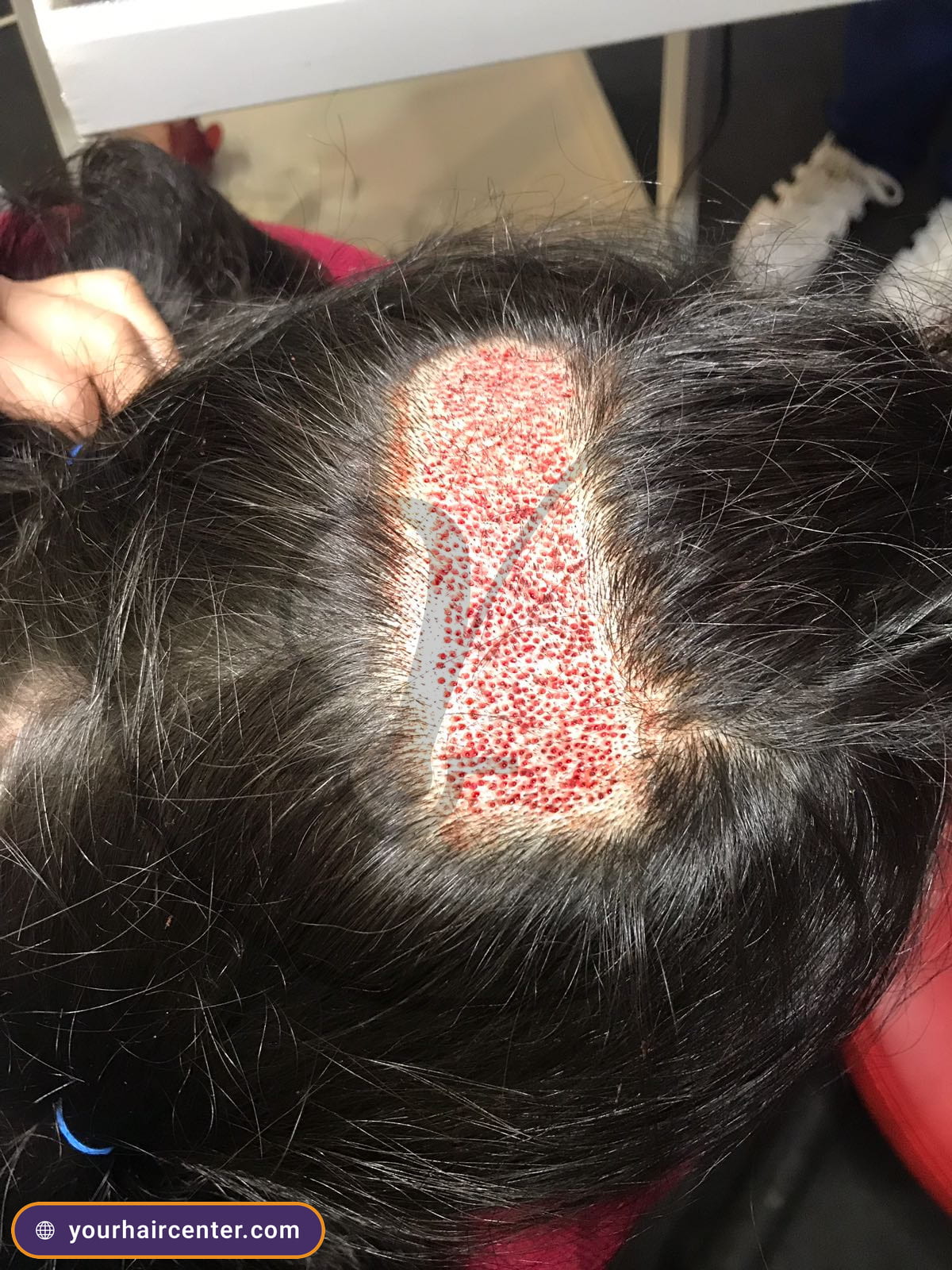
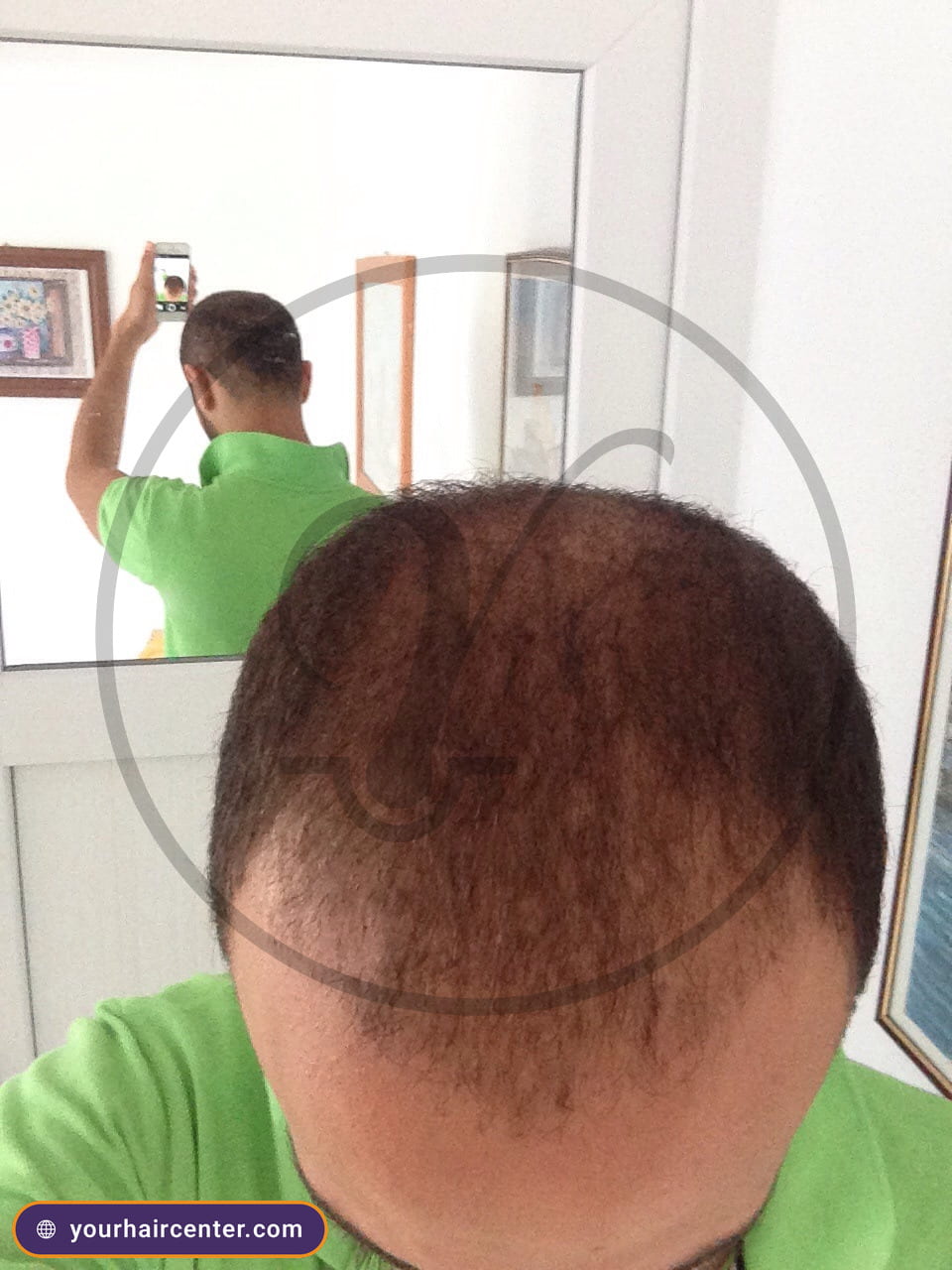
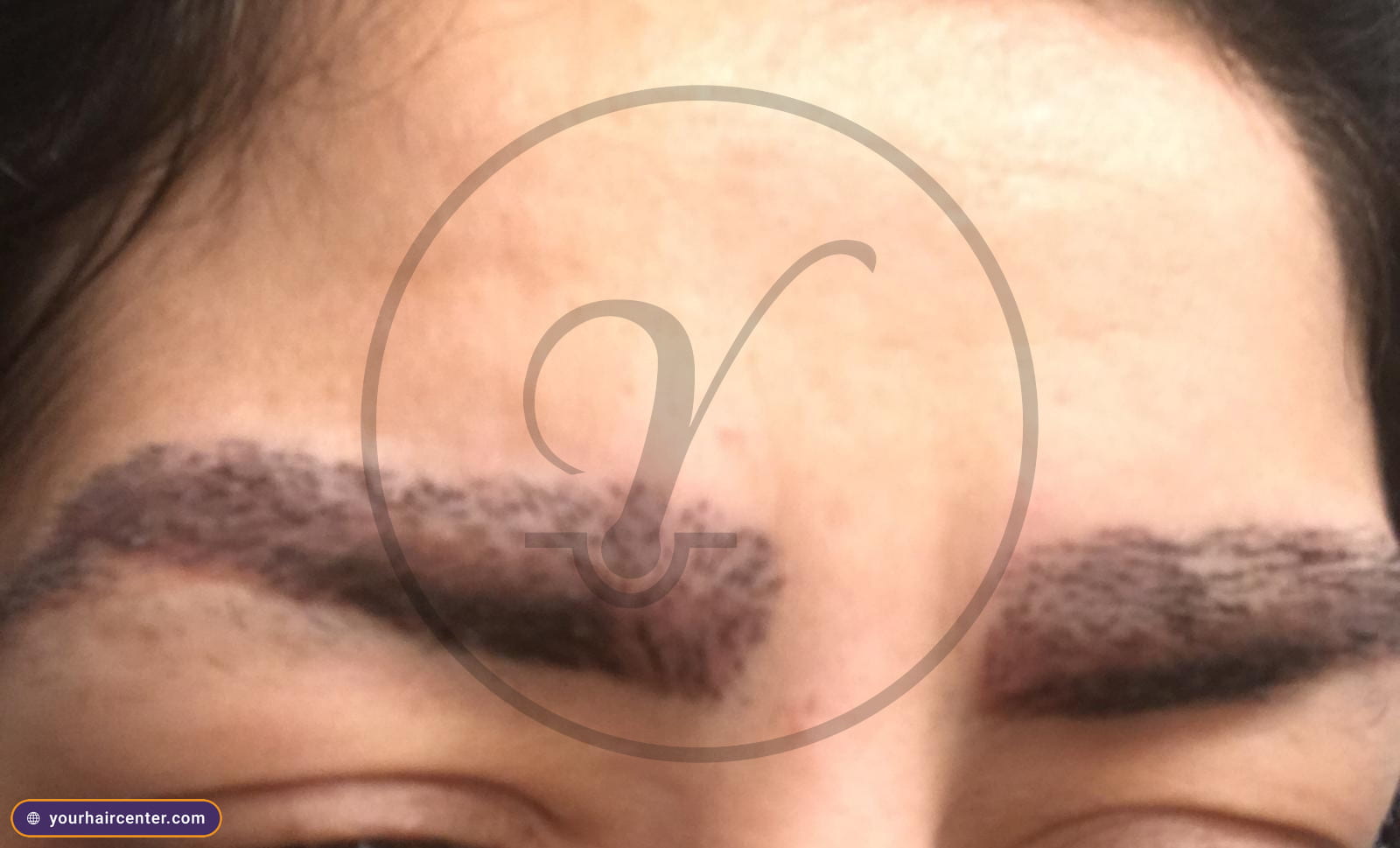
Real results from our patients’ archive. Photos exactly as captured at our accredited partner clinics — no filters, no retouching. Browse more cases in our photo gallery.


Technique selection for a crown hair transplant, FUE, Sapphire, or Choi DHI
The parent service page explains that the doctor selects the technique based on your case and Norwood stage. For a crown hair transplant specifically, the whorl-and-volume problem nudges that choice in predictable ways.
FUE for the crown, the workhorse
Follicular unit extraction removes individual follicles without a scalpel strip and is the default for most crown transplant cases, because the volume a crown demands favors a high-throughput extraction-and-implantation cadence. Opening recipient channels at the planned whorl angle before implanting also makes the rotating-axis geometry easier to control. For most men, a FUE Hair Transplant is the crown backbone.
Sapphire for density at the whorl center
Sapphire FUE uses sapphire-crystal blades to open finer channels, which the parent page ties to less tissue trauma and higher achievable density. For a crown hair transplant, finer channels let a surgeon place grafts closer together at the dense whorl-center cluster without compromising healing, which is useful when the cosmetic target is full restoration rather than light smoothing. A Sapphire Hair Transplant plan suits the visibly thin crown.
Choi pen DHI for fine control at the whorl edge
DHI with a Choi pen implants the follicle directly without a pre-opened channel, giving the finest control over angle exactly where the spiral is most demanding, at the whorl perimeter. The trade-off is a slower implantation rate, which is why Choi pen DHI is more often a precision adjunct around the whorl edge layered onto an FUE or sapphire core than a stand-alone crown hair transplant plan.
For the working professional who wants minimal visible signal during recovery, the Unshaved Hair Transplant option is worth raising in your consultation. The article does not prescribe a technique. Your case, your donor density, and your Norwood stage decide it.
Crown hair transplant in Turkey, how the package math actually works
The primary search intent for a crown hair transplant is transactional, so once you have your donor budget and your graft estimate, this is where the number becomes a package. The crown-specific point is that the all-inclusive structure handles a high graft count better than per-procedure pricing elsewhere.
Crown graft counts and their package tier
A crown hair transplant plan usually lands in the upper-middle to advanced graft range, which slots into the parent service page’s 3,000-graft most-popular tier and its 4,500+ advanced-loss tier. The published all-inclusive packages start around $1,650 at the entry tier and typically top out at $4,650 at the top tier. Your exact tier depends on the donor-area assessment, not on a guess from a photo.
Why all-inclusive absorbs the high graft count
A crown demands volume, and volume is where pricing models diverge. The parent page publishes a US range of $8,000 to $15,000 and a UK range of £6,000 to £12,000, generally covering the procedure only, with travel and aftercare billed separately. The Turkey all-inclusive structure bundles the procedure, three nights of hotel, transfers both ways, medication, and 12 months of follow-up into one figure, so a high-graft crown plan stays inside the published band rather than scaling steeply with graft count. The value gap is widest exactly at the graft counts the crown requires. Turkish medical tourism is regulated by the Ministry of Health, and leading clinics carry international accreditation, so the lower price reflects volume and exchange rates rather than a downgrade. You can send your photos for a free evaluation to get your own tier confirmed.
What the package includes
Rather than restate the full list, the short version is that the package covers the procedure, hotel, transfers, medication and aftercare kit, and 12 months of medical follow-up. The full inclusions live on the All-Inclusive Packages page, and the airport-to-hotel logistics are handled through Reception & Accommodation logistics. For the wider topic, the Hair Transplant category overview collects every related service.
Treat the crown medically before a crown hair transplant
Top pages mention finasteride and minoxidil in passing. The crown-specific reason to take them seriously is donor-budget preservation, which is a planning argument, not a marketing add-on.
Why pre-op treatment matters for the crown
The crown is highly susceptible to continued miniaturization during the long regrowth window that follows a crown hair transplant. A man who arrives at surgery with un-stabilized crown hair loses more native hair around the new grafts during recovery, which makes the early result look worse before it looks better. Stabilizing first protects both the cosmetic result and the donor-budget plan you built in the capacity check above.
The finasteride and minoxidil runway
Finasteride and minoxidil are the two FDA-approved medications for male pattern hair loss, both long established and widely used.[4:1] They can be used together, and both require continuous use, once you stop, the hair loss returns.[4:2] A runway of several months before surgery, continued afterward, gives the surgeon a stabilized canvas. Results are also better when treatment starts soon after loss is noticed, so the runway is worth beginning before you book.[4:3] Our Hair Loss Treatment program sets this up.
Combination treatments during the regrowth window
Platelet-rich plasma can be given before a hair transplant to improve results, per dermatology guidance, and is sometimes paired with other in-office treatments during the follow-up window.[4:4] The evidence for accelerating graft maturation is mixed, so treat these as supportive rather than guaranteed. PRP hair therapy, Hair mesotherapy, and Exosome therapy are all available as adjuncts to discuss with the doctor.
The scalp analysis is the gate
What decides whether you need a medical runway first, or are stable enough to schedule directly, is a proper diagnosis. A free Hair & Scalp Analysis measures your donor density and crown stability and turns this whole guide into a personal plan.
Frequently asked questions about crown hair transplants
Do hair transplants on the crown work?
Yes, crown hair transplants work when the surgeon is experienced in whorl-direction planning and the patient’s donor zone passes the capacity check. Coverage from the procedure relies on planting in the spiral direction with crosshatching to build the illusion of fullness, and the result matures on a longer schedule than the hairline, which the patient must accept before scheduling.[2:4][3:7]
Can crown area hair regrow?
Yes, in two different senses. Native crown hair that is thinning but not gone can often be held or partially regrown with finasteride and minoxidil, which require continuous use.[4:5] Hair that is already lost is restored surgically, and that transplanted crown hair grows in over the months-long maturation window covered above.[3:8]
How much do 3,000 hair grafts cost in the USA?
In the US, the parent service page reports hair transplant pricing in the range of $8,000 to $15,000, generally for the procedure only, with travel and aftercare billed on top. The Turkey all-inclusive packages for the same kind of case run from about $1,650 to $4,650 and bundle hotel, transfers, medication, and a year of follow-up, which is why a high-graft crown plan is far more cost-efficient in a package structure.
How long does it take crown hair to grow back?
Plan for a long curve after a crown hair transplant. New hair typically begins emerging around 3 to 6 months, grafts mature substantially across the first 6 to 12 months, and the crown specifically tends to keep thickening past that point before the final density is in.[3:9] Measuring progress before month 6 will only frustrate you.
Is a crown hair transplant worth it?
It depends on where you sit on the Norwood scale and how your donor budget looks. A crown hair transplant is often worth it for a Norwood VI man with an obvious vertex sink and a hairline already handled. It is usually not yet worth it for an early-stage Norwood II to III man, whose donor capacity is better conserved while medication stabilizes the loss.[5:2][4:6]
What is the success rate for crown hair transplants?
Success on the crown is best understood as graft survival, the share of transplanted follicles that take and cycle normally, rather than a single headline figure. When the donor zone is healthy and the surgeon plans whorl direction and density correctly, crown survival can approach the standard expected elsewhere on the scalp, with full maturation taking longer at the vertex.[3:10] Any clinic quoting you a precise success number without examining your scalp is selling, not assessing.

Your crown decision, in one frame
A smart crown plan comes down to three checks, does your donor area have the capacity to spend on the vertex without mortgaging your future, should the hairline come first in your sequence, and are you ready for a regrowth curve that runs longer than the front. Get those right and a crown hair transplant is a solved problem. For the full procedure mechanics, day-by-day journey, and package detail, the men’s hair transplant in Istanbul page is your next stop. When you are ready, the fastest path is to send your photos for a free evaluation on WhatsApp and let a doctor measure your donor density and crown stability directly. Still weighing technique? The DHI vs FUE comparison and the Norwood Scale Explained guides are the companion reads.
References
-
Cleveland Clinic. Male Pattern Baldness (Androgenic Alopecia). https://my.clevelandclinic.org/health/diseases/24515-male-pattern-baldness-androgenic-alopecia (opens in new tab) ︎
-
Recipient Area. PMC (PubMed Central). https://pmc.ncbi.nlm.nih.gov/articles/PMC6371721/ (opens in new tab) ︎ ︎ ︎ ︎ ︎
-
Hair Transplantation. StatPearls, NCBI Bookshelf. https://www.ncbi.nlm.nih.gov/books/NBK547740/ (opens in new tab) ︎ ︎ ︎ ︎ ︎ ︎ ︎ ︎ ︎ ︎ ︎
-
American Academy of Dermatology. Male Pattern Hair Loss Treatment. https://www.aad.org/public/diseases/hair-loss/treatment/male-pattern-hair-loss-treatment (opens in new tab) ︎ ︎ ︎ ︎ ︎ ︎ ︎
-
Assessment of Safe Donor Zone of Scalp and Beard for Follicular Unit Extraction. PMC (PubMed Central). https://pmc.ncbi.nlm.nih.gov/articles/PMC6484564/ (opens in new tab) ︎ ︎ ︎
-
Effect of Follicular Unit Extraction on the Donor Area. PMC (PubMed Central). https://pmc.ncbi.nlm.nih.gov/articles/PMC6066700/ (opens in new tab) ︎ ︎
-
International Society of Hair Restoration Surgery. 2025 Practice Census Results, procedures performed in 2024. https://ishrs.org/wp-content/uploads/2025/05/report-2025-ishrs-practice-census_05-12-25-final.pdf (opens in new tab) ︎