A neutral DHI vs FUE comparison from a center whose specialists perform both techniques. We walk eight axes, graft handling time, density per square centimeter, scarring, recovery duration, shaving, cost, session length, and candidate fit by Norwood stage. No single method wins everything, so the right one tracks your hair loss pattern rather than a clinic's inventory. Read the side-by-side data, then get a free evaluation.
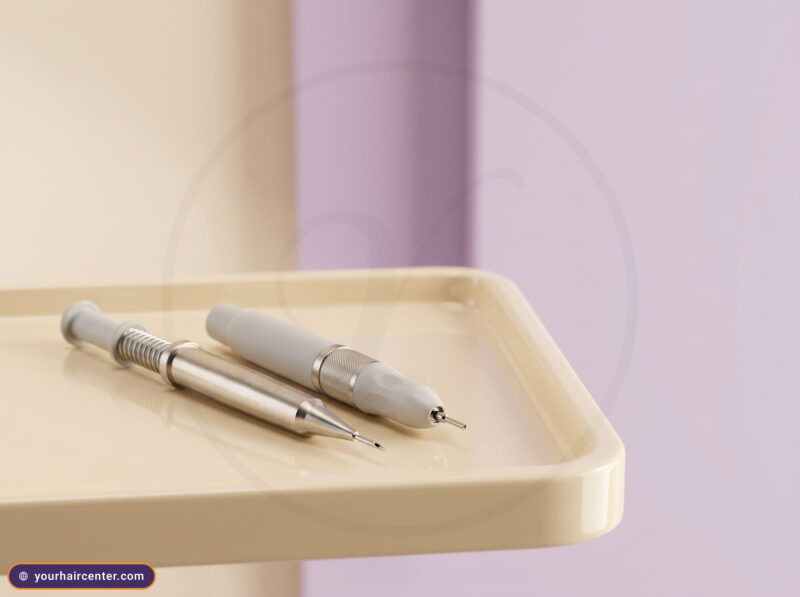
You have ruled out the strip method, you know you want follicular unit work, and now the whole decision narrows to one question that every clinic answers differently. The DHI vs FUE comparison is the first real fork in the road, and the answer you get usually depends on which technique the clinic in front of you happens to sell. This guide comes from a center whose specialists perform both, so the recommendation here tracks your hair loss pattern rather than our inventory. Over the next sections we walk eight comparison axes head to head, graft handling time, density per square centimeter, scarring, recovery duration, shaving, cost, session length, and candidate fit, and we close with a decision matrix you can screenshot and send to a partner for the second opinion. No single technique wins on every axis. The right one wins for your specific case.
What Is the Difference Between DHI and FUE?
The difference between DHI and FUE is how grafts go back in. FUE opens recipient channels first, then places grafts in a separate step. DHI loads each follicle into a Choi implanter pen and creates the opening and places the graft in one motion. That single step drives the gaps in density, scarring, and recovery.
In the dhi vs fue comparison, both techniques extract individual follicular units from the donor area identically, so the donor experience is the same. Everything that separates them happens at the recipient phase.
How the Choi Pen DHI Technique Works
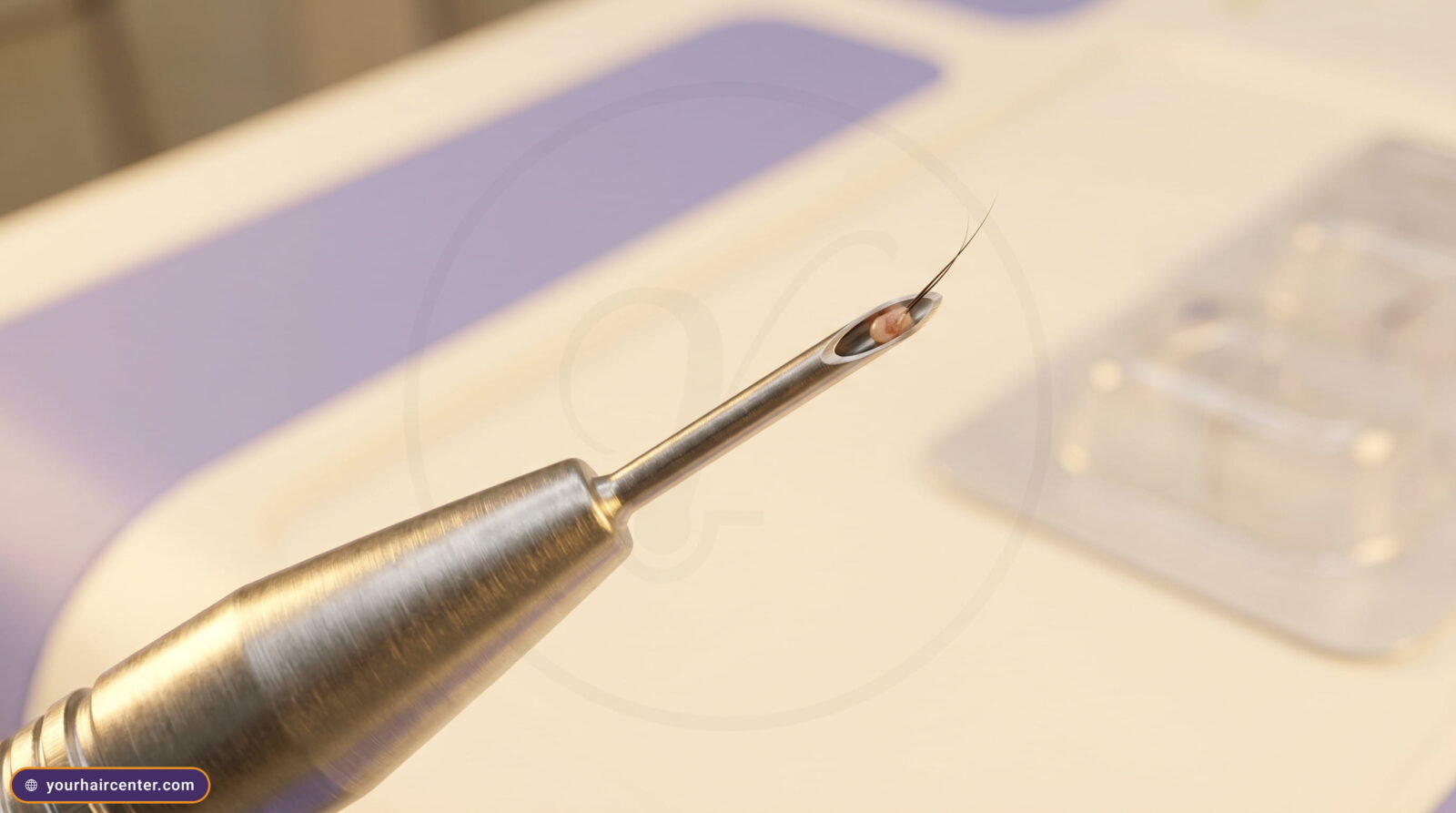
DHI, direct hair implantation, runs the recipient phase through a pen. The follicle is harvested from the donor area, loaded into the ultra-fine hollow tip of the Choi Pen DHI technique device, and implanted directly into the recipient area in one continuous motion. There are no pre-made channels. The pen creates the opening and seats the graft at the same instant, which is the mechanical fact that separates DHI from every channel-then-place method.
Why does the single step matter clinically? Graft survival is sensitive to how long follicles sit outside the body. The published survival curve shows roughly 95 percent viability when grafts are reimplanted within about two hours, declining at a rate near one percent per hour after that.[1] Because the implanter pen places each graft the moment it is loaded, it shortens that out-of-body window and minimizes the direct handling that can crush or sever a follicle, whereas forceps placement into a pre-cut channel adds contact and time.[2] Implanter-based placement has reported follicle survival around 92 percent at six months in the device literature.[3]
The pen also gives the operator tight control over the angle, depth, and direction of every follicle. That control is what lets DHI pack grafts densely along a frontal hairline where the eye is least forgiving of a wrong-angled hair. Each Choi pen is single-use and discarded after one patient, which removes a cross-contamination vector. On the dhi vs fue map, DHI is strongest in density-critical zones, the frontal hairline and the part line, and it supports no-shave protocols because the recipient area does not need to be cleared. For the broader category context, DHI sits inside the family of hair transplant techniques that share the same donor-harvest foundation.
How the FUE Technique Works
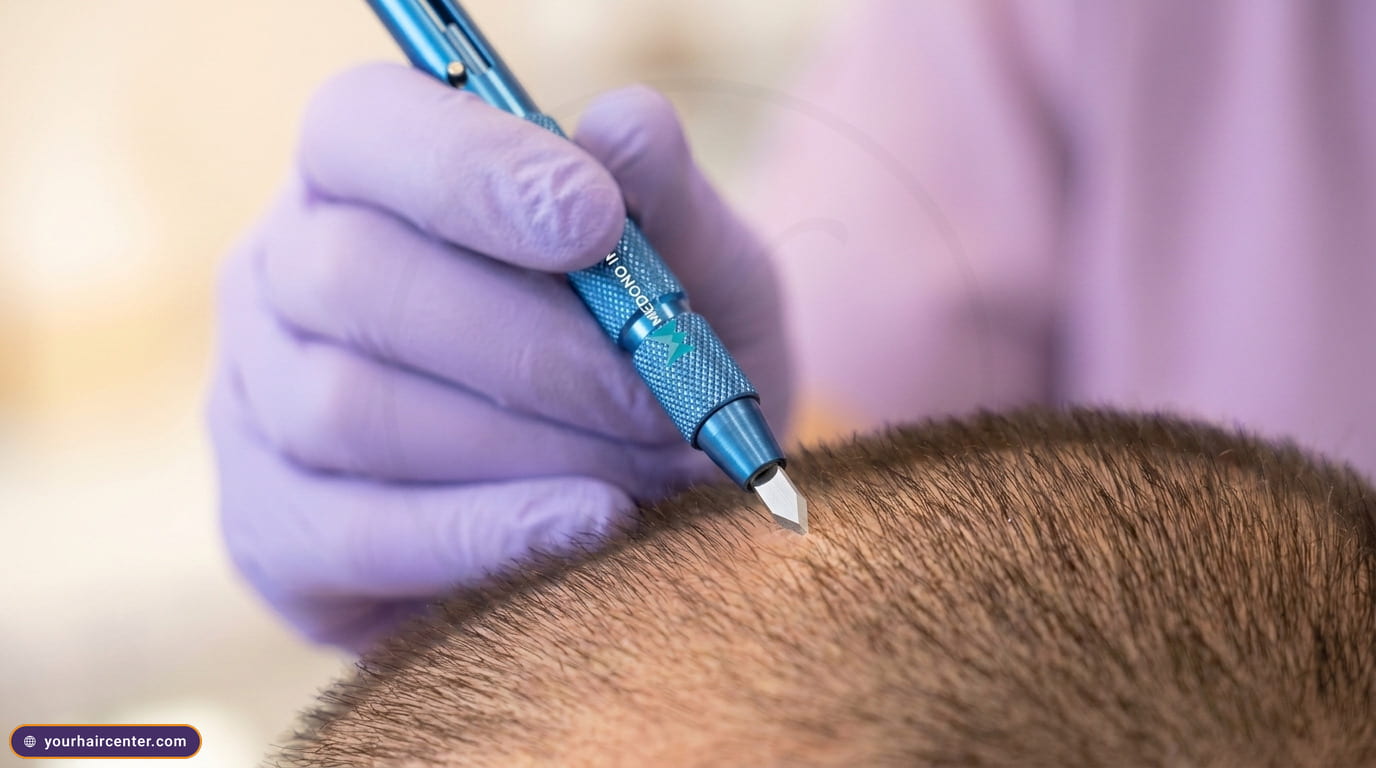
FUE, follicular unit extraction, splits the work into two distinct steps. A micro-punch extracts each follicular unit from the donor zone, the surgeon then opens recipient channels, and grafts are placed into those channels with forceps. That extraction phase is mechanically identical to the one DHI uses, which is why the two methods share a donor-area healing signature, small dot-shaped extraction marks rather than a linear scar. In a fue vs dhi hair transplant comparison, this shared foundation is the part most people miss.
The two-step rhythm is not a weakness, it is a different set of trade-offs. Separating channel creation from placement lets a skilled team work through a larger graft volume in one sitting, which is why FUE handles bigger sessions comfortably. A well-planned FUE session places up to about 4,000 grafts, and larger cases run over two days under one plan or as a second session months later. Survival is strong when grafts are handled well, with FUE studies reporting over 90 percent follicle survival and most patients exceeding 95 percent at twelve months.[4]
By mechanism, the dhi vs fue split puts FUE forward as the better fit for full-crown coverage and for advanced hair loss where the sheer number of grafts matters more than packing maximum density into a small zone. It is also the workhorse when donor density is the limiting factor and every harvestable graft has to be spent efficiently.
One refinement worth flagging if you searched “sapphire” on your way here. Sapphire FUE is classic FUE with the steel channel blade swapped for a sapphire-tipped blade, which makes finer, more uniform channels. It changes the channel-creation step, not the extraction, so it lives on the FUE side of this comparison. If that is your real question, the dedicated sapphire blade refinement page covers it, and the full FUE technique page covers classic FUE in depth.
DHI vs FUE Side by Side, 8 Comparison Axes
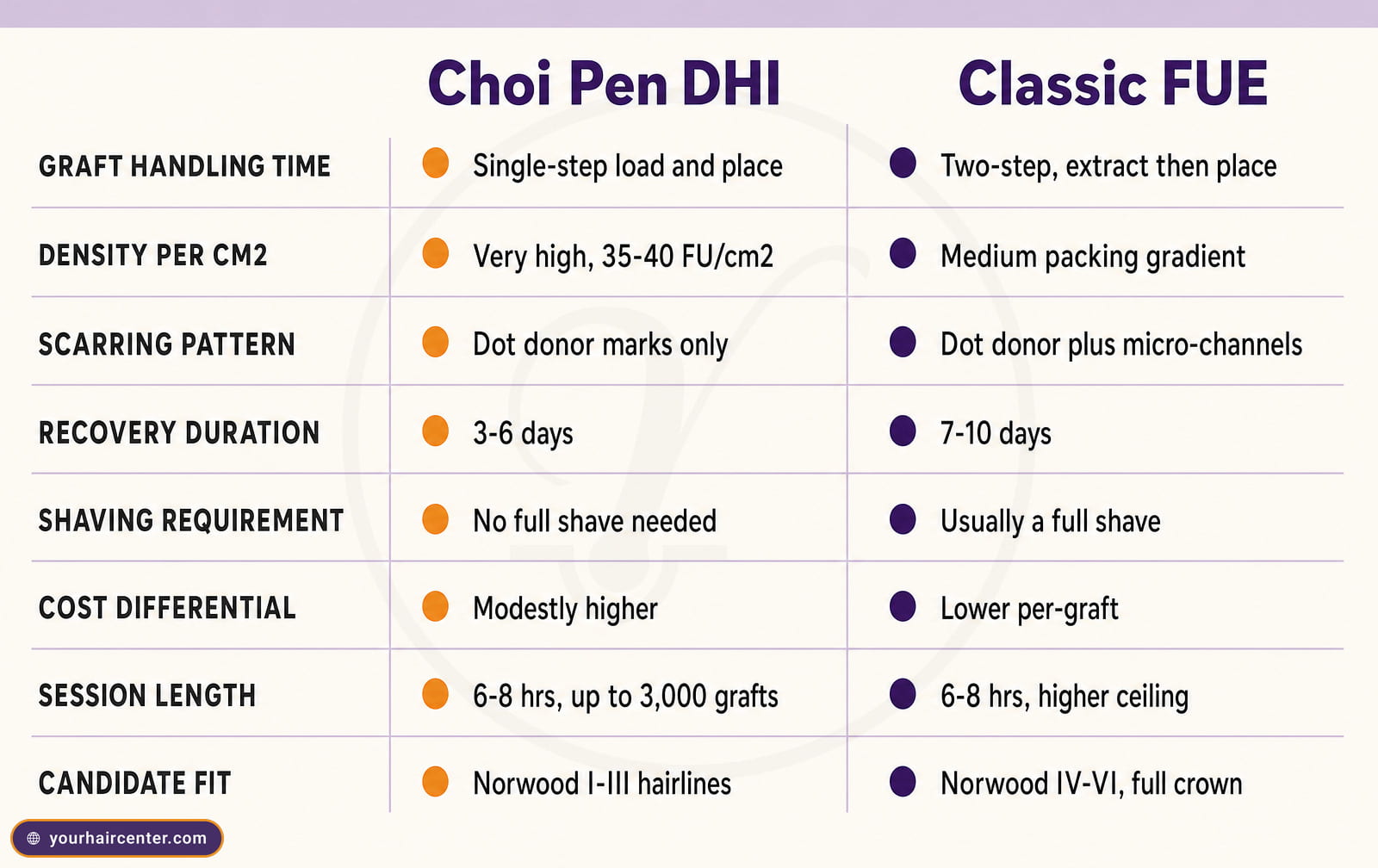
Here is the whole dhi vs fue comparison in one place. Each row gives a single value for each technique, with citations on the clinical and numerical claims, so a dhi hair transplant vs fue read is a matter of data rather than salesmanship.
| Axis | Choi Pen DHI | Classic FUE |
|---|---|---|
| Graft handling time | Single-step load-and-place shortens out-of-body time[1:1][2:1] | Two-step extract, channel, then place adds handling[2:2] |
| Density per cm² | Very high, suited to ~35-40 FU/cm² at the hairline[5] | Medium, often a lighter packing gradient |
| Scarring pattern | Dot-shaped donor marks, no recipient-zone channel marks | Dot-shaped donor marks plus micro-channel recipient openings |
| Recovery duration | About 3-5 days back to daily life, scabs clear in 7-14 days | About 3-5 days back to daily life, scabs clear in 7-14 days |
| Shaving requirement | No full shave required, donor-only shave possible | Usually a full shave |
| Cost differential | Sits modestly above FUE in most packages | Lower per-graft baseline |
| Session length | 6-8 hours for up to 3,000 grafts | 6-8 hours for up to about 4,000 grafts |
| Candidate fit | Norwood I-III, density-critical hairlines, no-shave cases | Norwood IV-VI, large-area and full-crown coverage |
A few rows carry more nuance than a single cell can hold.
Graft handling time. This is the axis most comparison articles skip, and it is where DHI has a genuine mechanical edge. Every minute a follicle spends outside the body chips away at its odds, and the published curve puts satisfactory survival at the under-two-hour mark, falling about one percent per hour beyond it.[1:2] DHI places each graft the moment it is loaded into the pen, which compresses that window and reduces the forceps contact that can damage a follicle.[2:3] FUE is perfectly capable of excellent survival when the team is fast and the grafts are kept hydrated, the difference is that DHI removes a step where time and trauma can accumulate. On this axis the dhi vs fue verdict tilts toward the pen.
Density per square centimeter. The recipient density a surgeon can safely achieve is bounded by blood supply, and the literature recommends roughly 35-40 follicular units per square centimeter at the frontal hairline, tapering toward the crown.[5:1] DHI’s pen control makes it easier to approach the top of that range in a small, visible zone, which is why it is described as the very-high-density option. FUE typically targets a medium packing gradient across a larger surface.
Candidate fit by Norwood stage. This is the row that decides dhi vs fue which is better for you specifically. Early to moderate loss with a density-critical hairline rewards DHI’s precision. Advanced loss that needs more than about 3,000 grafts rewards FUE’s higher session ceiling, with the largest plans run over two days. That fit, not the marketing language on any single clinic’s homepage, is what should drive the choice.
It is worth answering the skeptical take you will find on forums directly. The claim that “DHI is just renamed FUE” is half right and half wrong. Both share the identical extraction phase, so the donor experience is the same. They diverge entirely at the recipient phase, where FUE creates channels first and DHI does not, and that is a real, falsifiable mechanical distinction, not a rebrand.[2:4] For the adjacent question of how DHI stacks up against a sapphire-blade FUE specifically, the DHI vs sapphire FUE comparison goes deeper, and both the Choi Pen DHI technique and FUE technique pages document each method on its own terms.
Recovery and Scarring Compared
Recovery is the axis the search results overweight, and it is the number you will copy into your “what do I tell the office” notes. On the recovery front, the difference between FUE and DHI hair transplant downtime is smaller than clinic marketing suggests. With either technique most people are back at a desk within about 3-5 days, and the scabs clear within 7-14 days. DHI’s pen openings are made and filled in the same motion, which spares the recipient zone a separate channel step, but that has not been shown to shorten the calendar in a way worth planning around.
Scarring follows the same logic. Because the extraction step is identical, both techniques leave the same dot-shaped marks scattered across the donor area, which fade into surrounding hair and are not visible at a normal haircut length. The difference is in the recipient zone, where DHI leaves no separate channel marks and FUE leaves the tiny micro-channel openings that heal over the first week.
A timeline detail that matters for sedentary versus active work. Office workers are usually comfortable returning within the DHI or FUE window above, while jobs with heavy exertion, sweating, or hard-hat contact warrant a longer pause regardless of technique. For the full day-by-day picture, see the DHI day-by-day recovery timeline.
One misconception to retire from the dhi vs fue debate. Shock loss, the temporary shedding of transplanted hairs during weeks two to four, is not avoided by choosing DHI. Implanted hairs fall out almost completely within that window with either technique, the follicles enter a brief dormant phase and regrow, and this is a function of follicle physiology, not the method used to place them. A clinic’s medical follow-up program is what carries you through that phase with confidence rather than panic.
Cost and Session Length Compared
Session length is similar for both techniques at the high level, 6-8 hours of chair time depending on graft count, but the drivers differ. A DHI session of up to 3,000 grafts spends its time on the per-graft pace of the pen, which places one follicle at a time with deliberate angle control. FUE spends comparable hours but can push a higher graft ceiling in a single session, up to about 4,000 grafts, which is exactly why it suits the larger advanced-stage cases. Most first sessions are smaller than either ceiling, averaging 2,347 grafts among ISHRS member surgeons.[6]
On the dhi vs fue cost question, DHI generally sits modestly above FUE. The reason is concrete, not marketing, the single-use pen consumables and the slower per-graft handling pace are real costs that land in the price. The gap is usually a band rather than a cliff, and it is the same direction across most Istanbul packages.
The bigger cost story is geography, not technique. The difference between domestic clinics in the US or UK and an Istanbul package is large and consistent across both DHI and FUE, with Turkey commonly delivering the same procedure for up to 70 percent less while keeping the medical standard. For the full itemized breakdown, including what an all-inclusive package covers and what it does not, see DHI hair transplant cost in Turkey and the all-inclusive packages page.
Which Technique Fits Your Hair Loss Pattern
Here is the decision rubric, organized the way you should walk into a consultation.
If you are early to moderate, roughly Norwood I to III, with the loss concentrated at the frontal hairline or the part line, DHI is generally the closer fit in the dhi vs fue decision. The pen’s angle control matters most exactly where the hair is most visible, and density there is what reads as a natural result.
If you are advanced, Norwood IV to VI, and you need more than about 3,000 grafts to cover the crown and mid-scalp, FUE typically suits better because of its higher session ceiling, and the largest plans run over two days.
If keeping your hair long through recovery matters to you, the no-shave preference settles dhi vs fue in DHI’s favor, since the recipient area does not need to be cleared and only the donor zone is trimmed.
On density goals, both techniques are bounded by the same blood-supply ceiling at the recipient site, roughly 35-40 follicular units per square centimeter at the hairline.[5:2] No technique safely exceeds the biology, so be skeptical of any promise that does.
There is also a combination route. An advanced-stage patient can receive DHI on the frontal hairline for density and precision and FUE or sapphire FUE on the crown for coverage, in a single session. That is a real option here, not a compromise, and it is often the most honest dhi vs fue answer for an advanced case. Explore the Choi Pen DHI technique, the FUE technique, and the sapphire technique refinement, or take the shortcut and request a free WhatsApp evaluation to have your pattern assessed directly.
Frequently Asked Questions
Is DHI more effective than FUE?
DHI is not universally more effective than FUE, the effectiveness depends on the hair loss pattern and the surgical team’s experience with each technique. In a dhi hair transplant vs fue head-to-head, DHI’s pen placement shortens out-of-body time, which supports strong graft survival,[1:3] while FUE achieves comparable survival in skilled hands.[4:1] The better question is which technique fits your Norwood stage and density goal.
What are the disadvantages of DHI?
In a dhi vs fue comparison, the disadvantages of DHI include a higher per-graft cost and a lower session graft ceiling, which makes it less efficient for advanced Norwood stages. The pen places one follicle at a time, so very large cases that need maximum coverage in a single sitting are often better served by FUE. DHI also requires a team experienced specifically with the implanter pen.
How does DHI compare to FUE?
In a fue vs dhi hair transplant comparison, both extract grafts identically, then diverge at placement. DHI implants in one pen-driven motion with no pre-made channels, giving higher recipient density and no recipient-zone scarring. FUE opens channels first, then places, which suits larger sessions and full-crown coverage. Recovery is about the same for both, 3-5 days back to daily life and 7-14 days for the scabs. Neither is globally better.
What is the cost difference between DHI and FUE?
The dhi vs fue cost gap is modest, DHI runs a little higher than FUE because the single-use implanter pen and the slower per-graft pace add real cost. The gap is a band rather than a large jump and runs in the same direction across most packages. The far larger cost factor is location, with Istanbul commonly up to 70 percent below US and UK pricing for either technique.
Does DHI take longer than FUE?
On the dhi vs fue timing question, for the same graft count DHI can run slightly longer because the pen places follicles one at a time with deliberate angle control. In practice both techniques occupy a 6-8 hour session, and FUE’s advantage is a higher graft ceiling per sitting rather than a faster pace for an equal number of grafts.
Get a Free DHI vs FUE Evaluation
The right technique tracks your Norwood stage, your density goal, and how much recovery time you can spare, not whatever a clinic happens to sell. The honest DHI vs FUE answer is that the comparison only resolves once someone looks at your actual hair loss pattern, which is why a team that performs both can route your case to whichever one fits instead of steering you toward a single product. Get a free DHI vs FUE evaluation to have your case assessed, or message us on WhatsApp to start the conversation.
References
- Review of Factors Affecting the Growth and Survival of Follicular Grafts. https://www.ncbi.nlm.nih.gov/pmc/articles/PMC2956960/ (opens in new tab) ︎ ︎ ︎ ︎
- Recipient Area (recipient-site creation and graft placement). https://pmc.ncbi.nlm.nih.gov/articles/PMC6371721/ (opens in new tab) ︎ ︎ ︎ ︎ ︎
- Evaluation of survival rate after follicular unit transplantation using the KNU implanter. https://pubmed.ncbi.nlm.nih.gov/11493294/ (opens in new tab) ︎
- Using the follicular unit extraction technique in treatment of male androgenetic alopecia. https://pmc.ncbi.nlm.nih.gov/articles/PMC11566358/ (opens in new tab) ︎ ︎
- Recipient Area (recommended implantation density). https://pmc.ncbi.nlm.nih.gov/articles/PMC6371721/ (opens in new tab) ︎ ︎ ︎
- International Society of Hair Restoration Surgery, 2025 Practice Census Results (procedures performed in 2024). https://ishrs.org/wp-content/uploads/2025/05/report-2025-ishrs-practice-census_05-12-25-final.pdf (opens in new tab) ︎
