If your hair is falling out months after giving birth, you are not alone and you are not stuck waiting it out. This postpartum hair loss treatment guide maps the shedding timeline so you know when it should peak and when it should stop, walks through which options are genuinely safe while breastfeeding, names the exact blood panel to ask your doctor for so treatable causes are not missed, and shows when persistent shedding past a year calls for in-clinic care rather than patience.

Postpartum hair loss treatment is best understood not as a single product but as a tiered plan matched to where you are in the shedding timeline. Postpartum hair loss is a temporary, hormone-driven form of telogen effluvium triggered by the drop in estrogen that follows delivery. For most mothers it begins two to four months postpartum, peaks around the fourth month, and resolves on its own within six to twelve months. This guide goes past the usual “be patient and use volumizing shampoo” advice and gives you a breastfeeding-safe postpartum hair loss treatment protocol instead, including which treatments are safe while nursing, which tests to ask your doctor for, and what to do if the shedding lingers past a year.
What is the best treatment for postpartum hair loss?
The best postpartum hair loss treatment is a tiered protocol matched to your point in the shedding window. In months 3 to 6, the plan is supportive, built on gentle scalp care, nutritional optimization, and breastfeeding-safe topical adjuncts. In months 6 to 12, it adds a clinical evaluation if shedding has not begun to taper. After month 12, it escalates to in-clinic intervention.
That sequence matters because postpartum hair loss is self-limiting for most mothers. The American Academy of Dermatology describes this shedding as a temporary condition that typically returns to normal fullness around a child’s first birthday.[1] The job of a good postpartum hair loss treatment is therefore not to “stop” the shed in month 3, which is physiologically normal, but to support recovery, rule out the reversible contributors that hide behind a postpartum diagnosis, and recognize the minority of cases that need more.
Why “be patient” alone is the wrong answer
The usual advice stops at “wait it out and use volumizing products.” For the typical mother that advice is correct, and this guide says so plainly. The problem is that it leaves the minority of mothers whose postpartum hair loss does not taper on schedule with no pathway forward, and it gives no one a way to check whether something treatable, like a thyroid shift or low iron stores, is riding along with the hormonal shed. A clinical-grade postpartum hair loss treatment plan keeps the reassurance and adds the escalation map.
The three decision points every mother needs to know
Three questions shape any postpartum hair loss treatment plan, and each routes to the section of this guide that answers it.
- Am I in the typical window or past it? The timeline in the next section tells you when postpartum hair loss should start, peak, and stop, and what crossing month 12 means.
- Am I breastfeeding, and which adjuncts are safe in that context? The breastfeeding section maps nursing status to the postpartum hair loss treatment options that are reasonable and the ones to avoid.
- What should I ask my doctor to test? The blood-panel checklist gives you a named list to bring to your OB or family doctor before assuming this is hormonal-only.
If you want a clinician to map your postpartum hair loss treatment rather than reading it off a page, Your Hair Center offers a free hair and scalp evaluation, and this article sits inside the broader Hair Loss Treatment overview that covers every cause and severity.
When does postpartum hair loss start, peak, and stop?
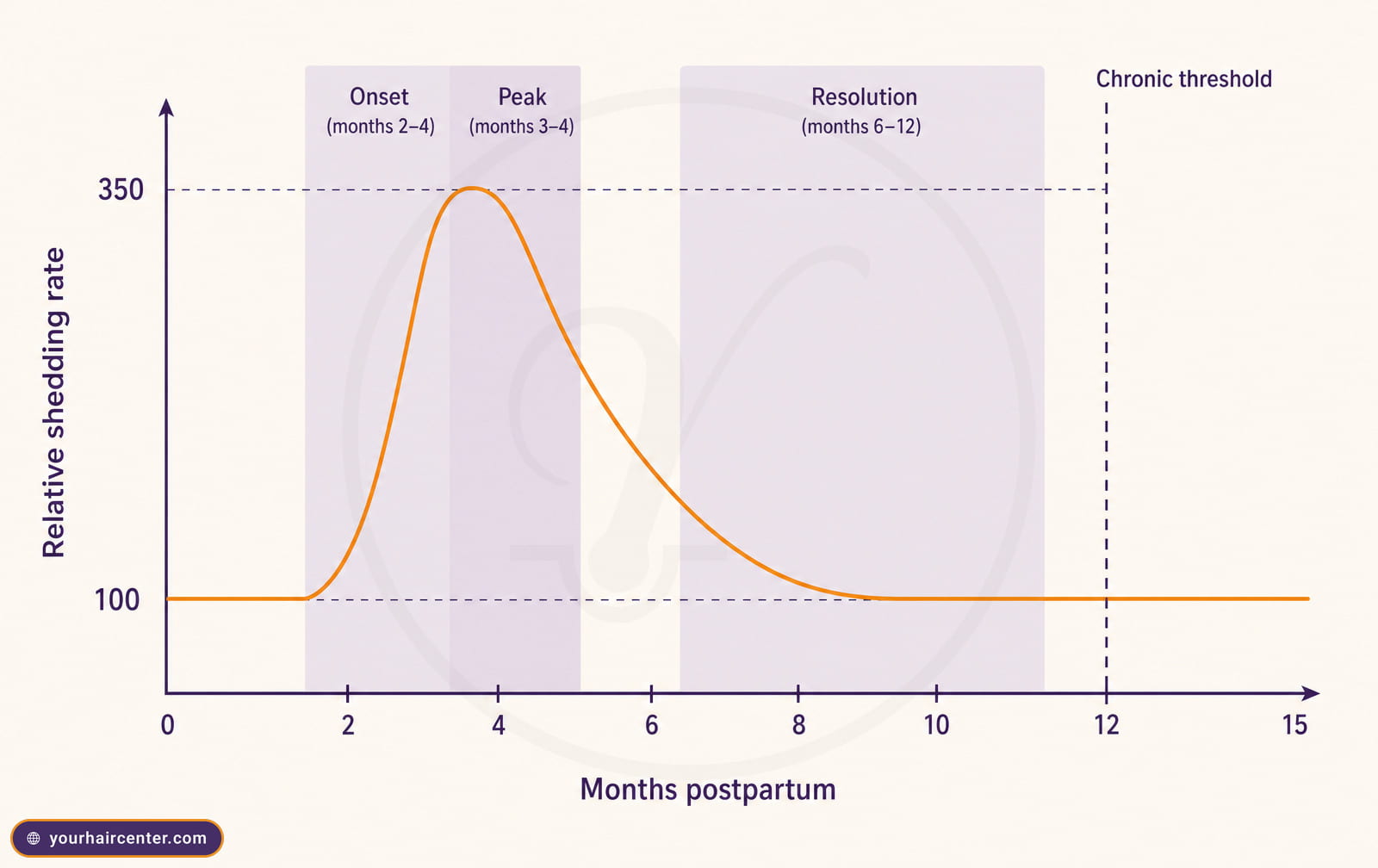
Postpartum hair loss follows a predictable arc, and knowing the milestones is the single most reassuring thing a new mother can carry into the experience. The major medical authorities converge on the same window, so the numbers below are well triangulated rather than one source’s estimate.
When does the shedding start? Months 2 to 4 is the typical onset
During pregnancy, elevated estrogen extends the growth (anagen) phase of the hair cycle and holds back the normal daily shedding, which is why so many women describe pregnancy hair as thick and full.[2] After delivery, estrogen falls sharply, and the follicles that were held in growth shift into the resting (telogen) phase more or less in unison. Those resting hairs are released a few weeks later, which is why postpartum hair loss does not begin at delivery. It begins after the lag, usually around the two-to-four-month mark.
When does the shedding peak? Around month 4 for most mothers
Both the American Academy of Dermatology and Cleveland Clinic place the peak at roughly four months postpartum.[1:1][3] At the peak, a heavily affected mother can shed several hundred hairs a day against a normal baseline closer to 50 to 100 a day. The visible patterns that worry mothers most arrive together around this time, with a fringe of short regrowing “baby hairs” along the frontal hairline, thinning at the temples, and a part-line that looks wider in the mirror. These are expected signs of synchronized postpartum shedding and regrowth, not signs that something has gone wrong.
When does the shedding stop? Months 6 to 12 for most, a little longer for some
When does postpartum hair loss stop for most mothers? The American Academy of Dermatology frames recovery as the return of normal fullness by about a child’s first birthday, and Cleveland Clinic similarly describes the shed stopping on its own within six months to a year.[1:2][3:1] A six-month recovery and a twelve-month recovery are both inside the normal range. Recovery time tends to track the severity of the peak rather than anything a mother did or did not do, so a heavier shed that takes longer to settle is not a sign of a failed postpartum hair loss treatment.
What “still shedding past 12 months” means clinically
If heavy shedding has not begun to taper by month 6, or fullness has not returned by month 12, the picture has likely shifted from acute postpartum telogen effluvium into chronic telogen effluvium territory, and the workup changes. This is the point where a clinical evaluation earns its place and where a supportive-only postpartum hair loss treatment is no longer sufficient on its own. Shedding after the first year is common enough that it deserves a direct answer, and the in-clinic section below addresses it head-on. For the deeper chronic workup, this guide pairs with the Telogen Effluvium Treatment guide, and a hair and scalp analysis is the cleanest way to confirm whether you have crossed the threshold.
Which postpartum hair loss treatment is safe while breastfeeding?
Whether you are breastfeeding changes which treatments are reasonable, and the difference is large enough that it should be the first thing you settle, so every postpartum hair loss treatment plan starts from that one question. The framing below maps the decision space so you can have an informed conversation with your OB, family doctor, or dermatologist. It is not a prescription, and every safety question here should be confirmed with the clinician who knows your full history and your infant.
The first decision, are you breastfeeding or not?
If you are not breastfeeding, the full landscape of FDA-approved topical and oral postpartum hair loss treatment options is available to you, subject to your physician’s clearance. If you are breastfeeding, the landscape narrows. Topical-only adjuncts applied to a limited scalp area are generally the starting point, and oral medications usually mean either pausing breastfeeding or choosing a non-pharmacological path instead. Settle this branch first, because it determines everything downstream.
Is topical minoxidil safe while breastfeeding?
As a postpartum hair loss treatment for nursing mothers, topical minoxidil has lactation evidence that is reassuring but conditional. The National Institutes of Health LactMed database states that maternal topical minoxidil is acceptable once breastfeeding is established, while cautioning that the infant should not come into contact with skin treated with minoxidil, because it can be absorbed and cause adverse effects such as excess hair growth.[4] In practice that means applying it to the scalp only, away from areas the baby touches, and letting it dry fully. Even with that reassurance, manufacturer labeling and many dermatologists and OBs still err conservatively and prefer to wait until weaning. This guide presents the evidence and the genuine variability in clinical opinion rather than issuing a verdict; the call belongs with your clinician.
Oral minoxidil, finasteride, and spironolactone while breastfeeding, the documented “no”
This is the cleanest branch in the tree. Oral minoxidil, finasteride, and spironolactone are not postpartum hair loss treatment options to start while breastfeeding without specialist clearance, given their systemic absorption and the anti-androgenic mechanisms involved. Finasteride carries a broader restriction that has nothing to do with breastfeeding. The FDA prescribing information states it is contraindicated in women who are or may become pregnant, because blocking the hormone it targets can harm the development of a male fetus.[5] For that reason finasteride is not part of the women’s protocol at all. Treat this branch as a firm stop unless a specialist who knows your case says otherwise.
Do caffeine, peptide serums, or rosemary oil help?
These sit in a low-risk, limited-evidence lane. Topical caffeine and peptide serums have some published support for reducing shedding in non-postpartum populations and are generally considered low concern during breastfeeding given their negligible systemic absorption when applied topically. Rosemary oil has one frequently cited 2015 randomized trial that compared it against 2 percent minoxidil over six months in androgenetic alopecia and found broadly comparable hair-count outcomes, with less scalp itching in the rosemary arm.[6] None of these is a primary postpartum hair loss treatment for a heavy shed, and the article frames them as reasonable, low-risk adjuncts to clear with your OB rather than as the answer on their own.
Which supplements help postpartum hair loss?
Supplements are where most mothers look first, and the honest answer is that they work as a postpartum hair loss treatment only when they correct a real deficiency and do little when they do not. A postnatal multivitamin prescribed by your OB is the sensible baseline. Iron makes sense if your iron stores are low, vitamin D makes sense if your 25-OH vitamin D is low, and both of those are best decided from the blood panel in the next section rather than guessed at. Biotin deserves a specific caution. It is widely marketed for hair but is only useful in the rare case of true biotin deficiency, and at high supplement doses it can distort laboratory results, including thyroid and cardiac troponin tests, which the FDA has warned about directly.[7][8] If you are about to have a thyroid panel run, tell the lab you take biotin, or pause it beforehand.
For mothers whose deficiency picture is the main driver, Your Hair Center’s specialists can deliver targeted nutrients directly to the scalp through mesotherapy nutrient cocktails customized to the postpartum window. For those past the typical window, the next postpartum hair loss treatment step is finding out why the shed has not settled, which is what the blood panel below is for.
Which blood tests to ask your doctor for
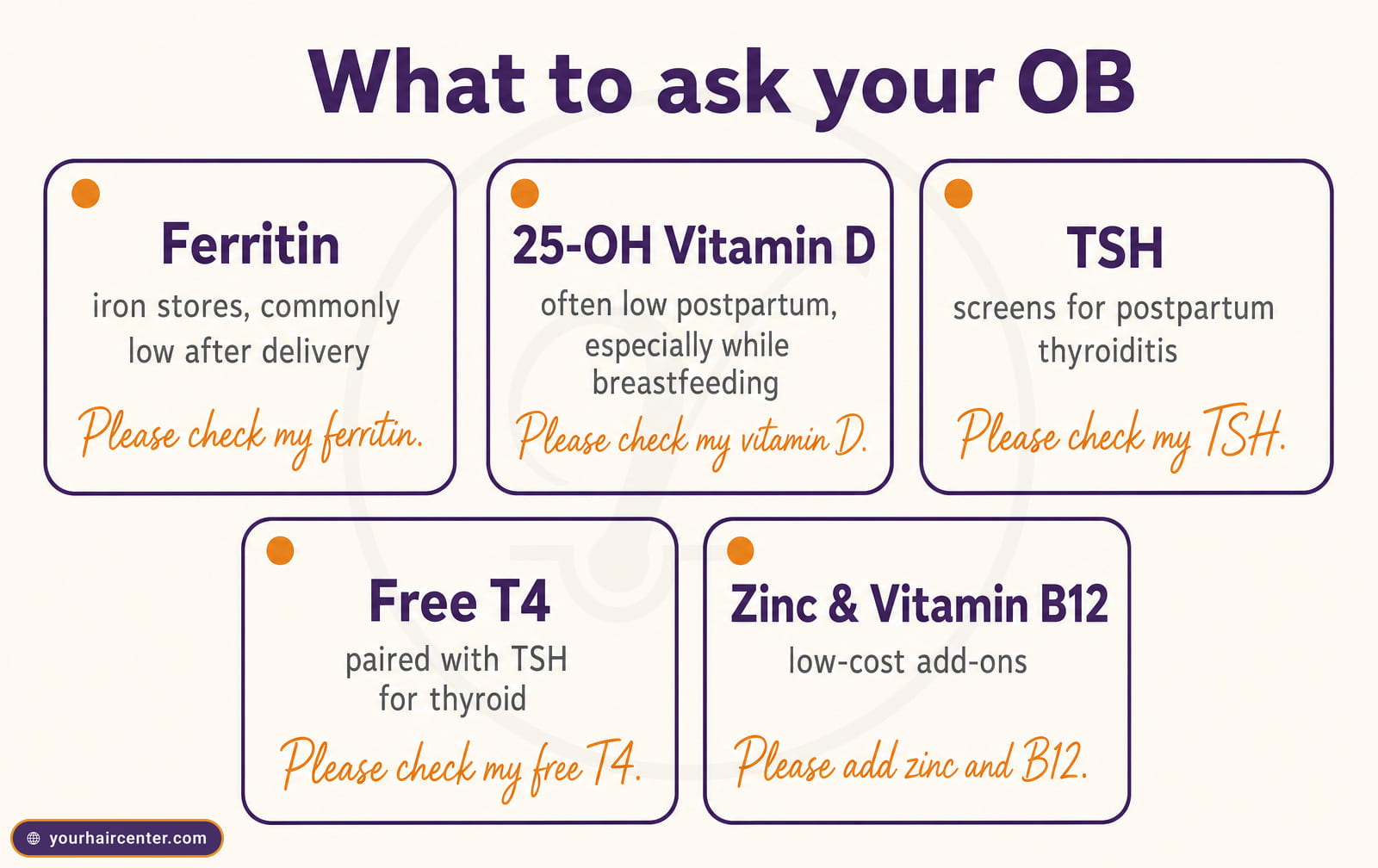
A blood panel is one of the most useful steps in postpartum hair loss treatment, and it starts with walking into your appointment with a named list of tests to ask about. Thyroid often gets a passing mention without a named panel to request, and that gap is exactly where treatable causes get missed. The list below is something you can screenshot and bring with you.
The five lab markers worth asking about
- Ferritin. This reflects iron stores, which are commonly depleted after pregnancy and delivery blood loss. Low iron stores are a recognized contributor to diffuse shedding. The exact ferritin level at which hair is affected is debated in the literature, so treat any single number you see online as commonly cited rather than a hard cutoff, and let your doctor interpret it alongside the rest of the panel.
- 25-OH vitamin D. Postpartum vitamin D depletion is common, especially in breastfeeding mothers, and correcting a low level is low-risk and worthwhile on its own merits.
- TSH and free T4. This pair screens for postpartum thyroiditis, the panel item that matters most because it has a specific treatment. Postpartum thyroiditis affects roughly 4 to 7 percent of mothers in the first year after delivery, and its incidence peaks at about two to five months postpartum, overlapping almost exactly with the postpartum hair loss peak.[9]
- Zinc and vitamin B12. Less often the primary driver, but inexpensive to include in the same draw and reasonable to check while the needle is already in.
Why thyroid is the panel item to insist on
Postpartum thyroiditis is missed often because its symptoms, fatigue, mood changes, weight shifts, and hair shedding, overlap almost entirely with the normal postpartum experience, so it is easy to attribute everything to “just being a new mom.” Many women never get a TSH check unless they specifically ask for one, which is how a treatable cause of postpartum hair loss gets missed. A simple script helps. Tell your doctor you want to rule out postpartum thyroiditis as a cause of your shedding. Because the condition has a defined treatment and a recovery that the hair follows, it is the one item on the panel worth insisting on before any postpartum hair loss treatment begins.
How to interpret a normal panel
A normal panel is good news, not a dead end. It means the common reversible contributors have been ruled out and that the postpartum hair loss is most likely the expected telogen effluvium, which is self-limiting. This framing matters because a mother who hears “your labs are normal” can feel dismissed, when in fact a clean panel is permission to continue the supportive postpartum hair loss treatment with confidence and to stop worrying that a hidden deficiency is being missed.
When to push for a dermatology or trichology referral
Escalate when the supportive postpartum hair loss treatment plan is clearly being outrun. Reasonable triggers are shedding severe enough that the scalp shows through the part line, daily shedding that stays heavy past month 6, no sign of tapering by month 9 to 12, or a thyroid or iron abnormality that is not normalizing on treatment. At that point the next step is a dermatology consult with a scalp examination, which a hair and scalp analysis appointment provides, and the in-clinic options in the next section come into view.
Postpartum hair loss treatment when shedding lasts past 12 months
This section is for the minority of mothers whose postpartum hair loss has crossed the twelve-month line without recovering, or whose labs are normal but whose shedding is severe and persistent. It is explicitly not for the four-month-postpartum mother in the typical window, who should stay with the supportive plan and let the timeline do its work. If you are early in the arc, save this section for later rather than seeking treatment you do not yet need. For the chronic subset, an effective postpartum hair loss treatment starts with finding the real cause of the long shed, such as low iron, a thyroid problem or genetic loss that the shedding has unmasked, and each option below has a narrow, defined role in that plan.
Is PRP a treatment for postpartum shedding?
PRP hair plasma uses a concentrate of your own platelets, injected into the scalp to deliver growth factors, and its evidence comes from androgenetic alopecia rather than from postpartum or other telogen shedding.[10] PRP is not a postpartum hair loss treatment, because the postpartum shed settles once the hormonal trigger has passed, and no study shows that PRP shortens that clock. PRP enters the picture only when the workup finds female-pattern loss that the shedding had been hiding, the case described in the transplant section below. Our specialists then treat the pattern loss with a course of three to six sessions, two to four weeks apart, and maintenance every four to six months.
Mesotherapy with custom nutrient cocktails
Mesotherapy delivers a tailored cocktail of vitamins, minerals, and amino acids directly into the scalp through micro-injections, which pairs cleanly with the deficiency-driven postpartum case identified by the blood panel. Breastfeeding compatibility depends on what is in the cocktail, so for nursing mothers the clinical team reviews and adapts the ingredient list to breastfeeding-safe components in advance rather than using a default mix. This is the modality that maps most directly onto a “labs show a deficiency, deliver the correction where it is needed” logic. A course runs six to eight sessions, one to two weeks apart, and less shedding usually shows after one to two months, while the deficiency itself is still corrected by your doctor. The mesotherapy program builds this postpartum hair loss treatment around that customization.
Low-level light therapy (LLLT), the fully breastfeeding-safe adjunct
LLLT is the cleanest postpartum hair loss treatment in the in-clinic stack for a nursing mother because it involves no drug, no injection, and no systemic exposure. It uses low-level light to stimulate the scalp, and there are FDA-cleared in-clinic and at-home devices for hair growth. The photobiomodulation mechanism is well characterized, the evidence base is strongest in androgenetic alopecia, and it layers comfortably alongside mesotherapy as a maintenance adjunct. For a mother who wants to do something active while staying entirely clear of systemic exposure, LLLT laser hair treatment is the natural choice.
Are exosomes used for postpartum shedding that does not stop?
Exosome therapy delivers stem-cell-derived signaling content into the scalp, with promising but limited evidence, and no study supports it for postpartum or other telogen shedding. A long postpartum shed that does not settle is a reason to look again for the cause, such as low iron, a thyroid problem or genetic loss that the shedding has unmasked, rather than to add a costlier injection. Where exosomes are discussed at all, it is as an add-on to a working plan for early to moderate pattern loss, never as the next step for a shed that has not stopped.
When, rarely, a transplant becomes the right answer
The vast majority of postpartum mothers will never need a transplant as part of their postpartum hair loss treatment, and it is worth saying that plainly. The narrow exception is the mother whose postpartum shedding has unmasked an underlying female-pattern hair loss that was present before pregnancy and would have surfaced regardless. In that specific picture, continuing a medical postpartum hair loss treatment indefinitely is not the answer, and the right route is the Women’s Hair Transplant program using the unshaven U-FUE transplant technique, which restores density without shaving the surrounding hair. If you are unsure which group you fall into, the simplest next step is a free consultation on WhatsApp.
When postpartum hair loss is not postpartum hair loss
Not every shed that happens after a baby is postpartum telogen effluvium. A handful of other conditions overlap with the postpartum timeline, and mistaking one of them for ordinary postpartum shedding can cost a mother months of “wait it out” reassurance that does not apply. Each of the following has a different distinguishing signal and calls for something other than standard postpartum hair loss treatment.
Chronic telogen effluvium that began before pregnancy
A mother who was already shedding heavily for months or years before conceiving, who improved during pregnancy thanks to the estrogen-driven growth phase, and who then resumed her old baseline after delivery is not experiencing new postpartum hair loss. She is seeing pre-existing chronic telogen effluvium re-emerge. The distinguishing signal is the temporal history, the memory of shedding before the pregnancy, and the next step is the chronic workup covered in the Telogen Effluvium Treatment guide.
Female-pattern hair loss unmasked
A mother whose part line has been slowly widening for years, who went through the usual postpartum shed, and whose density never returned to the pre-pregnancy baseline by month 12 to 15 may be seeing female-pattern hair loss surface. The distinguishing signal is central-scalp widening rather than even, all-over shedding, and a family history of female-pattern thinning makes it more likely. The pathway here is distinct from postpartum hair loss treatment and may include topical minoxidil 2 percent, anti-androgen therapy in selected cases after weaning, and, where appropriate, the Women’s Hair Transplant program.
Postpartum thyroiditis-driven shedding
Named already in the blood-panel section, it earns a place here too among the postpartum hair loss mimics. The distinguishing signal is an abnormal TSH on the panel, the next step is endocrinology evaluation and thyroid-specific treatment, and the hair recovery follows the thyroid recovery rather than the postpartum clock.
Iron-deficiency-driven shedding
The distinguishing signal of this postpartum hair loss driver is low ferritin on the panel, with or without anemia on a complete blood count. The postpartum hair loss treatment here is iron repletion guided by your OB or family doctor, and the hair recovery follows the recovery of iron stores over a span of months rather than weeks.
Frequently asked questions about postpartum hair loss treatment
What is the best treatment for postpartum hair loss?
The best postpartum hair loss treatment is a tiered plan matched to your timeline. In months 3 to 6 it is supportive: gentle scalp care, nutrition, and breastfeeding-safe topical adjuncts. From month 6, add a clinical evaluation if heavy shedding has not begun to taper, and by month 12 a full workup if it persists. If you are nursing, keep the plan to breastfeeding-safe options, which you can send your photos for a free evaluation to map.
Will postpartum hair loss grow back?
For most mothers, yes, without any postpartum hair loss treatment beyond supportive care. The shed is self-limiting, and the American Academy of Dermatology describes postpartum hair loss regaining its normal fullness by about a child’s first birthday, with a six-to-twelve-month recovery being typical and a slightly longer recovery still within range.[1:3] A small minority cross into chronic territory past twelve months and benefit from a clinical evaluation, which is when a tapering check and a scalp examination become worthwhile.
How to control postpartum hair loss?
Postpartum hair loss treatment at home comes down to three things you actually control. Optimize nutrition by staying on your postnatal vitamin and correcting low iron or vitamin D if labs show a deficiency. Be gentle with the scalp, favoring loose styles over high-tension ponytails and avoiding aggressive chemical treatments during the shedding window. And raise it with your OB if shedding is severe or if you have any thyroid symptoms, so a panel can be run early rather than after months of guessing.
What vitamins are good for hair loss after pregnancy?
Start with the postnatal multivitamin as a baseline, then add targeted supplements only where a blood panel shows a real shortfall, meaning iron for low ferritin and vitamin D for a low 25-OH level. Biotin helps only in the rare case of true deficiency, and at high doses it can interfere with thyroid and cardiac lab tests, so mention it before any blood draw.[7:1] Supplements support postpartum hair loss treatment by correcting deficiencies; they do not override the hormonal timeline.
Are there hair loss treatments that are safe while breastfeeding?
Several. Breastfeeding-safe postpartum hair loss treatment options include topical minoxidil 5 percent used on the scalp only with the caveats above, topical caffeine and peptide serums, rosemary oil, and low-level light therapy.[4:1] The contraindicated lane is oral minoxidil, finasteride, and spironolactone, which should not be started while nursing without specialist clearance.[5:1] The right choice depends on your history, so route it through your OB or dermatologist.
Choosing a postpartum hair loss treatment for your stage
Postpartum hair loss runs on a clock you can mostly trust. It starts two to four months after delivery, peaks around month four, and for most mothers resolves on its own within six to twelve months. The point of a real postpartum hair loss treatment is what to do rather than only what to wait for. Support recovery with gentle care and sensible nutrition, ask your doctor for the ferritin, vitamin D, and thyroid panel so the treatable causes are not missed, and keep any medication choices inside the breastfeeding-safe lane while you are nursing. The one cue that changes everything is time. If you are still shedding without any tapering past month 12, or your panel flags a thyroid or iron problem, your postpartum hair loss treatment shifts from patience to clinical intervention.
If you are past that twelve-month mark, or you have thyroid-symptom red flags alongside the shed, the most direct next step is a free WhatsApp evaluation for postpartum shedding. You can also explore the full Hair Treatments category overview or read the broader Hair Loss Treatment hub to see where postpartum hair loss fits among the other causes. Your Hair Center is a medical tourism center in Istanbul that works through accredited partner clinics and hospitals, and its team reads every photo evaluation and tailors the postpartum hair loss treatment to your stage rather than handing out a one-size protocol.
References
- American Academy of Dermatology, “Hair loss in new moms.” https://www.aad.org/public/diseases/hair-loss/insider/new-moms (opens in new tab) ︎ ︎ ︎ ︎
- Johns Hopkins Medicine, “Postpartum Hair Loss.” https://www.hopkinsmedicine.org/health/wellness-and-prevention/postpartum-hair-loss (opens in new tab) ︎
- Cleveland Clinic, “Postpartum Hair Loss.” https://my.clevelandclinic.org/health/diseases/postpartum-hair-loss (opens in new tab) ︎ ︎
- National Institutes of Health, Drugs and Lactation Database (LactMed), “Minoxidil.” https://www.ncbi.nlm.nih.gov/books/NBK501032/ (opens in new tab) ︎ ︎
- U.S. Food and Drug Administration, finasteride (Propecia) prescribing information. https://www.accessdata.fda.gov/drugsatfda_docs/label/2013/020788s022lbl.pdf (opens in new tab) ︎ ︎
- Panahi Y, et al. “Rosemary oil vs minoxidil 2% for the treatment of androgenetic alopecia: a randomized comparative trial.” Skinmed. 2015. https://pubmed.ncbi.nlm.nih.gov/25842469/ (opens in new tab) ︎
- U.S. Food and Drug Administration, “Biotin Interference with Troponin Lab Tests.” https://www.fda.gov/medical-devices/in-vitro-diagnostics/biotin-interference-troponin-lab-tests-assays-subject-biotin-interference (opens in new tab) ︎ ︎
- National Institutes of Health Office of Dietary Supplements, “Biotin Health Professional Fact Sheet.” https://ods.od.nih.gov/factsheets/Biotin-HealthProfessional/ (opens in new tab) ︎
- U.S. National Library of Medicine, Endotext, “Postpartum Thyroiditis.” https://www.ncbi.nlm.nih.gov/books/NBK278999/ (opens in new tab) ︎
- Gupta AK, Carviel JL. Meta-analysis of efficacy of platelet-rich plasma therapy for androgenetic alopecia. J Dermatolog Treat. 2017. https://pubmed.ncbi.nlm.nih.gov/27152474/ (opens in new tab) ︎
