Does LLLT work for hair loss? For early androgenetic alopecia with viable follicles, low-level laser therapy delivers measurable density gains in peer-reviewed trials. This clinical FAQ answers the questions that decide outcomes, who responds, how it compares to minoxidil and PRP, how long it takes, the side effects, and how to use it correctly. Every claim is cited, with a clear path to a scalp evaluation that maps your candidacy.
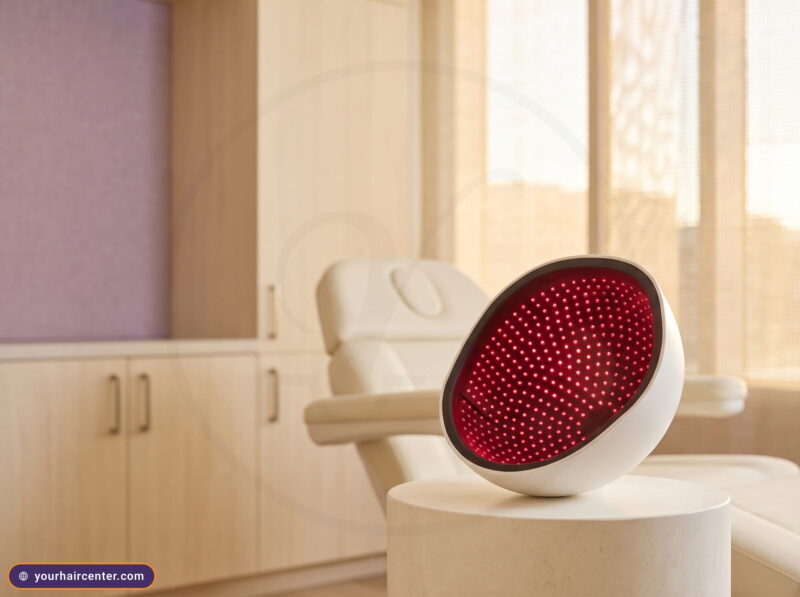
Does LLLT work for hair loss? Yes, with an important qualifier. For androgenetic alopecia caught early, where miniaturized but living follicles still populate the thinning zone, pooled randomized trials show that low-level laser therapy delivers a statistically significant density gain over sham treatment.[1] The question that actually decides outcomes is not whether the therapy works, but for whom, with what plan, and with what consistency. This clinical FAQ answers the ten questions the informed patient is searching, every claim cited, no laser-101 padding. If you arrived using the consumer term, the companion guide to whether red light therapy works for hair loss covers the same ground in plainer language.
Does it regrow hair, or just slow shedding?
It does both. The therapy reduces active shedding within the first weeks and, over months, stimulates regrowth from dormant follicles. The two effects share one mechanism, photobiomodulation, where 650nm light is absorbed by follicle cells and lifts mitochondrial energy output, pushing follicles back into an active growth phase.
The clinical picture is consistent. A meta-analysis pooling eight studies across eleven double-blind randomized controlled trials found a significant increase in hair density for laser-treated scalps versus sham devices.[1:1] A separate 26-week multicenter trial measured terminal density gains of roughly 18 to 26 hairs per square centimeter against far smaller sham gains.[2] The magnitude depends on follicle viability and how consistently the protocol is followed. You can map your candidacy through the supervised laser program in Istanbul or the broader hair loss treatment workup.
Does LLLT work as well as minoxidil?
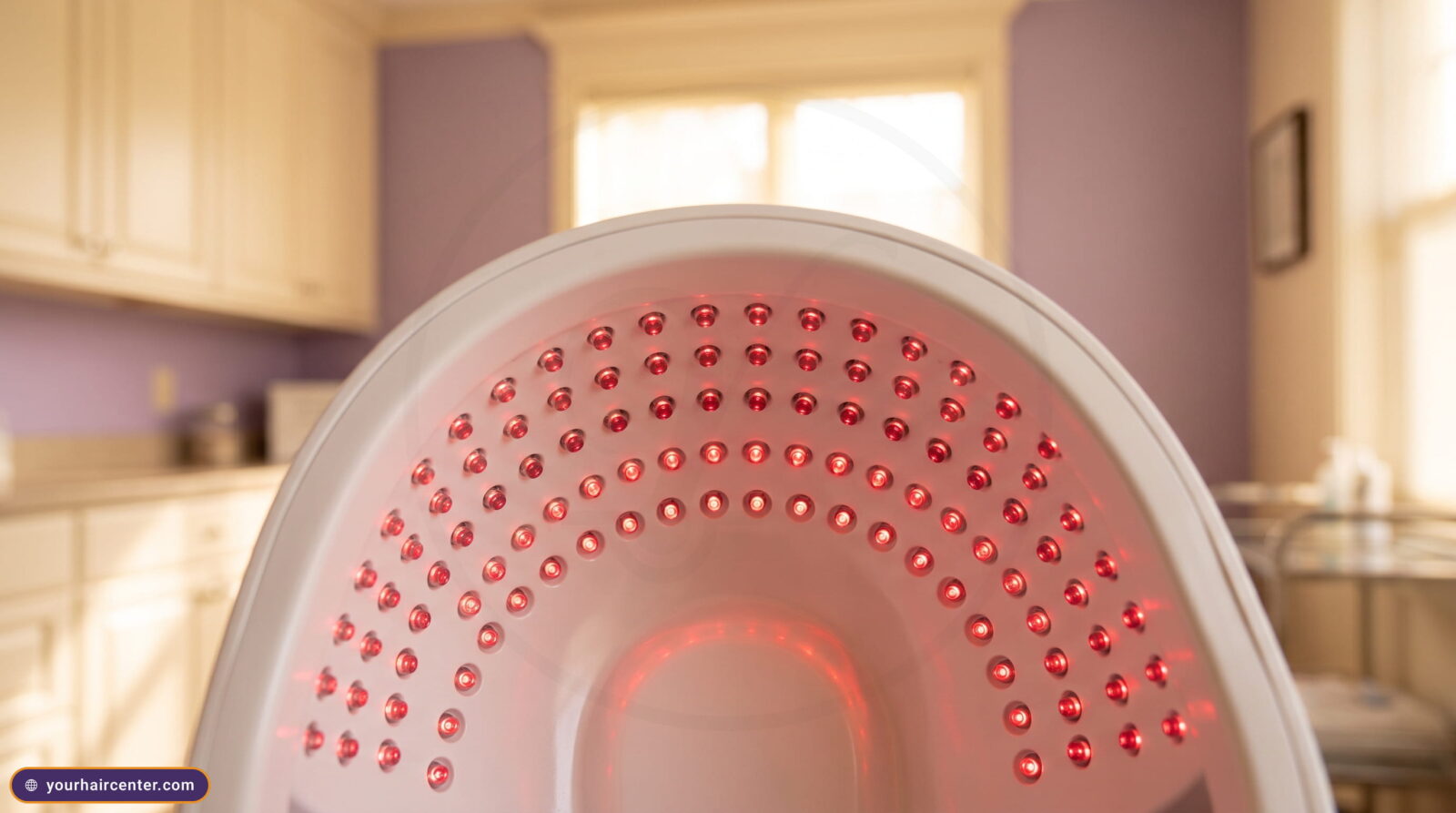
For early-stage androgenetic alopecia, the honest answer is that the therapy and topical minoxidil each beat placebo for hair growth in men in a meta-analysis of randomized trials,[3] and the American Academy of Dermatology describes a study in which laser worked as well as minoxidil, with the best results in patients who used both.[4] They work through entirely different mechanisms, and they stack rather than compete. Minoxidil is a daily topical that prolongs the growth phase; the laser is a light-based stimulus with no systemic absorption and no scalp medication to apply.
The trade-offs split cleanly. Minoxidil is well-studied and available without a prescription in the US, but it requires daily application and carries a dose-dependent risk of scalp irritation, the specifics of which belong to the FDA product label rather than a number invented here. The laser has no systemic absorption and no medication-driven irritation, but it asks for a session-time commitment. Crucially, the literature suggests minoxidil, finasteride, and the light therapy may act synergistically when combined rather than swapped.[5] If you are weighing the early-shedding question, the minoxidil shedding phase explainer is the better deep-dive, and the LLLT program at Your Hair Center can be planned alongside it.
Does LLLT work for women?
Yes. It is FDA-cleared for female-pattern hair loss, with the first laser comb cleared for men in 2007 and for women in 2011,[5:1] and clearances have since multiplied across caps and helmets, with indications covering both sexes.[6] In the controlled trials, female cohorts recorded terminal-density gains in the same range as the male cohorts.[2:1]
For women, the practical advantages matter as much as the numbers. It is non-surgical, requires no shaving, and leaves no marks. The caveat is that female hair loss frequently has a driver underneath the pattern, postpartum telogen effluvium, perimenopausal shedding, thyroid or iron status. Laser therapy addresses the follicle’s response, not the root cause, so the underlying driver must be evaluated first. The right starting point is a hair and scalp analysis that maps Ludwig stage and screens for telogen effluvium drivers, feeding into the broader hair loss treatment evaluation.
Does LLLT work for Norwood 3+?
This is the candidacy edge, and it deserves a straight answer rather than a sales pitch. Efficacy is best documented for Norwood 1 to 3 in men and Ludwig I to II in women, the stages where miniaturized but still-living follicles dominate the recession zone and have something to reactivate.
At Norwood 3V to 4, the response is reduced but real. This is where a combination approach earns its place, pairing laser with PRP hair treatment and mesotherapy for hair as a common non-surgical stack. From Norwood 5 to 7, the vertex follicles are largely dormant or gone, and no amount of light can create a follicle that no longer exists. There the appropriate conversation is transplant evaluation, with the therapy shifting to a supporting role; the protocol for red light therapy after a hair transplant covers that adjunct use.
How long until results show?
Response unfolds in stages across roughly six months, not overnight. Months one to two bring reduced shedding as follicles re-enter the growth phase. Months three to four are when fine new hairs emerge at the recession zones and existing shafts begin to thicken. Months five to six deliver the density gains visible to the naked eye.
These milestones follow our specialists’ program timeline, and the controlled trials measured density gains at 16 and 26 weeks.[2:2] The single variable that decides whether you land on the favorable end of the curve is consistency. Missed weeks flatten the response. After the main program, our specialists use a once-monthly maintenance session to preserve the gain. For the trial evidence in plainer language, see whether red light therapy works for hair loss.
Are the results permanent?
No treatment for androgenetic alopecia is permanent, because the condition itself is chronic and progressive. Laser therapy is a management protocol, not a cure. What it delivers is durable as long as the maintenance schedule continues.
The model is plateau-and-maintain. After the main program of 24 to 36 sessions, a monthly maintenance session holds the density you gained. Stop entirely and the follicle response gradually resets toward baseline, with shedding tending to return over six to twelve months. For patients who want a one-and-done restoration and still have viable donor follicles, a transplant is the more permanent route; the therapy is the right tool when the goal is preserving the hair you still have, which is why the LLLT maintenance program at Your Hair Center is built around ongoing visits rather than a single course.
LLLT vs PRP vs finasteride, which is best?
There is no single winner, because these treatments work at different points in the hair-loss cascade and are complementary rather than competing. The best choice depends on your Norwood stage, your tolerance for systemic medication, and your budget.
It is non-systemic photobiomodulation, with no sexual side effects and no medication to absorb. PRP uses growth factors concentrated from your own blood, injected to activate follicle stem cells, and it is often paired with the laser, although no controlled trial has tested the pair and researchers still describe it as an idea under consideration.[7] Finasteride works upstream, inhibiting the conversion of testosterone to the DHT that drives genetic hair loss; it is prescription-only in the US and UK, and its side-effect profile belongs to the FDA label rather than a figure asserted here. The community "big 3" shorthand, finasteride plus minoxidil plus a stimulus like laser or microneedling, is informal patient language, not a formal protocol. Our specialists’ usual combination is laser plus PRP plus mesotherapy, coordinated within the broader hair loss treatment program.
Are there LLLT side effects?
Yes, but they are mild and short-lived. In the largest trial in a review of ten randomized trials, 5.1% of treated users reported dry skin, 2.5% pruritus, and 1.3% each scalp tenderness, mild irritation and a warm sensation; across the trials, most side effects resolved within two weeks and none was severe.[8] One detail worth expecting is a brief uptick in shedding in the first weeks, which precedes regrowth rather than signaling failure.[8:1]
There are real contraindications to clear with a clinician first, including a history of skin cancer on the scalp, head, or neck, certain photosensitizing medications, and pregnancy as a precaution. As for whether you can overdo it, more sessions do not add benefit past the protocol and simply waste time. The full safety picture lives in the dedicated laser cap side-effects deep-dive.
How do you use LLLT correctly?
There are two valid delivery modes, and each has its own cadence. Our specialists’ supervised protocol runs 24 to 36 sessions over six months, starting at two to three sessions per week, tapering to weekly by month three and monthly by month six, with each session lasting 20 minutes and the dose adjusted to your scalp condition and combination plan.
A consumer cap or helmet follows a different rhythm, typically several short sessions a week, as its clearance specifies, sustained for at least six months before judging the response. Consistency is exactly where most consumer-device reviews fall apart. The decision pivot is straightforward. A cap is defensible for Norwood 1 to 2 with disciplined daily use, while Norwood 3 and beyond usually need a combination plan and follow-up, which a supervised protocol provides. Either way, the sensible first step is a hair and scalp analysis to confirm candidacy, then a structured plan through the clinical laser program.
What do Reddit and review forums say about LLLT?
Anecdotal reports on hair-loss forums broadly mirror the clinical evidence. Positive responders cluster around early-stage genetic loss treated with disciplined, daily consistency, while disappointed reviewers cluster around inconsistent use or more advanced loss treated with a home device alone.
The important caveat is one of credibility. Forum threads are a useful reader resource for setting expectations, but they cannot stand behind a clinical claim, so this article cites the underlying randomized trials rather than the threads themselves. The pattern the forums describe is the same one the trials quantify, that response depends on candidacy, device tier, and consistency. Those are precisely the variables a supervised protocol manages on your behalf, which is the core argument for evaluating the LLLT program at Your Hair Center rather than self-prescribing a cap.
The bottom line for the informed patient
LLLT works for androgenetic alopecia when three conditions line up. The first is viable follicles in the Norwood 1 to 3 or Ludwig I to II range; the second is the right plan for the stage; the third is six or more months of consistent dosing. No trial has compared in-office and home devices head to head, so what a supervised program adds past early thinning is dose discipline, follow-up and combination treatment. The right next step is a scalp evaluation that maps your candidacy and frames the protocol against your goals. Map your LLLT candidacy with a free scalp evaluation, ask whether LLLT fits your hair-loss profile, or start with a hair and scalp analysis at Your Hair Center.
References
-
Liu KH, Liu D, Chen YT, Chin SY. Comparative effectiveness of low-level laser therapy for adult androgenic alopecia: a systematic review and meta-analysis of randomized controlled trials. Lasers in Medical Science, 2019. https://pubmed.ncbi.nlm.nih.gov/30706177/ (opens in new tab) ︎ ︎
-
Jimenez JJ, Wikramanayake TC, Bergfeld W, et al. Efficacy and safety of a low-level laser device in the treatment of male and female pattern hair loss: a multicenter, randomized, sham device-controlled, double-blind study. American Journal of Clinical Dermatology, 2014. https://pmc.ncbi.nlm.nih.gov/articles/PMC3986893/ (opens in new tab) ︎ ︎ ︎
-
Adil A, Godwin M. The effectiveness of treatments for androgenetic alopecia: a systematic review and meta-analysis. Journal of the American Academy of Dermatology, 2017. https://pubmed.ncbi.nlm.nih.gov/28396101/ (opens in new tab) ︎
-
American Academy of Dermatology. Is red light therapy right for your skin? https://www.aad.org/public/cosmetic/safety/red-light-therapy (opens in new tab) ︎
-
Munck A, Gavazzoni MF, Trüeb RM. Use of Low-Level Laser Therapy as Monotherapy or Concomitant Therapy for Male and Female Androgenetic Alopecia. International Journal of Trichology, 2014. https://pmc.ncbi.nlm.nih.gov/articles/PMC4154149/ (opens in new tab) ︎ ︎
-
Wang S, Seth D, Ezaldein H, et al. Shedding light on the FDA’s 510(k) approvals process: low-level laser therapy devices used in the treatment of androgenetic alopecia. Journal of Dermatological Treatment, 2019. https://pubmed.ncbi.nlm.nih.gov/30252550/ (opens in new tab) ︎
-
Hamblin MR. Photobiomodulation for the management of alopecia: mechanisms of action, patient selection and perspectives. Clinical, Cosmetic and Investigational Dermatology, 2019. https://pmc.ncbi.nlm.nih.gov/articles/PMC6737896/ (opens in new tab) ︎
-
Egger A, Resnik SR, Aickara D, et al. Examining the safety and efficacy of low-level laser therapy for male and female pattern hair loss: a review of the literature. Skin Appendage Disorders, 2020. https://pmc.ncbi.nlm.nih.gov/articles/PMC7548873/ (opens in new tab) ︎ ︎
