Does red light therapy work for hair loss, or is it a wellness purchase you will regret? This is a peer-reviewed-style guide to whether laser therapy actually regrows hair, who it works for, and where it fails. We survey the randomized-trial evidence, separate what the device does from what a supervised program adds, and map a Norwood-stage verdict matrix so you can see what to realistically expect for your stage of loss before you spend a dollar or book a trip.
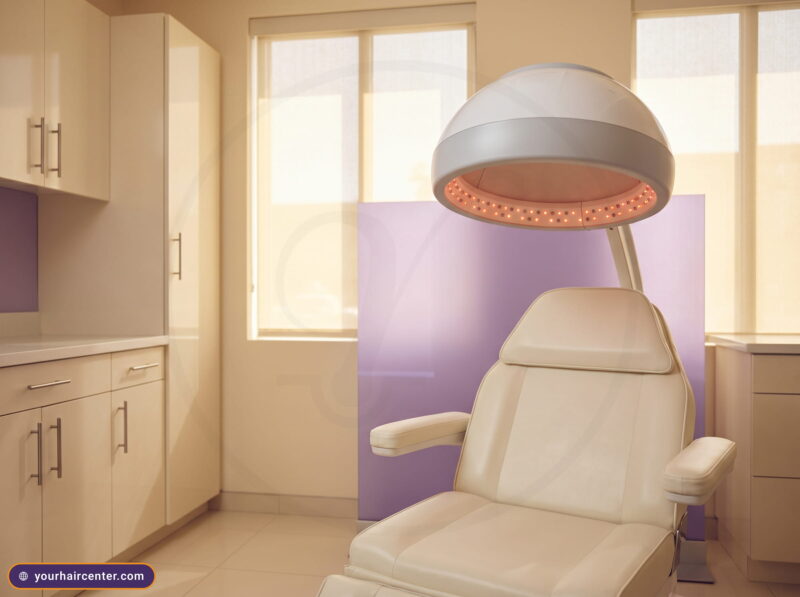
Does red light therapy work for hair loss? For many people with early genetic thinning, yes, and the gain is moderate. In sham-controlled trials of home-use 655 nm helmets, hair counts rose 35 to 39% more than sham in men and 37% more in women over 16 weeks,[1][2] but the light cannot revive follicles that are already gone. This guide reads like a peer-reviewed digest, not a sales page. It walks the four things that actually decide your result, the mechanism, the randomized-trial evidence, what a supervised program adds over a home device, and a Norwood-stage verdict matrix you can map yourself onto, so you can tell whether laser therapy is real medicine for your case or a wellness purchase you will regret.
The Short Answer to Does Red Light Therapy Work for Hair Loss
Red light therapy works for hair loss when three conditions line up. The follicles have to still be alive, the device has to deliver enough light to actually reach them, and you have to use it consistently, several times a week for months. Hit all three and the published data supports it. Miss any one and you join the long tail of disappointed reviews. The best-known figures come from the home-use helmet trials above, where treatment ran every other day for 16 weeks.
That headline matters less than the mechanism behind it. Low-level laser therapy (LLLT), the clinical name for what is marketed as red light therapy or photobiomodulation, is cleared by the US Food and Drug Administration for hair growth through its 510(k) device process, with clearances growing steadily since 2007 and indications later expanding to cover both men and women, though the authors of that review warn that the marketed indications have not been adequately explored.[3] It does not create new follicles. It wakes up and strengthens follicles that are miniaturizing but still present, which is why candidate selection is the whole game.
This is also why online reviews are so mixed. They come from people with different causes and stages of hair loss, using different devices for different lengths of time, with no control group, so they cannot tell you what the light itself did. The rest of this guide unpacks the four things that decide your result, the biology, the trial evidence, what supervised non-surgical laser therapy programs add over a home device, and a stage-by-stage verdict matrix. If you are early in your research, a scalp and follicle evaluation is the step that tells you which group you fall into.
How Photobiomodulation Stimulates Hair Follicles
The mechanism is well characterized, which is part of why this is treated as medicine rather than a fad. Red light around 650 nm travels only a few millimeters into skin, and modeling work puts the point where red light is extinguished at about 4 to 5 mm beneath the surface.[4] Hair and pigment absorb part of it on the way, which is why devices deliver it close to the scalp.
Once the photons reach the follicle, the mitochondria absorb them, which increases electron transport, oxygen consumption and the synthesis of ATP, the cell’s energy currency.[5] More available energy is thought to push dormant follicles back into an active growth cycle. The effect on the hair cycle has been measured in the laboratory. In a study of human follicles kept alive in culture, follicles exposed to 650 nm light stayed in the anagen growth phase for 8 days versus 6 days in untreated controls, and a larger share remained in anagen on day 8, 45.8% versus 33.3%, alongside higher expression of Wnt pathway genes that drive follicle-cell proliferation.[6]
Two more effects are proposed in parallel. Scalp microcirculation improves, so nutrients and oxygen reach the follicle more efficiently, and the photobiomodulation signal nudges miniaturized follicles toward producing thicker shafts. None of this is the same process as laser hair removal, which is worth saying plainly because the names confuse people. Hair removal uses a different wavelength at high energy to destroy the follicle. Photobiomodulation uses low-energy light to stimulate it. Different wavelength and energy, opposite intent. For the protocol detail, see the underlying photobiomodulation protocol our specialists run.

What the RCT Evidence Actually Shows
Here is the citation-dense part the skeptical reader came for. Start with the mechanism. The 650 nm follicle study did not just count hairs, it sequenced the follicles’ RNA and found changes in cell-cycle and growth-signaling genes alongside the longer anagen phase.[6:1] It was a laboratory study with six follicles per group, so it gives the clinical findings a plausible biological engine rather than proof that density improves in patients, which is still more than most wellness treatments can claim.
On the clinical side, randomized controlled trials with sham-device control arms are the gold standard, and they exist for LLLT. The sham arm matters because it controls for the placebo effect and for natural variation, which is exactly the rigor a skeptical reader should demand before spending money. A 16-week multicenter randomized, double-blind, sham-controlled trial of a home-use helmet, with diodes of 5 mW or less, reported density up 41.9 hairs per square centimeter and shaft thickness up 7.5 micrometers in the treatment group, against 0.7 hairs per square centimeter and a 15 micrometer fall in thickness in the sham group.[7] Two earlier sham-controlled trials of another home-use 655 nm helmet, used every other day for 16 weeks, found hair counts rose 35 to 39% more than sham in men and 37% more than sham in women.[1:1][2:1] That is the kind of result that survives the placebo test rather than riding on it.
A broader review of photobiomodulation for alopecia surveys the mechanism and patient selection and notes that the field remains contentious, with small samples and a perceived risk of bias in some studies.[5:1] A systematic review of double-blind trials found that LLLT stimulated hair growth compared with sham devices, while warning that the results must be interpreted with caution and calling for larger, independently funded studies.[8] A 2025 meta-analysis of 38 studies found hair density rose significantly with LLLT in androgenetic alopecia compared with placebo, with a larger effect in trials longer than 20 weeks and wide variation between studies.[9] The International Society of Hair Restoration Surgery’s patient guide describes low-level light as able to grow hair by itself and to help other treatments such as minoxidil work better.[10] When a mechanistic study, several sham-controlled trials and pooled analyses all point the same direction, the "wellness fad" framing stops holding up, even though the trials are small and the gains moderate.
The honest caveat is heterogeneity. Trials vary in wavelength, total light dose, treatment duration, and which Norwood stages they enrolled, so pooled effect sizes are real but the range around them is wide. The defensible reading is that a typical responder can expect a moderate gain in density, not that every patient should expect the maximum. The way to know where you land is a scalp evaluation that determines whether LLLT is the right first step, which feeds into the low level laser therapy programs our specialists run in Istanbul.
In-Clinic Devices vs At-Home Laser Caps, the Evidence Gap Most Pages Gloss Over
Many pages sell this as a hardware question, clinic machines against home caps. The trial evidence does not support that framing. The sham-controlled trials behind the headline numbers used home-use helmets,[7:1][1:2] and no trial has compared an in-clinic device with a home device head to head.
The specifications are closer than marketing suggests. FDA summaries for home caps and helmets cleared in June 2026 list 128 to 552 diodes of under 5 mW each,[11] and a prescription-only in-office system cleared the same month uses 7 laser diodes, also under 5 mW.[12] Red diodes of about 5 mW are the norm in both settings.
What differs is everything around the device. Photobiomodulation depends on dose, meaning power, session time and how often you treat, and on the light reaching the thinning zones. The American Academy of Dermatology notes that seeing some growth may take several treatments a week for many months, and that not everyone who uses a laser sees regrowth.[13] Because nobody is supervising a home device, many users quietly drift below the schedule the device was tested at without realizing the protocol has stopped being a protocol.
Three variables do the work. The first is dose, the power, session length and frequency a device was cleared and tested at; running it for less time or less often than its protocol is under-dosing, whatever the label says. The second is coverage. A comb lights the scalp one strip at a time, so the crown can be missed, while a well-fitting cap or helmet covers it evenly. The third is compliance, and it is the quietest failure of all. A supervised program is scheduled, attended and logged, and a specialist checks whether the scalp is responding and whether the cause of the loss has been treated. A home cap depends on a person remembering, for months, to run it correctly several times a week, which is a behavioral ask most people lose to ordinary life. None of this means home caps are useless. The headline trial results came from home helmets used as directed.
For the affordability-minded reader weighing affordable red light therapy for hair loss, the practical call is straightforward. An FDA-cleared home cap is a defensible bet for early-stage genetic thinning with disciplined use. A supervised program becomes worth the cost when loss is accelerating, when a cap has clearly stalled, when the cause of the loss is unclear, or when laser is being stacked with PRP or mesotherapy. Our specialists run that path through supervised LLLT programs in Istanbul. For the safety side of the comparison, see the in-depth look at side effects across device tiers, and for the clinical-term deep dive, the clinical FAQ for LLLT-aware patients.
A Norwood-Stage Verdict Matrix for Who Should Expect What
Here is the matrix the lede promised. Map your stage to the device tier and the realistic expectation. The numeric bands below are directional ranges, not guarantees, and they assume consistent use over six months.
| Stage | What it looks like | Realistic approach | Expected response |
|---|---|---|---|
| Norwood 1-2 | Early temple recession or mild thinning | A cleared home cap is defensible; a supervised program adds little unless stacking | Modest density gain over months with disciplined use |
| Norwood 3 | Vertex thinning or M-pattern recession, live follicles | Home cap or supervised program, usually with medication | Moderate density gain; combining treatments improves the odds |
| Norwood 3V-4 | Visible vertex involvement, miniaturized follicles remain | Light alone tends to disappoint; plan a combination | Best odds come from light combined with medication and other treatments |
| Norwood 5-7 | Advanced loss, dormant or absent follicles in crown | Neither tier creates follicles | Minimal; transplant evaluation is the appropriate next step |
The pattern is consistent. The earlier the stage and the more live follicles remain, the better laser performs, and the more a consumer cap can hold its own. As involvement deepens, light alone does less and the plan shifts toward combining treatments. For the Norwood 3V-4 patient especially, the stronger non-surgical approach combines modalities rather than relying on light alone, which is where PRP hair treatment and mesotherapy for hair enter the picture.
Read the matrix the way a clinician would, as a question about follicle inventory rather than about how bald you look in the mirror. Two men can both photograph as a Norwood 3, yet one has a crown full of thin, miniaturized hairs that light can revive while the other has already lost the follicle population in that zone. The first is an excellent laser candidate and the second is not, and no photo tells them apart. That is why the matrix gives ranges, not promises. It sorts you into a likelihood, and only an actual scalp examination converts that likelihood into a plan. The candidacy criteria our specialists use line up with the matrix, early loss with live but dormant follicles responds, complete baldness with no viable follicles does not, because the laser cannot create a follicle that is gone.
Female-pattern loss follows the same logic. For women in the Ludwig I-II range, FDA clearances cover female pattern hair loss,[11:1] the sham-controlled trial in women found a 37% gain in hair counts over sham,[2:2] and some trials have shown somewhat better results in women than in men.[5:2] That answers a common related search directly, red light therapy does work for many women with pattern thinning, provided the follicles are still viable.
None of this replaces an individual assessment. A hair and scalp analysis that maps follicle viability and Norwood stage uses trichoscopy to check whether the follicles you are counting on are actually still there, stages the loss, and judges candidacy for combination therapy. When laser alone is not the right answer, it routes into the broader hair loss treatment program.
LLLT in a Combination Stack with Minoxidil, Finasteride, PRP, and Mesotherapy
Most serious patients are not choosing between laser and nothing. They are choosing which stack to run, and laser slots into every standard combination because its mechanism does not overlap with the others. That is the key point. Adding LLLT to a regimen may add to, rather than duplicate, what the drugs do, because it works through a different lever.
Laser plus minoxidil is the most studied pairing. Minoxidil prolongs anagen partly through vasodilation and laser works through photobiomodulation at the mitochondrial level. In a randomized trial in women, the combination gave significantly better results than either treatment alone and the authors recommend it to hasten regrowth,[14] and a 2025 meta-analysis of seven randomized trials found greater gains in density with the pair than with minoxidil alone,[15] though a second 2025 meta-analysis of four studies found no significant advantage.[16] Laser plus finasteride has not been tested head to head in a trial. Finasteride suppresses the upstream DHT driver while laser acts at the follicle, so the two can run side by side, and the ISHRS guide suggests light may even work synergistically with medications like minoxidil or finasteride.[10:1] The standard finasteride caveats apply, it is a prescription medication, FDA-approved at 1mg for male pattern loss, with a side-effect profile you should discuss with a prescriber rather than read off a blog.
Laser plus PRP is a combination some specialists use, but it has not been tested on its own in a controlled trial, and researchers still describe it as an idea under consideration.[5:3] Laser plus mesotherapy adds direct scalp nutrient delivery, a vitamin and mineral cocktail placed at the root, which is useful when bloodwork flags a micronutrient deficiency or when a patient wants cofactor support with minimal needling. Both run inside the full hair loss treatment program alongside low level laser therapy in Istanbul.
For the US or UK researcher comparing options, the comparative context is worth naming without pretending to quote a firm price. A standalone clinic laser program of two-to-three dozen sessions runs materially higher in the US and UK than the Istanbul equivalent, where combination programs are typically bundled rather than billed à la carte. Itemized figures live on the service page, not here.
One frequent question deserves a straight answer. In the US, the IRS generally excludes cosmetic procedures from medical expenses and names hair transplants as an example, so LLLT for genetic hair loss is usually treated as cosmetic for HSA and FSA purposes, though a diagnosis tied to a disease can change the picture.[17] Do not take that as a ruling. Defer to the source documentation and a tax or benefits advisor, because eligibility turns on your specific diagnosis and plan.
When Red Light Therapy Does Not Work, the Honest Limits
Credibility requires saying where this fails, and it fails in predictable ways. The most absolute limit is scarring alopecia. In conditions like lichen planopilaris, frontal fibrosing alopecia, and central centrifugal cicatricial alopecia, the follicle is physically destroyed and replaced with scar tissue. Light cannot bring back a follicle that scar tissue has replaced.
The second hard limit is advanced loss. At Norwood 5-7 with a bald crown, too few miniaturized follicles remain to stimulate, and no amount of light creates new ones. That is the point where a transplant evaluation, not more laser, is the honest recommendation.
The rest of the failure modes are avoidable. Inconsistent use is the single most common reason consumer-cap reviews are disappointed, because effective dosing means several sessions a week for six months or more, and skipped weeks erode the response curve. The wrong plan for the stage is next, a Norwood 3V-4 patient relying on a comb alone is asking light to do a job it rarely does at that stage. Then there is the untreated underlying cause. Thyroid dysfunction, iron-deficiency anemia, postpartum telogen effluvium, and drug-induced shedding all drive hair loss that laser cannot fix, because laser addresses the follicle’s response, not the upstream driver. Bloodwork and a scalp workup have to come first, which is exactly what a scalp analysis and bloodwork workup is for, feeding a broader hair loss treatment evaluation when needed. If shedding traces to a self-resolving trigger, telogen effluvium management is a different path entirely. The last failure is expectation. LLLT thickens existing miniaturized follicles and extends anagen. It does not grow hair where no follicle exists.
Frequently Asked Questions
Can red light therapy regrow your hair?
It can thicken and revive hair where the follicle is still alive but miniaturizing, which describes most early-to-mid genetic thinning. It cannot regrow hair from follicles that are scarred over or already gone. The honest answer turns entirely on follicle status, which is why an evaluation comes first. Our specialists run a supervised version through low level laser therapy programs.
How did Matthew McConaughey regrow his hair?
No clinic can responsibly confirm any celebrity’s private treatment. What public reporting on hair restoration commonly describes is a combination, hair-restoration surgery paired with FDA-approved medications like finasteride or minoxidil, with laser therapy sometimes added as an adjunct. Treat celebrity speculation as a prompt to get your own case evaluated, not as a protocol to copy.
What are the big 3 for thinning hair?
In the male hair-loss community, the "big 3" is shorthand for finasteride, minoxidil, and a third adjunct, often microneedling or LLLT. It is community language, not a formal clinical protocol, and the right combination for you depends on your diagnosis and stage rather than a fixed recipe.
What did Elon Musk use to regrow hair?
Same answer as the celebrity question above. The publicly discussed pattern for visible restoration is surgery plus medication, sometimes with laser support, but no one outside the patient’s own clinic can verify the specifics. The useful move is an evidence-backed evaluation of your case.
Does red light therapy work for hair loss in women?
Yes for many women with pattern thinning in the Ludwig I-II range. FDA clearances cover female pattern hair loss, and a sham-controlled trial in women found a 37% gain in hair counts over sham after 16 weeks.[2:3] The same rule holds, viable follicles respond, scarred or absent ones do not.
It works when three things line up
So, does red light therapy work for hair loss? It does when three things align, viable follicles, the right device tier for your Norwood stage, and consistent dosing over six months. Cleared home helmets produced the headline trial results when used as directed, and a supervised program earns its cost through follow-up, a diagnosis of the underlying cause and the combination options our specialists can stack. The right next step is to book a free scalp evaluation to map your candidacy for LLLT, which tells you your device tier and whether laser is your standalone answer or one part of a combination program. If you would rather talk it through first, message us to discuss whether a supervised program or a home cap fits your case.
The content and sources of this guide were reviewed on 29 September 2026.
References
-
Lanzafame RJ, Blanche RR, Bodian AB, et al. "The growth of human scalp hair mediated by visible red light laser and LED sources in males." Lasers Surg Med. 2013;45(8):487-495. https://pubmed.ncbi.nlm.nih.gov/24078483/ (opens in new tab) ︎ ︎ ︎
-
Lanzafame RJ, Blanche RR, Chiacchierini RP, et al. "The growth of human scalp hair in females using visible red light laser and LED sources." Lasers Surg Med. 2014;46(8):601-607. https://pmc.ncbi.nlm.nih.gov/articles/PMC4265291/ (opens in new tab) ︎ ︎ ︎ ︎
-
Wang S, Seth D, Ezaldein H, et al. "Shedding light on the FDA’s 510(k) approvals process: low-level laser therapy devices used in the treatment of androgenetic alopecia." J Dermatolog Treat. 2019;30(5):489-491. https://pubmed.ncbi.nlm.nih.gov/30252550/ (opens in new tab) ︎
-
Ash C, Dubec M, Donne K, Bashford T. "Effect of wavelength and beam width on penetration in light-tissue interaction using computational methods." Lasers Med Sci. 2017;32(8):1909-1918. https://pmc.ncbi.nlm.nih.gov/articles/PMC5653719/ (opens in new tab) ︎
-
Hamblin MR. "Photobiomodulation for the management of alopecia: mechanisms of action, patient selection and perspectives." Clin Cosmet Investig Dermatol. 2019;12:669-678. https://pmc.ncbi.nlm.nih.gov/articles/PMC6737896/ (opens in new tab) ︎ ︎ ︎ ︎
-
Yang K, Tang Y, Ma Y, et al. "Hair Growth Promoting Effects of 650 nm Red Light Stimulation on Human Hair Follicles and Study of Its Mechanisms via RNA Sequencing Transcriptome Analysis." Ann Dermatol. 2021;33(6):553-561. https://pmc.ncbi.nlm.nih.gov/articles/PMC8577899/ (opens in new tab) ︎ ︎
-
Yoon JS, Ku WY, Lee JH, Ahn HC. "Low-level light therapy using a helmet-type device for the treatment of androgenetic alopecia: a 16-week, multicenter, randomized, double-blind, sham device-controlled trial." Medicine (Baltimore). 2020;99(29):e21181. https://pmc.ncbi.nlm.nih.gov/articles/PMC7373546/ (opens in new tab) ︎ ︎
-
Delaney SW, Zhang P. "Systematic review of low-level laser therapy for adult androgenic alopecia." J Cosmet Laser Ther. 2018;20(4):229-236. https://pubmed.ncbi.nlm.nih.gov/29286826/ (opens in new tab) ︎
-
Perez SM, Vattigunta M, Kelly C, Eber A. "Low-Level Laser and LED Therapy in Alopecia: A Systematic Review and Meta-Analysis." Dermatol Surg. 2025;51(2):179-183. https://pubmed.ncbi.nlm.nih.gov/39404126/ (opens in new tab) ︎
-
Wasserbauer S. "A Guide to Red Light Therapy for Hair Loss." International Society of Hair Restoration Surgery, 2026. https://ishrs.org/red-light-therapy-hair-loss/ (opens in new tab) ︎ ︎
-
U.S. Food and Drug Administration. 510(k) summary K253231, Laser Hair Growth System (Laser Cap 128, Laser Helmet 272/352/552/500), cleared 16 June 2026. https://www.accessdata.fda.gov/cdrh_docs/pdf25/K253231.pdf (opens in new tab) ︎ ︎
-
U.S. Food and Drug Administration. 510(k) summary K251684, Alma TED+ System (prescription use), cleared 5 June 2026. https://www.accessdata.fda.gov/cdrh_docs/pdf25/K251684.pdf (opens in new tab) ︎
-
American Academy of Dermatology. "Hair loss: Diagnosis and treatment." https://www.aad.org/public/diseases/hair-loss/treatment/diagnosis-treat (opens in new tab) ︎
-
Esmat SM, Hegazy RA, Gawdat HI, et al. "Low level light-minoxidil 5% combination versus either therapeutic modality alone in management of female patterned hair loss: a randomized controlled study." Lasers Surg Med. 2017;49(9):835-843. https://pubmed.ncbi.nlm.nih.gov/28489273/ (opens in new tab) ︎
-
Mawu FO, Sondakh ORL, Kairupan TS, Christopher PM. "Comparative efficacy and safety of low-level laser therapy and topical minoxidil combination vs. topical minoxidil monotherapy in androgenetic alopecia management: a systematic review and meta-analysis of randomized controlled trials." Lasers Med Sci. 2025;40(1):338. https://pubmed.ncbi.nlm.nih.gov/40826200/ (opens in new tab) ︎
-
Alosaimi A, Algarni A, Alharbi A, et al. "Comparative efficacy of minoxidil alone versus minoxidil combined with low-level laser therapy in the treatment of androgenic alopecia: a systematic review and meta-analysis." J Dermatolog Treat. 2025;36(1):2447355. https://pubmed.ncbi.nlm.nih.gov/39828269/ (opens in new tab) ︎
-
Internal Revenue Service. Publication 502, Medical and Dental Expenses. https://www.irs.gov/publications/p502 (opens in new tab) ︎
