Wondering which stage your thinning has reached? The Ludwig scale sorts female pattern hair loss into three stages by how much density is lost across the crown, while the front hairline stays preserved. This guide explains what each stage looks like, then pairs it with the treatment that actually fits, from medical management at Stage I to combination regenerative care at Stage II and transplant restoration at Stage III, with the Sinclair and Norwood cross-references for full diagnostic clarity.

You notice it in the morning mirror first. The part line looks a little wider than it did last year, more scalp catches the bathroom light, and the ponytail feels thinner in your hand. Before a dermatologist appointment, almost every woman asks the same quiet question, which stage am I. The Ludwig scale is the tool that answers it. It is the dermatology classification system, introduced in 1977, that sorts female pattern hair loss into three distinct stages based on how much density has been lost across the crown and central scalp.[1] What makes this guide different from every other ranking page is that it does not stop at naming the stages. It pairs each stage on the Ludwig scale with the treatment that actually fits it, from medical management at the earliest stage to surgical restoration at the most advanced one. In plain terms, the Ludwig scale describes central thinning that spreads outward while the front hairline stays put, the feature that separates female pattern thinning from the male pattern entirely.[2]
What Is the Ludwig Scale, and Why Does Female Pattern Hair Loss Have Its Own Classification?
The dermatologist Erich Ludwig published this three-stage system in the British Journal of Dermatology in 1977 to grade female pattern hair loss.[1:1] Here is the whole Ludwig scale in four lines.
- Grades female pattern thinning by how much hair is lost across the crown, while the frontal hairline stays preserved at every stage.[1:2][2:1]
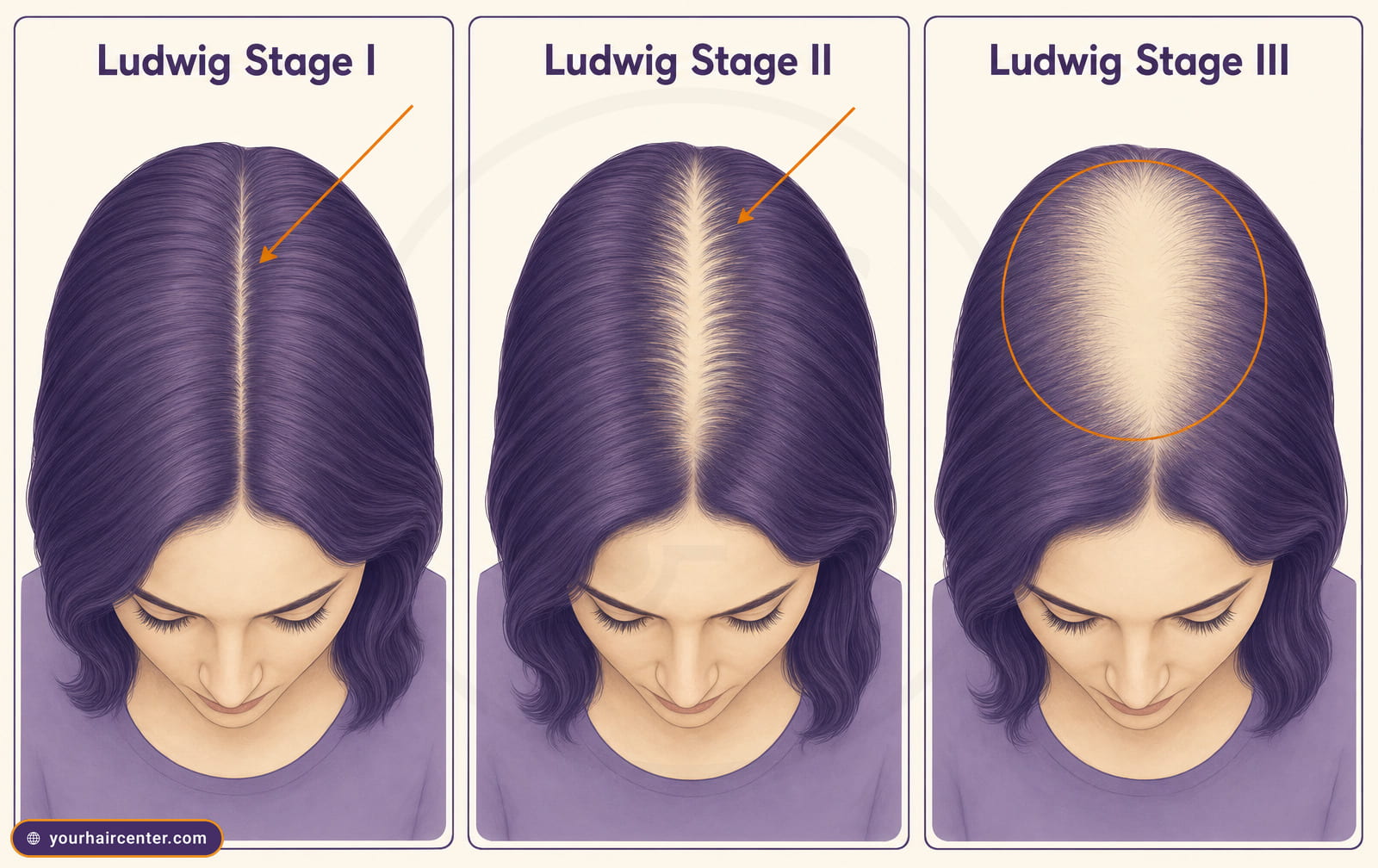
- Stage I is early central thinning, a perceptible reduction of density on the crown behind an intact front hairline.[1:3]
- Stage II is pronounced thinning, with the central part visibly widened and scalp showing through the hair under direct light.[1:4]
- Stage III is advanced loss, with the scalp clearly exposed across the crown within the same central zone.[1:5]
Women needed their own scale because they almost never lose hair the way men do. Men recede at the temples and lose the crown first. Female pattern hair loss instead thins diffusely down the central part, and the front hairline is typically preserved even in advanced cases.[2:2] A scale built for receding temples simply could not describe that. The dominant driver is genetic predisposition, the same inherited sensitivity that our partner clinics describe as gradual thinning at the part line and crown that rarely responds to medication alone. Hormonal shifts such as polycystic ovary syndrome, perimenopause, and menopause do not cause the Ludwig pattern on their own, but they can accelerate it, which is why younger women sometimes present further along the Ludwig scale than their age would suggest. A Hair and Scalp Analysis to confirm your stage is the cleanest way to know where you sit, and you can see the full picture of surgical options through the hair transplant category overview.
What Ludwig Stage I Looks Like and How to Treat It
The first stage on the Ludwig scale is the most forgiving. At Stage I the change is subtle. The central part widens slightly, overall volume drops a little, and there is no exposed scalp under normal lighting. The front hairline is fully intact.[1:6] Many women first notice it between their late twenties and their forties, and earlier onset in the twenties frequently signals a hormonal accelerator working alongside genetics. Under the surface, the follicle is miniaturizing, its shaft growing finer across successive cycles before any bald patch appears, which is exactly why catching it early matters more than waiting for visible loss.
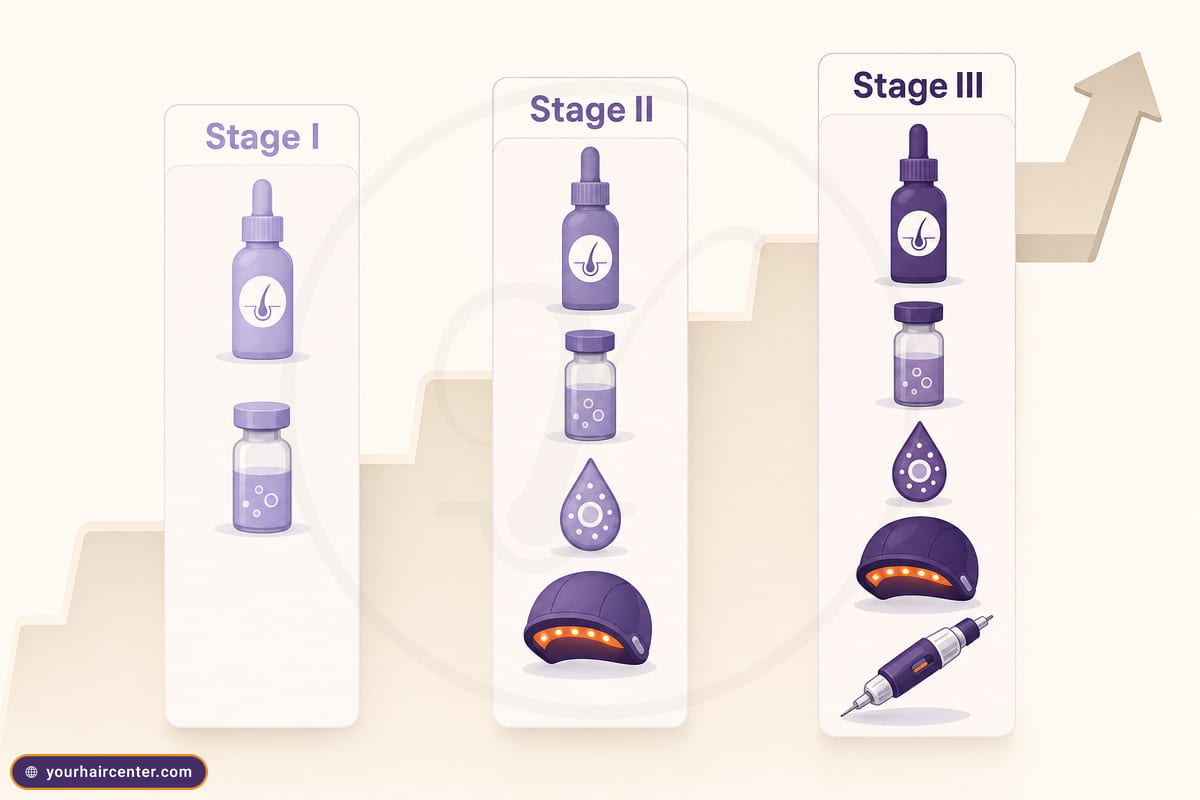
Stage I is the stage where medical management still works, so the treatment ladder is non-surgical.
- Topical minoxidil is the only treatment the FDA has approved for female pattern hair loss, and it is the first-line option dermatologists most often recommend.[3] Around 40 percent of users see meaningful regrowth, usually after 3 to 6 months of daily use.[4]
- PRP hair therapy uses your own platelet-rich plasma as a supportive treatment for early miniaturization, typically scheduled as a short series.
- Mesotherapy and exosome therapy are regenerative options that can sit alongside or in place of PRP for early thinning.
- Low-level laser therapy is a home-use or in-clinic adjunct that some women add to the routine.
- A Hair and Scalp Analysis sets the baseline, documents density, and lets the team re-image at 6 months to track the trend.
Surgery is rarely the right call at the earliest point on the Ludwig scale. The value of catching female pattern hair loss at Stage I is stopping or slowing the slide toward Stage II, and you can read more about the non-surgical treatment options for early stages before anything invasive is ever on the table.
What Ludwig Stage II Looks Like and When Surgery Comes In
The middle step on the Ludwig scale is where the loss becomes pronounced. At Stage II the central part is clearly widened, the classic Christmas-tree pattern fans out from the front toward the crown, and scalp is visible through the hair under direct or salon lighting. The frontal hairline still holds.[1:7] This is usually the point at which a woman starts to feel the loss socially rather than just notice it privately.
The trajectory itself is the diagnostic cue. If you have been on consistent medical management for 6 to 12 months and the part keeps widening, the condition has progressed and the plan needs to escalate. The Stage II ladder reflects that.
- Continue topical minoxidil as the foundation. Stopping it gradually surrenders the regrowth it produced, so it stays in the plan rather than being swapped out.[3:1]
- Add combination regenerative care, with PRP and exosome scheduled in series and mesotherapy as an alternative.
- Review hormonal drivers. If PCOS, perimenopause, or a thyroid imbalance is in play, stabilizing the endocrine cause comes before any surgical decision. Our guides on PCOS hair loss treatment options and menopause hair loss treatment go deep on each.
- Begin a transplant candidacy evaluation. This is a donor-density check and miniaturization map, not a commitment to surgery, just an honest baseline.
This is also where the surgical conversation earns its honesty. A women’s team and a DHI no-shave transplant technique matter most to the woman weighing her options here, and a hair transplant for women is one possible path, not the default. Stage II is the in-between step on the Ludwig scale, and a Hair and Scalp Analysis is what tells you whether the part-line widening is still active despite full medical management.
What Ludwig Stage III Looks Like and When a Transplant Fits
Stage III is the most advanced point on the Ludwig scale. By Stage III the scalp is clearly exposed across the crown, with significant volume loss through the central zone. The front hairline is typically still preserved, and that detail is the diagnostic anchor that separates advanced female pattern hair loss from advanced male-pattern vertex baldness.[1:8][2:3] The part line is no longer a wider part, it is an open area.
Medical management plateaus here for a structural reason. Minoxidil and regenerative care strengthen follicles that are still alive, but they cannot repopulate a zone where the follicular unit has already miniaturized past the point of growing a visible terminal hair.[3:2][4:1] That is the moment the ladder shifts toward surgery.
- A hair transplant evaluation becomes the primary stage-matched step, because, as our partner clinics put it, a hair transplant for women delivers permanent density in the affected areas once the loss is established.
- A donor-area stability check confirms the plan is viable. As our partner clinics frame it, the follicles harvested from the donor area at the back of the scalp are genetically resistant to the hormones that cause hair loss, which is the biology that makes the procedure work even when the crown shows heavy Ludwig III thinning, though a careful donor evaluation is essential because some women carry thinning into that zone too.[5]
- The DHI no-shave technique keeps the donor area free of any visible cut, with micro-scab healing only at the recipient site, which matters for women who cannot step away from work or family during recovery.
- Medical management continues after surgery to protect the native, non-transplanted follicles around the new grafts.[3:3]
Stage III, the most advanced point on the Ludwig scale, is when a hair transplant for women becomes the answer rather than a maybe. A donor-area evaluation through Hair and Scalp Analysis confirms candidacy, and the broader hair transplant category overview shows how the procedure fits the wider catalog.
How the Sinclair Scale Refines Ludwig Staging
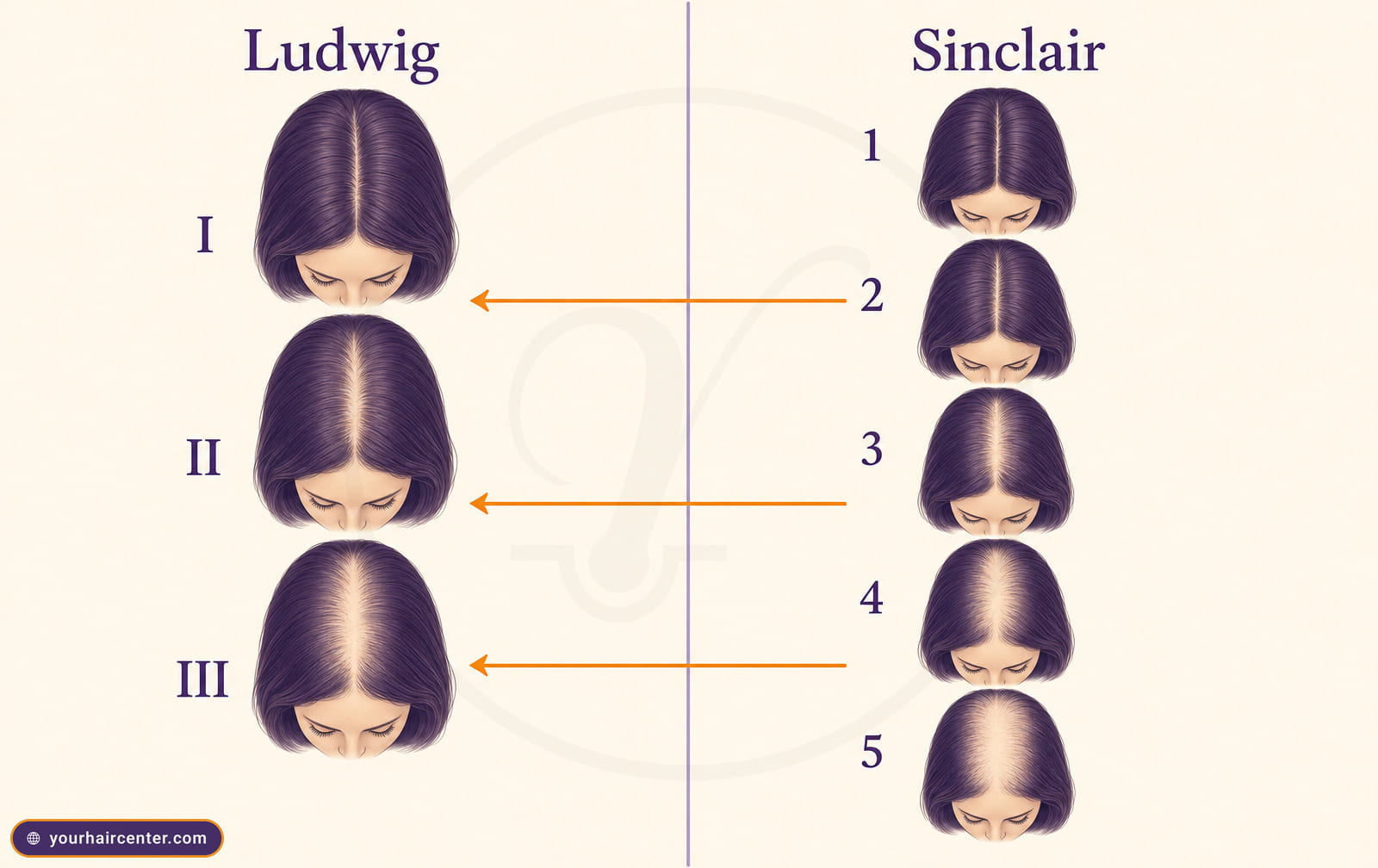
The Sinclair scale is the modern refinement of the Ludwig scale. Where Ludwig uses three stages, the Sinclair scale uses five grades, running from Grade 1 at normal density through Grade 5 at advanced central loss.[6] The extra resolution exists for a reason. Two intermediate grades let a dermatologist capture gradual change from one year to the next, change that would be invisible if every patient had to fall into only three buckets.
In practice, clinicians and researchers often reach for Sinclair grades when they need to track progression carefully or measure the endpoints of a clinical trial, because the finer gradation registers small shifts. The Ludwig scale remains the more widely recognized public-facing language, the terms most women encounter first. The two systems map onto each other in plain terms, roughly. Sinclair Grade 1 is normal, Grade 2 sits around Ludwig Stage I, Grade 3 around Ludwig Stage II, Grade 4 around Ludwig Stage III, and Grade 5 describes advanced central and vertex loss beyond the Ludwig range.[6:1] None of this is a precise conversion, it is an approximate cross-walk. The point for you is practical. If a dermatologist names a Sinclair grade instead of a stage on the Ludwig scale, this translation lets you understand it without confusion, and a Hair and Scalp Analysis for accurate staging will give you both numbers in the same report. You can also explore non-surgical treatment options across grades once your grade is confirmed.
How Ludwig (Women) Compares to Norwood (Men), a Diagnostic Cross-Reference
The cleanest way to understand the Ludwig scale is to see what it is not. Female pattern hair loss preserves the frontal hairline at every stage and thins the center.[1:9][2:4] Male pattern hair loss does the opposite, receding the frontal hairline at the temples first and only later involving the crown. The Norwood scale is the male equivalent of the Ludwig scale, charting that receding-temples-plus-vertex pattern across its own series of stages.
The underlying mechanism is the same in both sexes, an inherited follicular sensitivity to androgens, yet the patterns look different enough that a single unified scale was never workable. Ludwig had to capture the centrifugal central widening that women show, while Norwood had to capture the receding hairline that men show. That visual difference is not just academic, it changes the surgery. For stages on the Ludwig scale, a transplant plan places grafts to rebuild density across the central scalp and crown while leaving the preserved front hairline untouched. For the male pattern, plans rebuild the frontal hairline first. If you are researching a partner’s or family member’s stage in parallel, the companion Norwood scale guide to men’s hair-loss stages and treatment covers the male side in full, and a hair transplant for women is designed around the female pattern specifically.
When Should You Get Your Stage Assessed?
You do not need to wait until the scalp shows to get a stage on the Ludwig scale. Bring yourself in if you can see the central part widening against a baseline photo from one or two years ago, if shedding has run past 6 months with no postpartum or acute-stress explanation, if your mother or sister has female pattern hair loss, if you live with PCOS, perimenopausal, or thyroid context, or if the thinning started unusually early in your twenties.
A Hair and Scalp Analysis appointment is built to answer the question precisely. It documents density imaging across the central scalp, crown, and donor area, places you on both the Ludwig scale and the Sinclair scale, maps miniaturization, and produces a written, stage-matched treatment plan. The appointment commits you to nothing surgical. The plan is the deliverable, and surgery is only one possible recommendation depending on your stage, not the default outcome of a diagnostic visit. The assessment is carried out by a women’s team, which matters for something as personal as scalp imaging, and our specialists work at accredited partner clinics and hospitals, with English-speaking coordinators. Our team’s success rate across its hair transplant operations is 98%, a figure for surgery, while staging itself carries no such commitment. If hormonal accelerators are suspected, an endocrinology workup runs alongside the scalp diagnostic, and the PCOS hair loss treatment options and menopause hair loss treatment guides pick up from there, with non-surgical treatment options available at every stage.
Frequently Asked Questions
Can a Ludwig stage be reversed?
On the Ludwig scale, Stage I can be partially reversed with consistent medical management caught early. Stage II is usually slowed and stabilized rather than reversed. Stage III is permanent at the follicular level and is addressed through transplant restoration.
What Ludwig stage requires a hair transplant?
Stage III of the Ludwig scale is the stage where a transplant becomes the primary stage-matched treatment. Stage II is when a transplant evaluation enters the conversation. Stage I is rarely a surgical case at all.
Is the Sinclair scale more accurate than the Ludwig scale?
The Sinclair scale offers finer five-grade resolution that is often preferred in research, while the Ludwig scale remains the recognized public-facing three-stage system. Most clinicians use both, Sinclair for tracking and Ludwig for talking with patients.
What does Ludwig stage 2 look like and what should I do?
A clearly widened central part with scalp visible through the hair and the front hairline preserved. The plan combines continued minoxidil, regenerative supportive care, and an honest transplant candidacy evaluation through a Hair and Scalp Analysis.
Can female pattern baldness in your 20s be Ludwig stage I or II already?
Yes, particularly with hormonal accelerators such as PCOS or a thyroid imbalance, or a strong family history. Early diagnosis through hair and scalp analysis is the highest-value intervention at that age.
What is the male equivalent of the Ludwig scale?
The Norwood scale, which classifies male pattern hair loss with frontal-hairline recession and vertex involvement as its defining features. The companion Norwood scale guide covers it, and you can message our women’s team on WhatsApp for a quick steer.
Turning Your Ludwig Stage Into a Treatment Plan
The Ludwig scale answers the question every woman asks at the mirror, but the stage only matters because it points to a plan. Stage I calls for medical management, Stage II for combination regenerative care plus an honest surgical evaluation, and Stage III for transplant restoration. The fastest way to turn that map into a plan of your own is to book a free Hair and Scalp Analysis with our women’s team, which assigns your stage on the Ludwig scale, cross-checks it against the Sinclair grade, and hands you a written, stage-matched plan with no obligation to proceed to surgery. If you would rather start with a question, message our women’s team on WhatsApp for a Ludwig stage assessment.
References
-
Ludwig E. Classification of the types of androgenetic alopecia (common baldness) occurring in the female sex. British Journal of Dermatology. 1977;97(3):247-254. https://pubmed.ncbi.nlm.nih.gov/921894/ (opens in new tab) ︎ ︎ ︎ ︎ ︎ ︎ ︎ ︎ ︎ ︎
-
Female Pattern Hair Loss. National Center for Biotechnology Information (PMC), peer-reviewed review. https://www.ncbi.nlm.nih.gov/pmc/articles/PMC3968982/ (opens in new tab) ︎ ︎ ︎ ︎ ︎
-
American Academy of Dermatology. Thinning hair and hair loss: could it be female pattern hair loss? https://www.aad.org/public/diseases/hair-loss/types/female-pattern (opens in new tab) ︎ ︎ ︎ ︎
-
Efficacy and Safety of 5% Minoxidil in Female Pattern Hair Loss, randomized trial and review. National Center for Biotechnology Information (PMC). https://www.ncbi.nlm.nih.gov/pmc/articles/PMC9309533/ (opens in new tab) ︎ ︎
-
International Society of Hair Restoration Surgery. A guide to hair transplant for women. https://ishrs.org/hair-transplant-for-women/ (opens in new tab) ︎
-
Cleveland Clinic. Female pattern baldness, symptoms, stages, causes and treatment. https://my.clevelandclinic.org/health/diseases/24943-female-pattern-baldness (opens in new tab) ︎ ︎
