If you are vetting a laser cap for hair growth before someone you love uses one, you deserve more than a marketing reassurance. This guide lays out the documented laser cap for hair growth side effects from pooled trial data, the genuine contraindications most buyer's guides skip, the honest answer on cancer risk, and the gap between an unsupervised cap and a screened, dose-adjusted clinic protocol. Cited, not promotional.

If you are searching laser cap for hair growth side effects at 11pm because someone you love just ordered a several-hundred-dollar device online, you are asking the right question. The fears that surface on the results page are specific, not vague. Scalp cancer after years of red light. An FDA warning against a named brand. A medication interaction nobody asked about at checkout. This article does not answer with the “no side effects” line every device store repeats. It answers with the published evidence, the real frequencies pulled from pooled trial data, the genuine contraindications, and the gap between an unsupervised laser cap for hair growth and a screened, dose-adjusted clinic protocol. You came here suspicious. Good. The research rewards that suspicion.
What Side Effects Does a Laser Cap for Hair Growth Cause?
Here is the honest list. Low-level laser therapy for hair has a well-studied side-effect profile, and the documented effects are mild, transient, and low in frequency. They are not theoretical, but they are not the catastrophe the search results imply either.
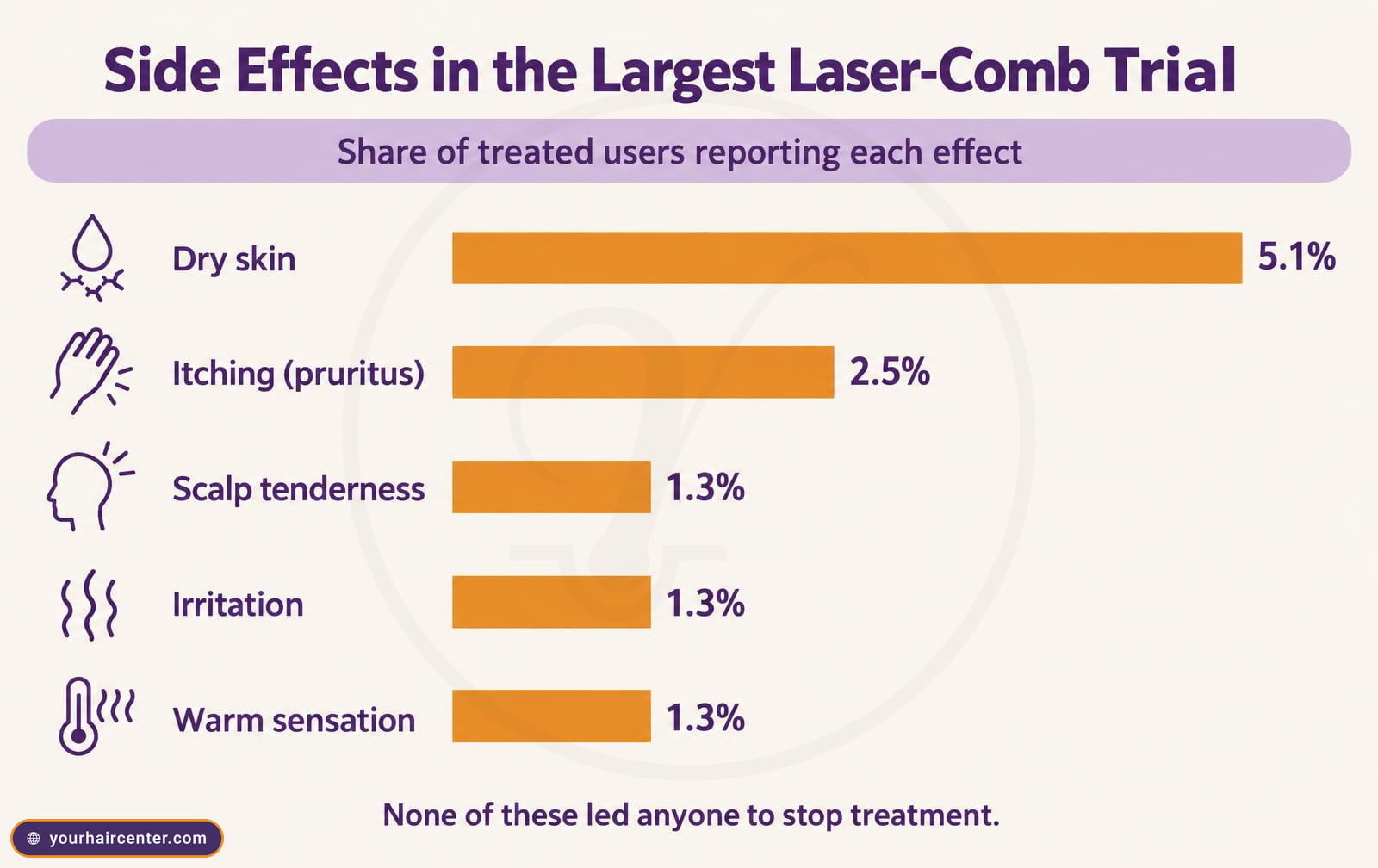
- Dry skin, reported in 5.1% of treated users in the largest sham-controlled laser-comb trial the review covers.[1]
- Scalp pruritus or itching, 2.5% in the same trial; across the reviewed trials, most side effects resolved within two weeks.[1:1]
- Scalp tenderness, 1.3%, with the same rate for irritation and for a warm sensation at the treated site.[1:2]
- A temporary shed that some users notice in the first one to two months, which disappeared with continued use in the study that reported it.[2]
- Headache, reported in one helmet trial at a rate no different from the sham group.[1:3]
- Eye irritation if a laser cap for hair growth is worn with light leakage or without proper scalp contact, which is a device-fit issue rather than a property of the laser therapy itself.
No study in the review reported a severe adverse event that forced participants to stop treatment, and most of the listed effects resolved within two weeks.[1:4] That distinction matters for anyone weighing a laser cap for hair growth. A side effect that clears in two weeks without intervention is a different category of risk from the scarring, burns, or permanent damage the word “laser” tends to summon.
Can a Laser Cap Cause Cancer?
The cancer fear is the one worth taking apart carefully, because the physics does the reassuring, not a marketing claim. A laser cap for hair growth uses red light at roughly 650nm. That is visible light, and it is non-ionizing. It does not carry enough energy per photon to break chemical bonds or damage DNA, which is the mechanism behind radiation-driven cancer.
Contrast that with ultraviolet-B light at 280 to 315nm, the wavelength range behind sunburn and most skin cancer, or with X-rays and gamma rays at the ionizing end of the spectrum. Those wavelengths carry far more energy per photon and can directly damage cellular DNA. Red light at 650nm sits at the opposite, low-energy end. The process it drives, called photobiomodulation, stimulates activity inside the follicle cell rather than damaging it.
The “Capillus FDA warning” search is worth addressing plainly, because the phrasing itself is misleading. When people search for an FDA warning against a specific laser cap for hair growth, what they find are clearance records, not safety actions. These devices reach the market through the FDA’s 510(k) substantial-equivalence pathway, which means the manufacturer showed the device is comparable to one already cleared.[3] That is a market-access pathway, not a safety endorsement, and it is also not a recall or a Class-I “warning.” Any clearance record or post-market notification is public on the FDA device database.[4]
On the question itself, no published cohort study has shown an elevated skin-cancer rate among people using a laser cap for hair growth at therapeutic doses. The reviews that pool this literature report only minor side effects,[1:5] though the trials ran for months rather than years and long-term follow-up is thin.[2:1] One review notes that light could in theory stimulate dysplastic or malignant scalp lesions, which is why a suspicious lesion sits on the contraindication list below.[2:2]
Who Should Not Use a Laser Cap?
This is where the side effects stop being the real story and screening becomes the point. Most documented problems trace back to using a device that should never have been started in that person, not to the therapy itself. Before anyone starts a laser cap for hair growth, this is the checklist a careful provider runs. A consumer purchase flow runs none of it.
- Active or recent skin cancer on the scalp, head, or neck. Directing any light at suspicious or treated lesions is off the table until a dermatologist has cleared the area.
- Photosensitizing medications. Tetracyclines such as doxycycline and minocycline, certain thiazide diuretics, isotretinoin, amiodarone, some retinoids, and St. John’s Wort are all linked to drug-induced light sensitivity.[5] This caution is precautionary for red-light therapy specifically, but it is a real screening step, and it is exactly the kind of detail a partner may be taking without ever mentioning it to a device retailer.
- Pregnancy. This is a precautionary deferral rather than a proven hazard. No completed trial has studied laser therapy in pregnant participants, so the reasonable move is to wait rather than to treat.
- Light-sensitive conditions. Systemic lupus erythematosus, polymorphic light eruption, and other photodermatoses are relative contraindications that warrant a dermatology consult before any light-based treatment.
- Open scalp wounds, active scalp infections, or recent in-office scalp procedures. Wait for clinical resolution before using a laser cap for hair growth on the area.
The pattern across that list is the same. Each item is a question a clinician asks during an in-clinic scalp analysis and a question the checkout page for a laser cap never poses.

Are Laser Caps Safe for Women? Pregnancy, Hormones, and the Female Checklist
Laser cap for hair growth side effects in female users follow the same documented profile as in men, but the decision around them is different, because the cause of a woman’s shedding is more often the variable that matters. The therapy is well studied in women. In the reviewed trials, the studies that enrolled only women also showed significant hair growth over sham devices.[1:6]
The first question is rarely the cap. It is the diagnosis. A proper medical workup runs a differential before recommending any device, because a laser cap for hair growth costing hundreds of dollars will not fix shedding driven by iron deficiency, thyroid dysfunction, or low vitamin D. A thyroid panel, ferritin, vitamin D, and an androgen panel sort out whether the loss is pattern hair loss or something a laser cannot touch. Consumer purchase flows skip this entirely.
Pregnancy and lactation default to precautionary deferral, as covered above. Postpartum shedding is its own situation. Hormonal telogen effluvium after childbirth usually resolves on its own within the baby’s first year, so the decision about a laser cap for hair growth belongs after that window has passed, not during it.
There is also a sensitivity factor. Hormonal cycling and postpartum scalp tenderness can amplify the low-frequency tenderness side effect, which a supervised protocol handles by adjusting session length or frequency. A woman using a laser cap for hair growth at home is left to make that call alone. For women weighing this alongside other options, PRP for women’s hair loss and a baseline scalp analysis before LLLT belong in the same conversation as the cap.
Is Long-Term Laser Cap Use Safe?
The “laser cap side effects long term” search is really a question about cumulative exposure. Do years of red light add up to damage? The published answer, so far, is no.
A laser cap for hair growth operates at sub-thermal energy levels. The doses used to stimulate follicles are low enough that they do not heat or burn tissue, and no published cohort has demonstrated cumulative tissue damage at therapeutic doses.[1:7][2:3] The trials behind these devices ran for 16 to 26 weeks, so data on years of use is thin, but none reported side effects escalating over the course of treatment.[1:8] In practice, the most common reason people stop multi-year use of a laser cap for hair growth is loss of effect or cost, not a new safety problem.
The device-specific worry behind searches like “Kiierr laser cap side effects” is worth separating cleanly. There are two different risk categories at play. One is the laser mechanism itself, which the trial data covers and which looks reassuring. The other is device-design risk, meaning battery issues, light leakage near the eyes, and poor fit. Those are hardware concerns common to consumer laser caps for hair growth as a class, and they are not the same as a biological risk from the light.
This is the gap a supervised LLLT protocol closes at the long-term horizon. A documented session log, dose titration over time, and a periodic scalp re-analysis turn “I have been wearing this for two years and hoping” into a monitored treatment with checkpoints.
How Supervision Reduces Laser Cap Risks
If side effects mostly come from the wrong person using a laser cap for hair growth the wrong way, then supervision is the variable that removes most of the risk. Here is what a competent provider should be doing, and here is what is missing when that layer is skipped.
- Pre-screening for photosensitizing medications and contraindications. The full screening list above, run as an intake protocol rather than left as a website disclaimer the buyer never reads.
- Scalp-analysis before dosing. Follicular density baseline, scalp-condition assessment, and imaging that set the right starting power and cadence for the individual case.
- Dose calibration to scalp condition. Home caps and in-office systems use the same class of red diodes, each under 5 mW in their FDA filings,[6][7] so the difference is not raw power. A supervised program sets session length, frequency and coverage for the case and adjusts them as the scalp responds, which a fixed home routine does not.
- Monitoring for shedding that runs long. An early shed in the first month or two is expected and temporary.[2:4] A shed that keeps going beyond that is a signal to reassess, and a consumer-cap user has no protocol for catching it.
- A defined intervention pathway. If a side effect does emerge, which is uncommon but real, the supervising specialist adjusts the dose, pauses sessions, or refers to dermatology. With a laser cap for hair growth bought online, the path is a call to customer service and a return label.
- A documented session log and periodic re-analysis. This is the long-term scaffolding the device-brand path simply does not include.
That checklist is the difference between buying a gadget and starting a treatment. A free hair and scalp analysis is the front door to it, the supervised LLLT protocol is the program it feeds, and PRP combination therapy is the add-on a supervised plan can layer in safely once screening is clear.
Frequently Asked Questions
What did Elon Musk use to regrow hair?
This question lands on nearly every laser-therapy search, so it is worth answering directly even though the honest answer is not LLLT. Public reporting and his own past comments attribute the regrowth to a hair transplant dating to the late 1990s or early 2000s, not to laser caps. For readers weighing a laser cap for hair growth, the published evidence points to a modest, real density benefit in pattern hair loss, not a transplant-level transformation.
Are laser hair growth caps safe?
A laser cap for hair growth is generally safe, with documented side effects that are mild, transient, and in the low single-digit percentages, mainly dryness, itching, and brief scalp tenderness.[1:9] The bigger safety question is screening rather than the light itself. Skin cancer on the scalp, photosensitizing medications, pregnancy, and photodermatoses are genuine contraindications a careful provider checks before recommending a cap.
What hair cannot be lasered?
Laser therapy cannot regrow follicles that are no longer viable. Areas of complete baldness with no dormant follicles, scarring (cicatricial) alopecia, and zones of active scalp inflammation will not respond, and the contraindications above apply. A hair and scalp analysis confirms whether living, dormant follicles are present before any program begins.
How long does it take for a laser cap to work?
Trials measured results at 16 to 26 weeks,[1:10] and a typical course runs about six months at several sessions a week.[2:5] Our specialists’ program expects reduced shedding from around month one and new hair from around month three. Supervision keeps that schedule on track, while a laser cap for hair growth used inconsistently often stretches it.
Are the side effects different for women?
The documented side-effect profile is the same, but the screening is what changes. Postpartum hormonal shedding and underlying causes like thyroid or iron issues should be ruled out first, since a laser cap for hair growth will not address them, and supervised dosing handles the cycle-related scalp sensitivity a fixed-output device cannot.
Is a Laser Cap for Hair Growth Safe Enough for You?
The research lands somewhere more useful than either the device-store reassurance or the worst-case search result. Laser cap for hair growth side effects are documented, mild, and transient, sitting in the low single-digit percentages, with real but uncommon contraindications and no published long-term cancer or cumulative-damage signal at therapeutic doses. The decision is not whether laser therapy is dangerous. It is whether a laser cap for hair growth used on its own is enough for your situation, or whether pre-screening, dose calibration, and monitoring close the small residual gap that an unscreened device leaves open. If that is the checklist you came here with, book a free hair and scalp analysis with a specialist-supervised laser evaluation. Have a specific safety question first? Message our specialists on WhatsApp, or start with the upstream scalp analysis.
References
- Egger A, et al. “Examining the Safety and Efficacy of Low-Level Laser Therapy for Male and Female Pattern Hair Loss: A Review of the Literature.” Skin Appendage Disorders, 2020. https://pmc.ncbi.nlm.nih.gov/articles/PMC7548873/ (opens in new tab) ︎ ︎ ︎ ︎ ︎ ︎ ︎ ︎ ︎ ︎ ︎
- Pillai JK, Mysore V. “Role of Low-Level Light Therapy (LLLT) in Androgenetic Alopecia.” Journal of Cutaneous and Aesthetic Surgery, 2021. https://pmc.ncbi.nlm.nih.gov/articles/PMC8906269/ (opens in new tab) ︎ ︎ ︎ ︎ ︎ ︎
- “Shedding light on the FDA’s 510(k) approvals process: low-level laser therapy devices used in the treatment of androgenetic alopecia.” PubMed, 2018. https://pubmed.ncbi.nlm.nih.gov/30252550/ (opens in new tab) ︎
- U.S. Food and Drug Administration, 510(k) Premarket Notification device database. https://www.fda.gov/medical-devices/premarket-submissions-selecting-and-preparing-correct-submission/premarket-notification-510k (opens in new tab) ︎
- “Drug-Induced Photosensitivity, From Light and Chemistry to Biological Reactions and Clinical Symptoms.” PMC, 2021. https://pmc.ncbi.nlm.nih.gov/articles/PMC8401619/ (opens in new tab) ︎
- U.S. Food and Drug Administration. 510(k) summary K253231, Laser Hair Growth System (Laser Cap 128, Laser Helmet 272/352/552/500), cleared 16 June 2026. https://www.accessdata.fda.gov/cdrh_docs/pdf25/K253231.pdf (opens in new tab) ︎
- U.S. Food and Drug Administration. 510(k) summary K251684, Alma TED+ System (prescription use), cleared 5 June 2026. https://www.accessdata.fda.gov/cdrh_docs/pdf25/K251684.pdf (opens in new tab) ︎
