How long does PRP last for hair is really three answers. A single session does almost nothing. A completed three-to-six-session course holds for roughly a year to eighteen months. After that, density fades unless you book a maintenance session every four to six months, indefinitely. PRP is closer to a yearly subscription than a one-time fix, so the smarter question is how long to keep paying before a transplant becomes the cheaper permanent answer.

The honest answer to how long does PRP last for hair is the one most clinic homepages would rather not lead with. A single session does almost nothing on its own. A completed course of three to six sessions holds for a while, and then results fade gradually unless you sit down for a maintenance session every four to six months, indefinitely. PRP is not a one-time procedure. It is closer to a yearly subscription that buys back density you would otherwise lose, and the lifetime cost math is what separates patients who should commit from patients who are about to overspend. This FAQ answers how long PRP lasts at every stage of treatment, ending with the stopping criteria almost nobody publishes.
How long does a single PRP session last on its own?
A single PRP session, on its own, does not produce durable hair regrowth, so how long does PRP last for hair after just one visit is effectively close to nothing. The growth-factor activity from one injection cycle rises in the first week or two and then tapers over the following weeks, which is exactly why the protocol stacks sessions rather than relying on a single visit. The initial course at our partner clinics runs three to six sessions, one session every two to four weeks, at forty-five to sixty minutes each.
The effect is cumulative. Each session adds another wave of platelet-derived growth factors into the same scalp tissue, and the follicle response builds across the course rather than landing in one shot. In the landmark randomized trial on this question, patients showed measurable gains only after three monthly cycles, not after a single injection.[1]
The caveat is blunt. Patients who book one session and never return almost never see lasting change, which is the real reason how long PRP lasts depends on finishing the course. PRP delivers when the course is completed, which is also the context behind the three-month results most patients ask about. If you are weighing whether to start, the PRP hair treatment course is the unit to budget for, not the single session.
How long does PRP last for hair after a full course?
After a complete initial course of three to six sessions, results typically hold for roughly a year to a year and a half before density begins to slip, and maintenance sessions every four to six months are needed to keep that result in place. PRP does not permanently regrow hair on its own. Improvement usually becomes visible around the third month and reaches its peak near the one-year mark, after which the effect requires ongoing top-ups to persist.[2]
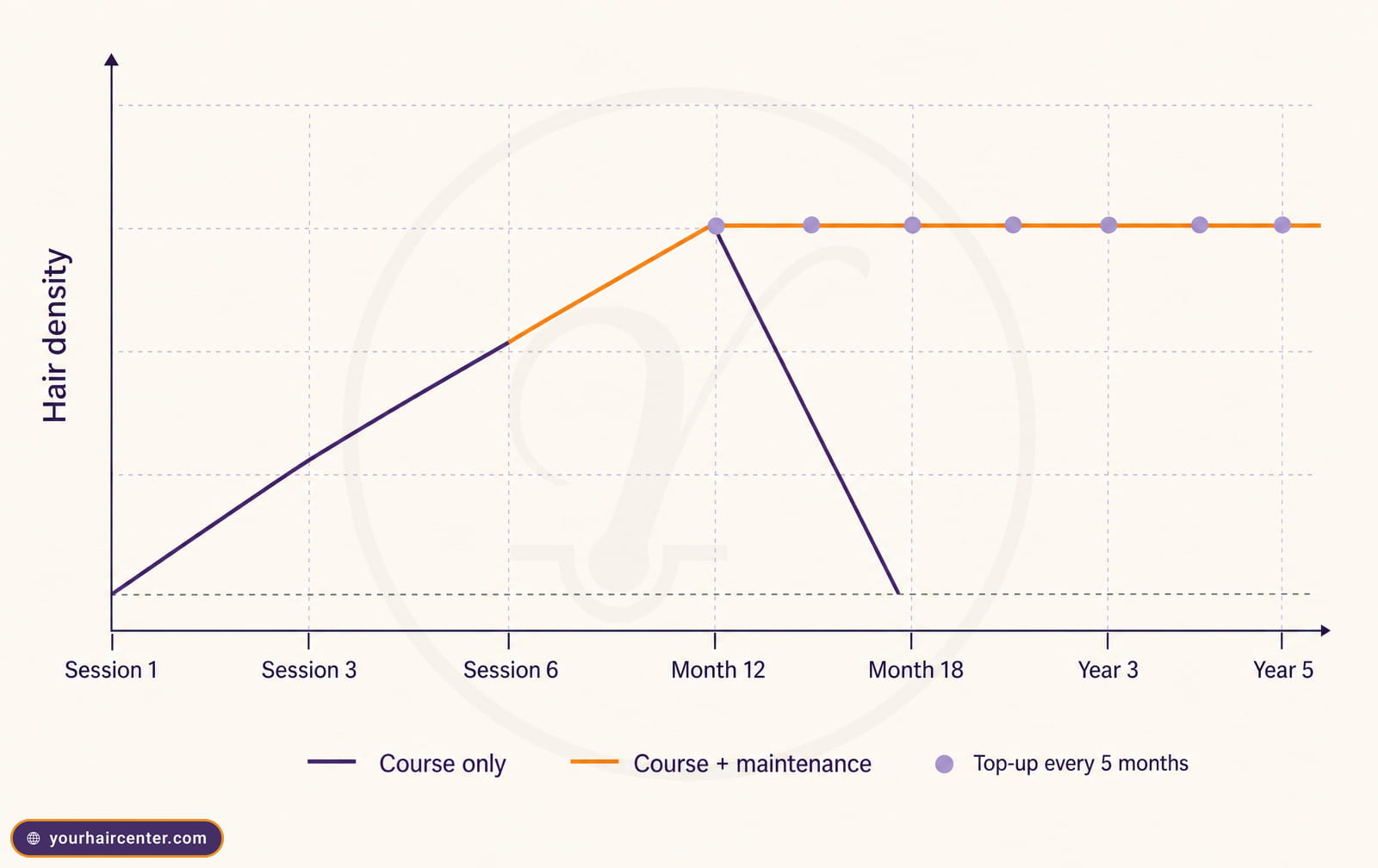
Why the window varies, and therefore how long your PRP results last, comes down to two layers. Patient-level factors move it most, androgen sensitivity, the Norwood stage at the time of treatment, and whether the underlying loss is being treated medically at all. Protocol-level factors matter too, the platelet concentration in the prepared plasma and the depth and density of the injection grid. Older content that promises eighteen to twenty-four months tends to oversell by blurring the line between any detectable benefit and maintained cosmetic density.[3] You can keep the hair treatments program working for years, but only with a maintenance plan, not on the strength of one course. Read the primary PRP service page for the full course schedule.
When do most patients see PRP results begin to fade?
When people ask how long does PRP last for hair, the more useful answer is when the fade actually starts, and it is gradual rather than a cliff. Through the first several months after the course, peak density is generally retained. Across the middle of the year the density tends to plateau, and somewhere past the nine-to-twelve-month mark subtle thinning starts to return at the original loss zones. Without maintenance, that becomes visible thinning again by the back half of the second year.
The early indicators are the ones patients actually notice, and they are the most reliable read on how long PRP lasts in your own mirror. Shedding count creeps back above baseline at the wash, the part line widens by a millimetre or two, and the original recipient zones, usually the temples and the crown, lose the filled-in look first.
The reason androgen-driven loss returns first is mechanical, and it sets the outer bound on how long PRP lasts. PRP does not switch off dihydrotestosterone activity at the follicle; it boosts the follicle’s resilience temporarily.[3:1] Once the growth-factor concentration normalizes, the underlying loss process resumes from where it was paused. The practical rule follows directly. If you started PRP to get ahead of active shedding, book your first maintenance session before the fade shows rather than after, and pair it with a broader hair loss treatment plan if the shedding is aggressive.
How often should PRP be done for hair maintenance?
After the initial course, the standard is one maintenance session every four to six months, and that interval is really the answer to how long does PRP last for hair between visits. That cadence matches both the protocol we use and the maintenance interval proposed in the published literature, which recommends an intensive monthly phase followed by top-ups at three-to-six-month intervals.[4]
The reason it is four to six months and not once a year is dosing. Growth-factor activity from a single session sustains follicle function for a matter of months, not a full year, so stretching maintenance out to an annual visit lets density slip between top-ups, and that slippage compounds across years.[2:1] A faster cycle, closer to every three to four months, suits aggressive androgen-driven loss; a slower six-month cycle often holds for stable post-transplant maintenance. Your own interval is a clinical decision, not a number to self-prescribe, so treat these as the framework rather than a prescription.
Framed factually, that is two to three maintenance sessions a year over five to ten years, a spending plan rather than a one-time figure, which is what how long the results last looks like in practice. When PRP plateaus, some patients add hair mesotherapy to the maintenance mix, and the PRP service page lays out how the maintenance schedule fits the initial course.
How long does PRP last after a hair transplant?
The post-transplant picture is different. Used as a follow-up to surgery, PRP first supports graft survival during the early healing window, then transitions into standard maintenance. The growth factors in the plasma accelerate healing across the donor and recipient areas, which in turn improves the survival rate of the transplanted follicles.
How long the results last in this setting tracks that two-stage rhythm. A typical post-transplant series runs more closely spaced sessions through the first few months, the graft-survival window, then settles into the same four-to-six-month maintenance rhythm from the end of the first year onward to preserve density in the non-transplanted zones.
In practice, a post-transplant PRP series tends to outlast standalone PRP, for a simple reason. Combined with the permanent follicles relocated into the recipient zone during a hair transplant, maintenance only has to protect the surrounding native hair, which is a smaller density-protection job than carrying a thinning scalp on PRP alone. The full timing protocol lives in the dedicated guide on PRP after a hair transplant.
Does combining PRP with finasteride or minoxidil extend results?
PRP versus minoxidil is the wrong comparison. If you want to change how long PRP lasts rather than just how it performs, the protocol that actually extends PRP’s effective duration is PRP combined with an FDA-approved medication, finasteride for men, topical minoxidil for both. Cleveland Clinic is explicit that the best results come from PRP used alongside minoxidil or finasteride rather than from PRP alone.[2:2]
The combination works because the two halves attack different ends of the problem. Finasteride reduces dihydrotestosterone exposure at the follicle, treating the cause of androgenetic loss, while PRP boosts follicle resilience, managing the consequence. Topical minoxidil at its labeled concentration adds a third mechanism through improved local blood flow and a longer growth phase. Pooled clinical evidence shows PRP plus minoxidil produces significantly greater density than either treatment on its own, with single-study evidence also pointing to greater shaft thickness.[5]
For the reader, this turns into a decision about how long your PRP results last. If you cannot tolerate finasteride, your maintenance frequency simply stays in the four-to-six-month band. If you can, the maintenance interval often stretches and the cost math improves. A combined hair loss treatment plan, sometimes paired with low-level laser therapy, is how that longer duration is built.
What happens if you stop PRP entirely?
If you stop PRP entirely after completing the initial course, how long does PRP last for hair becomes a finite countdown: the density you built will fade over the following year or so, and the underlying hair-loss process will resume from wherever it stood when you started.[2:3][1:1] PRP buys time; it does not buy permanence.
This is because PRP does not change the underlying biology. It does not reduce dihydrotestosterone, it does not alter the follicle’s genetic sensitivity to androgens, and it does not create new follicle stem cells. It strengthens what is already there, temporarily.[3:2]
Stopping is not a failure, though. It is a budgeting decision, and how long the results last after you stop is the variable you are trading against cost. The real question is whether you replace PRP with something else, finasteride on its own, continued laser therapy, a newer regenerative option, or a transplant, or whether you accept the gradual fade. Patients who want to keep a non-surgical option going often move to exosome therapy or stay on home laser maintenance rather than walk away entirely.
When should you stop PRP and consider a transplant instead?
There are three honest stopping criteria, and almost no one publishes them.
The first is the clinical signal, and it redefines how long PRP lasts for your particular scalp. If at your four-to-six-month maintenance follow-up you are no longer holding density, measured on an objective hair and scalp analysis rather than a subjective mirror check, PRP has reached its plateau for your case. Repeating the same protocol identically is unlikely to recover the trend.
The second is the cost crossover, where how long does PRP last for hair turns into a pure arithmetic question. If your cumulative annual PRP spend, projected across roughly ten years, has crossed the cost of a Turkey hair transplant at two and a half to four and a half thousand dollars all-inclusive, the transplant becomes the cheaper permanent solution. Two to three maintenance sessions a year, year after year, adds up faster than most patients expect.

The third is a candidacy shift, the point where asking how long does PRP last for hair stops being the useful question at all. If your loss has progressed past stable androgenetic thinning into a stage where PRP is fighting too much volume loss, the right answer has moved toward a transplant. The cleanest way to find which side of these lines you are on is a free evaluation, and the full PRP versus hair transplant cost comparison and the insurance and out-of-pocket breakdown walk through the same math in detail.
It is an annuity, until the transplant is cheaper
So how long does PRP last for hair? A single session does little, a three-to-six-session course holds for around a year to eighteen months, and maintenance every four to six months holds it indefinitely. PRP is functionally an annuity, not a one-time procedure, which means the sharper question is not how long it lasts but how long you should keep paying for it before a transplant becomes the cheaper permanent answer. For stable early-stage loss, how long your PRP results last is mostly a question of how diligently you maintain, so maintenance is often the right path; once annual spend crosses the Turkey-transplant line, the math has flipped. Tell us how many PRP sessions you realistically need and we will map it against the PRP hair treatment program, or read the full PRP versus hair transplant lifetime-cost comparison first.
References
- Gentile P, et al. The Effect of Platelet-Rich Plasma in Hair Regrowth: A Randomized Placebo-Controlled Trial. Stem Cells Transl Med. 2015. https://pmc.ncbi.nlm.nih.gov/articles/PMC4622412/ (opens in new tab) ︎ ︎
- Cleveland Clinic. PRP Therapy (Platelet-Rich Plasma) for Hair Loss. https://my.clevelandclinic.org/cosmetic-plastic-surgery/procedures/prp-therapy (opens in new tab) ︎ ︎ ︎ ︎
- International Society of Hair Restoration Surgery (ISHRS). PRP for Hair Loss: Procedure, Benefits and Costs. https://ishrs.org/patients/treatments-for-hair-loss/medications/platelet-rich-plasma/ (opens in new tab) ︎ ︎ ︎
- Gupta AK, Carviel JL. Platelet-rich plasma for androgenetic alopecia: A review of the literature and proposed treatment protocol. https://pmc.ncbi.nlm.nih.gov/articles/PMC6374694/ (opens in new tab) ︎
- The additive value of platelet-rich plasma to topical minoxidil in the treatment of androgenetic alopecia: a systematic review and meta-analysis. https://pmc.ncbi.nlm.nih.gov/articles/PMC11356437/ (opens in new tab) ︎
