Stuck on exosome vs prp? This guide skips the generic explainer and gives you a decision. PRP uses growth factors from your own blood for early thinning, while exosome therapy delivers lab-prepared stem-cell-derived vesicles, a promising option with a smaller evidence base. We map your Norwood stage, budget, and downtime tolerance to one recommended therapy, then show the combo protocol that stages PRP, exosome, and a transplant into a single regenerative ladder.
If you have spent months reading about regenerative hair therapy, the exosome vs prp question eventually becomes the one that stalls the decision. Both inject growth signals into a thinning scalp, both promise denser hair without surgery, and both are sold at wildly different prices depending on where you sit. This guide does what the typical comparison page does not. Instead of stopping at “here is what each one is,” it maps your hair-loss stage, your budget, and your tolerance for downtime to a single recommended therapy, then shows you how the two treatments stage together into one regenerative ladder.
Exosome vs PRP, the 30-Second Answer
For exosome vs prp, PRP uses growth factors from your own centrifuged blood, runs across more sessions, and fits early-stage thinning on a tighter budget. Exosome therapy delivers lab-prepared vesicles from stem cells and runs in fewer sessions, but it is the less studied of the two; no trial has compared them head to head, and PRP remains the most studied regenerative treatment.[1] The right pick depends on your stage and budget.
If you want the bottom line on exosome vs PRP before you read further, use these three frames.
Choose PRP if you have early-stage thinning, recent diffuse shedding tied to stress or a postpartum trigger, you are comfortable with a blood draw, you are watching cost, and a schedule of three to six sessions is acceptable.
Choose exosome if you have early-to-moderate thinning and have already plateaued on PRP, or you want the shortest schedule of two to four sessions and accept that the evidence is still limited. After a transplant it is an option to discuss with your doctor, since studies have not yet set its timing or dose.[2]
Choose neither yet if you have complete baldness with no remaining follicles (a transplant is the primary path), an active scalp infection, you are pregnant or breastfeeding, or you are undergoing chemotherapy. The honest first step in every case is a free Norwood staging via scalp analysis so the recommendation is built on your actual follicle map, not a guess. If you would rather talk it through, you can WhatsApp the medical team about your case.
PRP Built from Your Own Blood
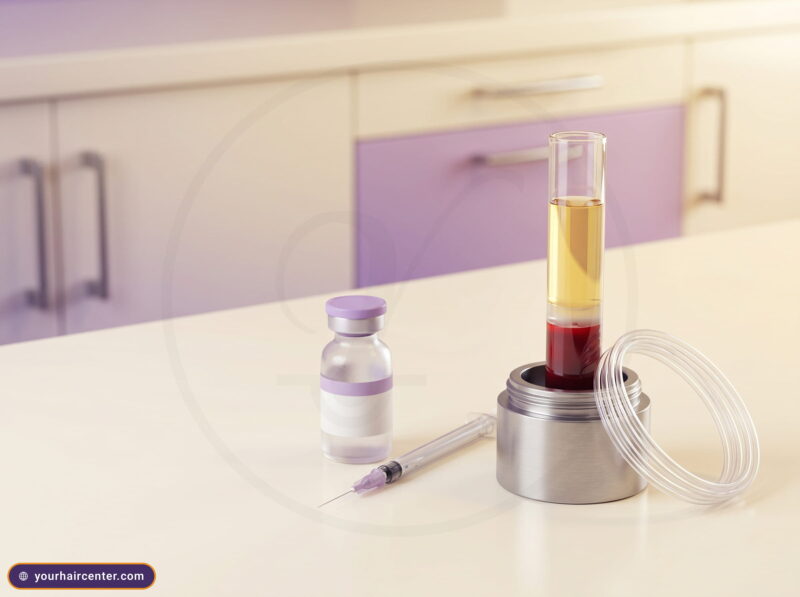
In the exosome vs prp comparison, PRP, or platelet-rich plasma, is the autologous option. A small volume of blood is drawn, spun in a centrifuge to isolate the platelet-rich layer, and re-injected into the scalp. Because the material comes from your own body, there is no external source to vet and no donor compatibility question, which is exactly the reassurance a safety-conscious researcher is looking for.
How PRP works
Platelets are not just clotting cells. Once concentrated and delivered into thinning areas, they release a cocktail of growth factors, including PDGF, VEGF, TGF-beta, EGF, and IGF-1. These signal dormant follicles to re-enter the active growth phase, improve local blood supply, and slow the miniaturization that drives pattern hair loss. The plasma is your own, so the mechanism is essentially your biology, amplified.
What the protocol looks like
PRP typically runs across three to six sessions to start, then periodic maintenance. It is an in-and-out clinic visit with no surgery, though the blood draw and centrifuge step do add time to each appointment. Meaningful density change is gradual rather than instant, with results that tend to appear around the three-to-four-month mark and build from there. PRP is best suited to early thinning and mild loss, and it pairs naturally with a scalp analysis to confirm PRP candidacy before you commit to a course.
Where PRP falls short
The autologous advantage comes with limits. A meaningful share of patients are partial responders or non-responders, and in moderate cases the response can plateau once the easy gains are made. The blood draw itself is a deal-breaker for some, whether from needle aversion or coagulation considerations. Session quality also varies with the operator’s centrifuge protocol and concentration kit, so clinic-to-clinic results are less uniform than the marketing suggests. For many patients weighing exosome vs PRP, PRP hair therapy is the right starting rung rather than the final answer.
Exosome Therapy with Stem-Cell-Derived Vesicles
On the other side of the exosome vs prp comparison, exosome therapy is the newer option. Exosomes are nanoscale vesicles, 30 to 150 nanometers in size, harvested from mesenchymal stem cells (human-derived or marine sources such as salmon), and there is no agreed standard yet for how they are prepared or tested.[1:1] They carry a dense payload of growth factors, proteins, and RNA, and once micro-injected they deliver those signals straight to weakened follicles. Crucially, there is no blood draw, because the source is prepared in the lab rather than spun from your own body.
What the evidence shows
The strongest current evidence comes from a 2025 systematic review that pooled 11 clinical studies covering 298 patients. Across that pool, exosome therapy produced hair-density gains in the range of 9.5 to 35 hairs per square centimeter, and the safety profile was favorable, with adverse events that were predominantly mild and transient and no serious systemic complications, infections, or immune reactions reported.[3] The pool is small, though, mostly androgenetic alopecia, with only two randomized trials and no study after a transplant, so exosome is a rung to discuss when PRP has stalled rather than a proven upgrade on it.[3:1]
Regulatory status, stated honestly
This is the part the careful researcher will check, so it belongs in plain sight. There is currently no exosome product approved by the US Food and Drug Administration for hair loss, and the FDA has issued a public safety notification about unapproved exosome and regenerative-medicine products.[4] That does not make the therapy fringe, but it does make clinic vetting the load-bearing decision. In a reputable setting the preparation comes with supplier documentation, a batch number and a cold-chain record, and is injected by a licensed physician; none of that amounts to an approval.
The exosome protocol
In practice, exosome therapy runs in only two to four sessions of about 45 minutes each, injection only, with no surgery and no downtime. With no blood draw and no centrifuge wait, the session itself is shorter than PRP. No study has compared how fast exosome and PRP results appear, so doctors assess the response at about the same point, from the third month, because hair grows on its own cycle whatever the treatment.[5] It is discussed for early-to-moderate thinning when PRP alone is not enough, which is where exosome hair treatment fits, and its use after a transplant is still untested.[3:2] For a deeper safety read, see what the 11-study clinical review actually documents on safety, and confirm your suitability with a scalp diagnostic before starting exosome therapy.
Where exosomes fall short
The honest weak points in the exosome vs PRP comparison are cost and consistency. In the US and UK a single exosome session can cost more than a full PRP course elsewhere. Because the regulatory framework is still maturing, source quality varies more between clinics than it does for autologous PRP, which is why supplier documentation matters. And while the density data is encouraging, the trial pool is smaller than the decades of PRP literature, so long-horizon data is still accumulating.
The Decision Matrix, Stage by Budget by Recovery Tolerance
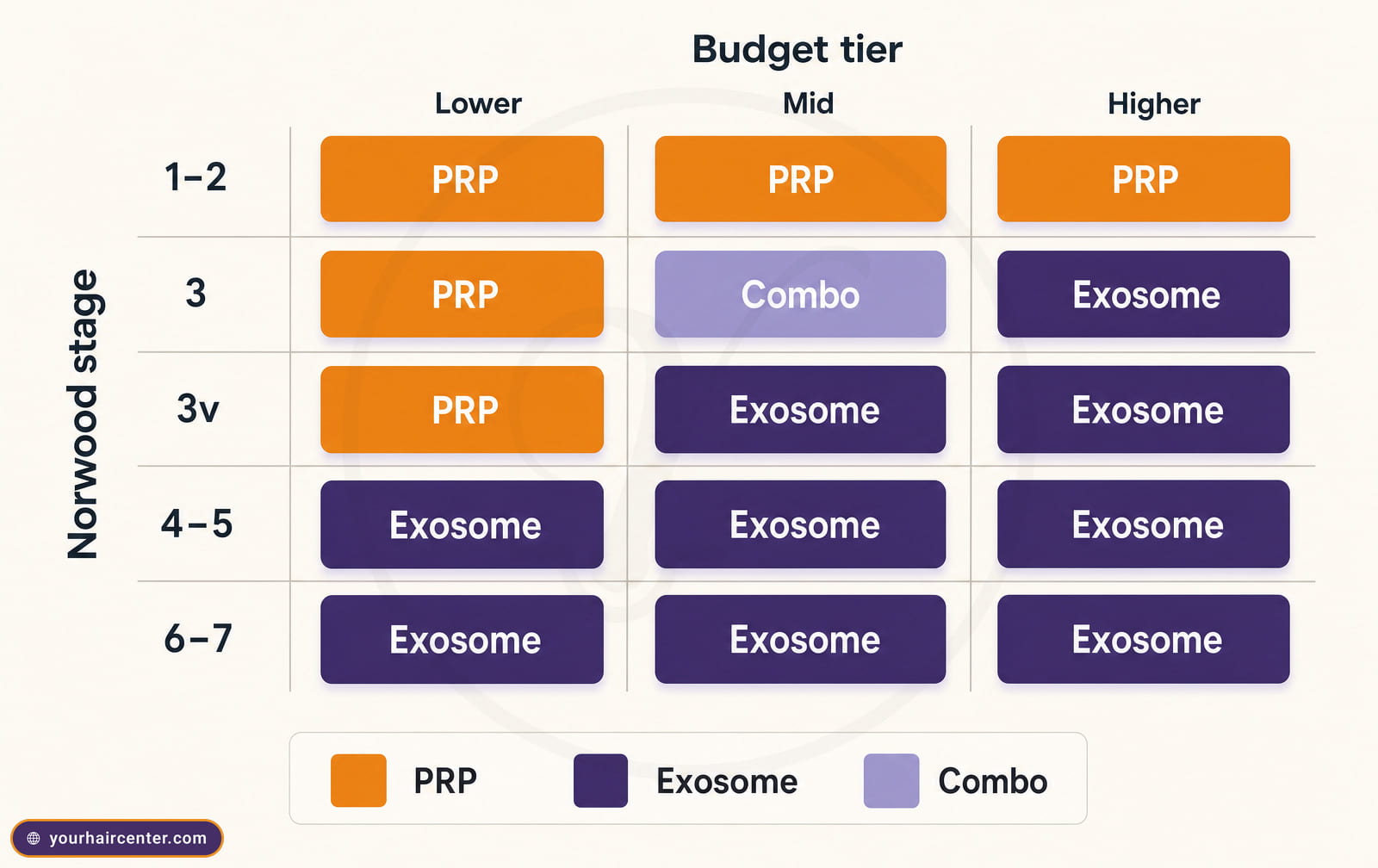
Here is the part of the exosome vs prp question no thin comparison page gives you. Read the matrix on three axes. Your Norwood stage comes from a scalp analysis, your budget tier is the total you are willing to spend on a course rather than a single session, and your recovery tolerance reflects how many days of mild scalp sensitivity you can absorb. The final column is the recommendation that fits all three.
| Hair-loss stage | Budget tier | Recovery tolerance | Recommended therapy | Why this fits |
|---|---|---|---|---|
| Norwood 1-2, early diffuse thinning | Lower total budget | Fine with 3-6 sessions over months | PRP, 4-6 sessions | Autologous safety, lowest cost, enough to activate early-stage follicles |
| Norwood 1-2 with prior PRP plateau | Mid total budget | Wants fewer sessions | Exosome, 2-3 sessions | An option after a PRP plateau, with evidence still limited |
| Norwood 3, frontal recession | Mid-to-higher total | Mixed | Combo, PRP base plus exosome boost | Covered in the combo section below |
| Norwood 3v, vertex thinning | Higher total, or Turkey medical tourism | Wants the shortest protocol | PRP first, exosome if it plateaus | PRP has the larger evidence base at this stage |
| Norwood 4-5, advanced but follicles present | Flexible | Comfortable with multi-month follow-through | Transplant evaluation, treatment continued | Neither injection regrows lost follicles; exosome has no proven edge |
| Norwood 6-7, donor available | Transplant budget | Committed to the surgical path | Transplant first; exosome after only as an option | Post-transplant evidence is still thin, covered below |
The cost-comparison frame
The trick the typical page misses in the exosome vs PRP cost question is to compare total-protocol cost, not per-session list price. A single exosome session in the US runs $3,500 to $7,500, while in the UK it is £2,500 to £5,000, and in those markets the price usually covers the session only, with consultation and follow-up billed separately. The same exosome protocol in Turkey starts from $500 per session and typically runs $500 to $1,500, with the session, the exosomes, and doctor follow-up included. Even adding flights and a hotel honestly, a full course in Istanbul often costs less than a single session in Manhattan or central London, which reframes the whole budget question for patients willing to travel.
The staging frame
If you are younger, paying out of pocket, and at an early stage, the smart move is not to overspend. Start with PRP at Norwood 1-2, give it the months it needs, and reassess at the six-month mark. Escalate to exosome only if PRP plateaus. This “don’t pay for what you don’t need yet” ladder is the most budget-efficient path for early-onset thinning, and it keeps the more expensive therapy in reserve for the moment it actually earns its cost.
When the matrix says “neither yet”
Both PRP and exosome need existing follicles, even miniaturized ones, to deliver a response. Patients with complete baldness and no remaining follicles, an active scalp infection, pregnancy or breastfeeding, or chemotherapy in progress are not candidates for either therapy as a standalone treatment. For complete baldness with adequate donor density, a transplant comes first, and exosome after surgery remains an untested option rather than an acceleration step.[3:3] Conversely, early thinning driven by a non-pattern trigger such as thyroid or iron issues should be addressed at the cause first. A scalp analysis and a broader review of broader hair-loss treatment options sort these cases before any injection is booked.
A quick recovery-tolerance reality check
In the exosome vs PRP decision, recovery rarely decides this. Both treatments are injection only with no downtime, and patients return to office work the same day. The standard aftercare is mild, avoid washing the hair for 12 hours and skip swimming pools and saunas for two days. PRP adds a small bruising risk at the blood-draw site, while exosome avoids that step entirely. Because neither requires real downtime, recovery tolerance mostly matters for patients with needle aversion, who should weight the lower session count of exosome hair treatment against the blood draw of PRP hair therapy.
The Combo Protocol, PRP First Then Exosome Then Transplant
The second thing thin comparison pages miss is that, framed as exosome vs prp, the two are not really rivals at all. They are tiers of one regenerative ladder, and some doctors combine PRP and exosome in a single program, although no study has yet measured whether the pairing works better than either alone.[5:1] The real exosome vs prp question is not “which one” but “which to start with, and when to escalate.”
Why staging beats picking one
Staging conserves budget where PRP is sufficient and reserves exosome for the moderate-thinning window, where it is discussed once PRP has stalled. It also gives you data. By starting low and reassessing, you turn exosome vs PRP from a one-time pick into a sequence and learn whether you are a strong responder before committing to the costlier therapy.
The 12-month staged ladder
A practical ladder looks like this. At month zero, a diagnostic scalp analysis confirms your Norwood stage and rules out non-pattern causes. Through months one to six, a PRP base of four to six sessions activates dormant follicles cost-efficiently and establishes your responder profile. At month six, a density comparison against your day-zero baseline decides the next step on the exosome vs PRP ladder. Responders continue maintenance, while partial responders move on through months seven to nine to an exosome boost of two to three sessions. By month twelve, sustained gains shift to long-interval maintenance, while insufficient gains at an advanced stage open a transplant evaluation, where exosome after surgery stays an option to discuss rather than a built-in step.
The combined-session program
Some patients want both modalities at once rather than a staged sequence, running the exosome vs PRP pairing together in a single visit. A combined PRP plus exosome program is sometimes offered in the moderate window, on the untested idea that the two add up to more than either alone. It is not a substitute for the staged ladder at early stages, where PRP by itself is usually enough. Before booking, ask for the protocol in writing, the number of sessions per modality, the spacing, and what triggers the escalation decision, with itemized pricing so you can pause or pivot at the six-month review without surprise costs.
Mesotherapy as an adjacent layer
Mesotherapy sits beside the regenerative ladder rather than competing on it. It delivers vitamins and minerals to the scalp over a longer course of about eight sessions, targeting nutritional-deficiency and weakened-follicle signals. For patients whose scalp analysis surfaces those signals alongside pattern loss, you can layer mesotherapy for nutritional-deficiency cases without changing the PRP-then-exosome sequence. If you want help mapping your own ladder, WhatsApp the medical team about your case.
Exosomes After a Transplant, the 2-to-4-Week Question
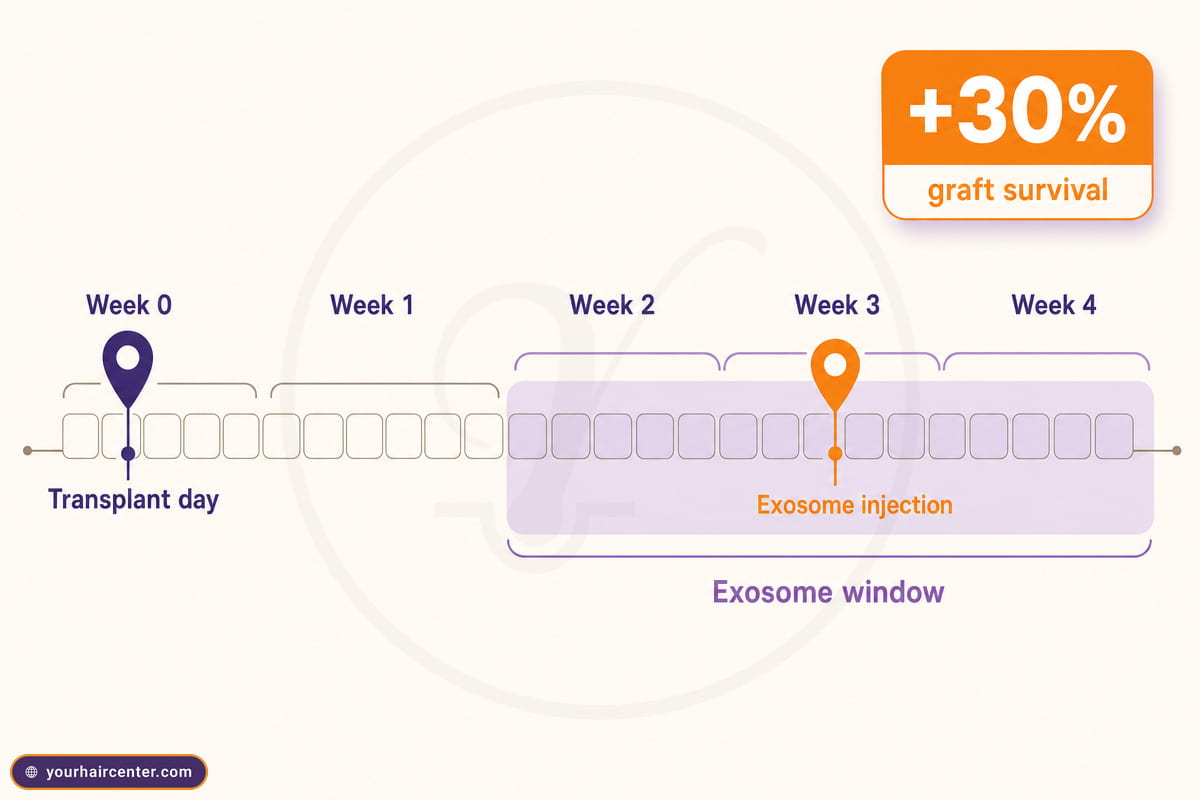
Patients planning surgery often ask about this window, yet it is the least studied use of exosome therapy, because no clinical study has tested exosomes after a transplant.[3:4]
Why the timing matters
Transplanted follicles spend the first two weeks anchoring and vascularizing in the recipient area. Injecting earlier risks disturbing healing grafts, which is why doctors who offer exosomes wait two to four weeks, a timing chosen by skin healing rather than by trials, since the right timing, dose and product after a transplant have not been determined.[2:1]
What has been measured
The +30% graft-survival figure that circulates in clinic marketing has no peer-reviewed measurement behind it, and the published reviews record no study of exosomes after a transplant.[3:5] Faster recovery and denser growth after surgery therefore remain hypotheses, so the post-transplant session is an optional add-on your doctor may discuss, not a built-in part of the surgical program.
How it fits either technique
The post-transplant exosome plan is the same whether you choose the Sapphire FUE technique or the DHI Choi pen technique. The choice between transplant methods is independent of the exosome decision, which is simply a yes-or-no add-on to either path. Patients traveling to Istanbul can pre-book the post-op sessions as part of a single extended stay or as a return visit, and the package math accounts for both. For the broader picture, our overview of broader hair-loss treatment options shows where surgery sits among non-surgical alternatives.
Frequently Asked Questions
Which is better, PRP or exosomes?
In the exosome vs prp question, whether PRP or exosomes is better depends on your hair-loss stage. PRP is the better fit for early thinning, budget-conscious patients, and those comfortable with a longer course of sessions. Exosomes are an option to discuss after a PRP plateau or for anyone who wants the shortest schedule, but no trial has compared the two head to head, and PRP has the larger evidence base.[1:2] The decision matrix above maps your stage and budget to the recommended therapy.
What is the dark side of exosomes?
The “dark side of exosomes” search usually surfaces a research paper about the role of exosomes in disease biology, which is a different subject from exosome hair therapy and its safety. For the therapy itself, the pooled clinical evidence across 298 patients reported no serious systemic complications. The documented effects were mild and transient, mainly scalp irritation or redness that settles quickly.[3:6]
Do celebrities use exosomes?
Public-figure use of exosome therapy for hair is sometimes mentioned in lifestyle coverage, but verified disclosures are rare and not a sound basis for a medical decision. In exosome vs PRP terms, the therapy sits in the same regenerative tier as PRP, which has a longer history of public association. The right basis for choosing is your Norwood stage and the published evidence, not celebrity association. For a grounded sense of typical outcomes, weigh the aggregate evidence on who actually sees results.
What is better than exosomes?
What is better than exosomes depends on the hair-loss stage. For early thinning, the FDA-approved medications finasteride and minoxidil remain the baseline and pair well with regenerative therapy. For advanced baldness where too few follicles remain, a transplant is the primary intervention, and no study has yet shown that exosome sessions after surgery improve graft survival.[3:7] Among non-surgical options in the moderate-thinning window, PRP hair therapy has the most evidence and exosome is a promising but less studied option, while a Sapphire FUE technique and DHI Choi pen technique round out the rest of the ladder.[1:3] For the full evidence picture, see what the 11-study clinical review actually documents on safety.
Stage first, then pick your rung on the ladder
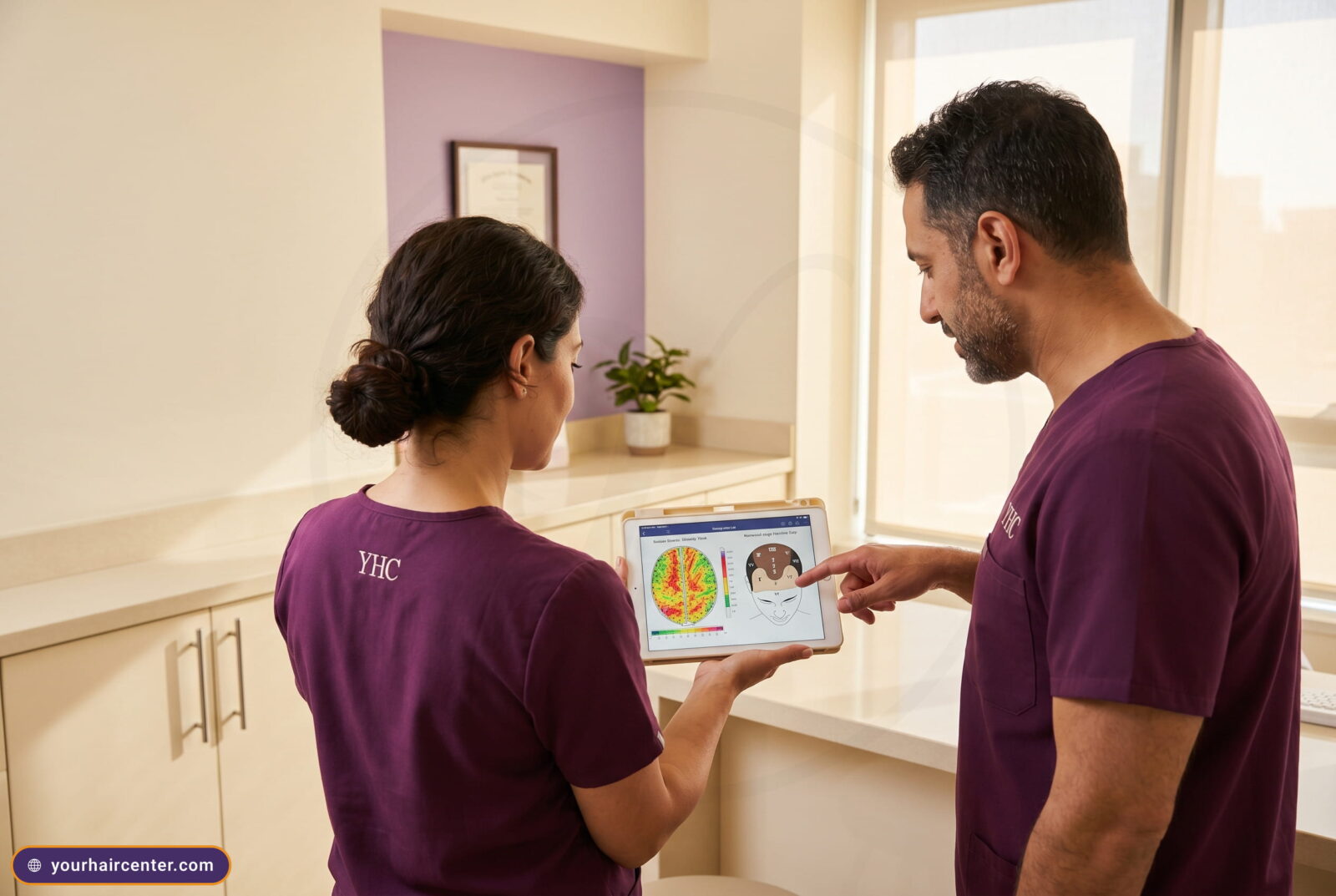
The exosome vs prp decision comes down to a simple frame. PRP fits early-stage thinning and tighter budgets and carries the larger evidence base, exosome is a promising option to discuss when PRP stalls, and the combo protocol stages them together for the cases in between. None of it should start before a Norwood-stage confirmation, which is the precondition for any sound therapy choice. Begin with a free scalp analysis, explore exosome hair treatment in Istanbul, or WhatsApp the medical team about your case for a personalized recommendation.
References
- Gupta AK, Wang T, Welter R, Unger R, Mejia R (ISHRS Ad Hoc Committee on Regenerative Medicine). “Promises and Pitfalls of Regenerative Therapies for Androgenetic Alopecia: Platelet-Rich Plasma, Photobiomodulation, Stem Cells, and Exosomes.” Medical Sciences, 2025. PubMed Central PMC12821594. https://pmc.ncbi.nlm.nih.gov/articles/PMC12821594/ (opens in new tab) (accessed 2026-10-06). ︎ ︎ ︎ ︎
- Acerbi Penha F, Acerbi Penha G, Caleiro Acerbi HM. “A Comprehensive Literature Review: The Potential of Exosomes in Hair Growth and Transplantation.” Hair Transplant Forum International, 2025;35(3):73-84. https://www.ishrs-htforum.org/content/35/3/73 (opens in new tab) (accessed 2026-10-06). ︎ ︎
- Al Ameer et al. “Exosomes and Hair Regeneration: A Systematic Review of Clinical Evidence Across Alopecia Types and Exosome Sources.” 2025. PubMed Central PMC12433634. https://pmc.ncbi.nlm.nih.gov/articles/PMC12433634/ (opens in new tab) (accessed 2026-05-28). ︎ ︎ ︎ ︎ ︎ ︎ ︎ ︎
- US Food and Drug Administration. “Public Safety Notification on Exosome Products.” https://www.fda.gov/vaccines-blood-biologics/safety-availability-biologics/public-safety-notification-exosome-products (opens in new tab) (accessed 2026-05-28). ︎
- Queen D, Avram MR. “Exosomes for Treating Hair Loss: A Review of Clinical Studies.” Dermatologic Surgery, 2025. PubMed 39447204. https://pubmed.ncbi.nlm.nih.gov/39447204/ (opens in new tab) (accessed 2026-10-06). ︎ ︎
