Most exosome hair treatment side effects are mild and transient, scalp irritation, redness, swelling, and itching that settle on their own. A 2025 systematic review of 11 studies and 298 patients reports no serious systemic complications or long-term adverse effects, while regulators stress there is still no FDA-approved exosome product. This guide separates the documented clinical evidence from forum speculation and gives you a five-question checklist to vet any clinic.

Most exosome hair treatment side effects are mild, short-lived, and settle on their own, and a 2025 systematic review of 11 clinical studies found no serious complications across 298 treated patients. Here is what the evidence documents before the anecdotes take over.
- Scalp irritation or pain at the injection sites.[1]
- Mild redness across the treated area; in the two studies that counted it, irritation or transient redness affected about 20% of patients.[1:1]
- Light swelling at the injection points.[1:2]
- Itching, and in one study numbness, across the treated area.[1:3]
- An occasional headache.[1:4]
- Swelling or pain from the microneedling, where the product is applied that way.[1:5]
- Effects that "resolved spontaneously and did not necessitate treatment discontinuation," in the review’s words.[1:6]
- No serious systemic complications, allergic reactions, or long-term adverse effects across the pooled clinical cohort.[1:7]
If you read three sections, read the regulatory-status section, the dark-side-paper section, and the clinic-vetting checklist. Those carry the questions that decide whether this therapy is right for you.
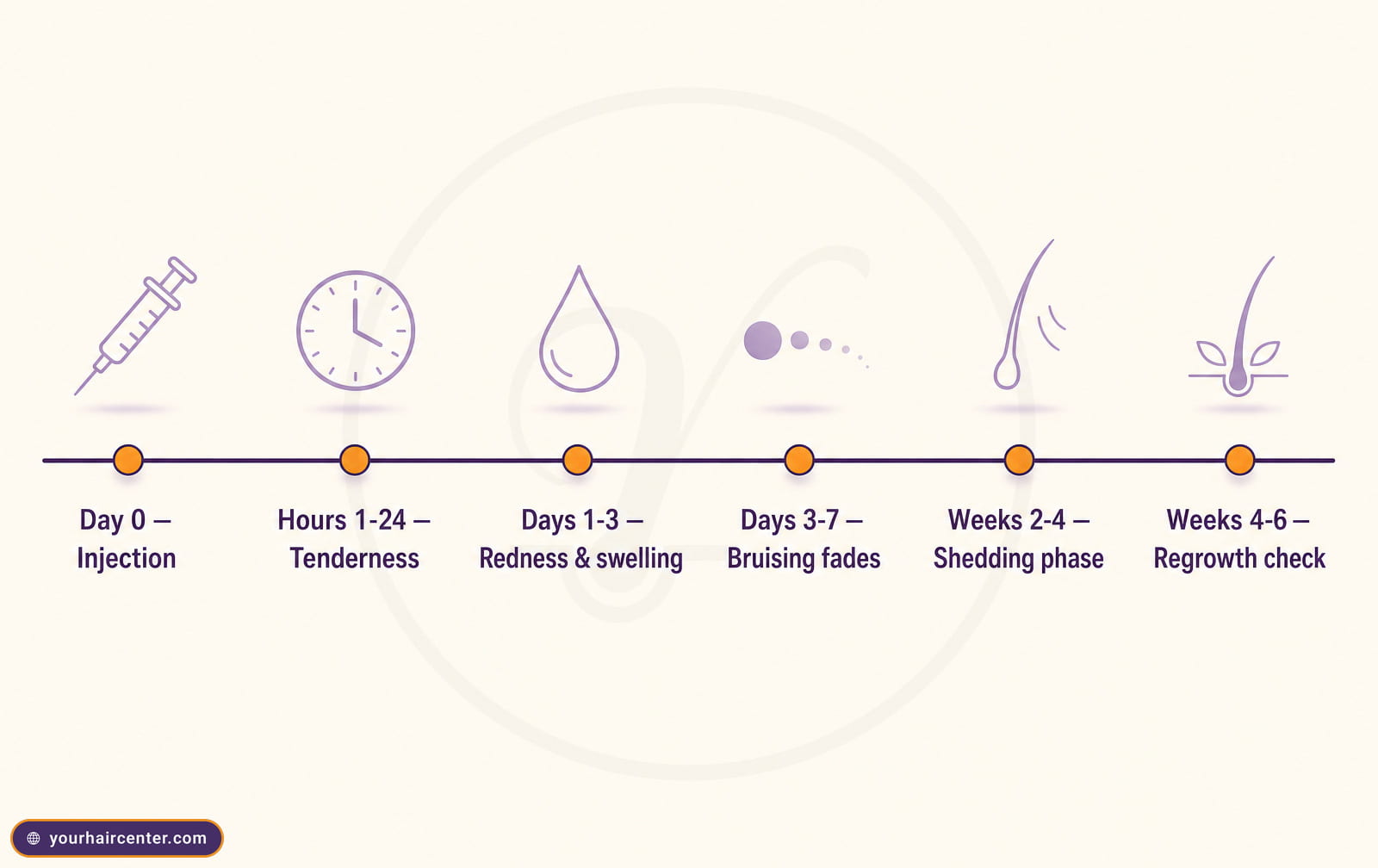
What the 11-study clinical review actually documents
A 2025 systematic review of exosome hair treatment side effects is the source for every clinical figure in this section, and it is fully auditable.
The cohort, 11 studies and 298 patients
The 2025 systematic review pooled 11 studies covering 298 patients, drawing on two randomized controlled trials, three retrospective studies, three prospective single-arm studies, one case series, and two case reports.[1:8] Patients span androgenetic alopecia in men and women, plus single reports in chemotherapy-induced alopecia and acquired trichorrhexis nodosa, and follow-up ranged from 6 weeks to 12 months.[1:9] This is the exosome hair treatment we offer assessed against the published record, not marketing copy.
What was reported, and at what frequency
The safety finding is direct. "No serious adverse events were noted," and those that did occur "were predominantly mild and transient, including scalp irritation, redness, swelling, itching, and occasional headaches."[1:10] In the studies that quantified it, mild irritation or transient redness affected about 20% of patients, and the review found "no serious systemic complications, allergic reactions, or long-term adverse effects."[1:11] A null finding across 298 patients is meaningful, not a lifetime guarantee.
The honest limitations of the evidence base
A responsible reading states the boundaries. The cohort is 298 patients, not 29,800, and the longest follow-up reaches 12 months, so multi-year safety evidence does not yet exist.[1:12] A separate scoping review agreed, noting the field still "lack[s] publicly available trials that analyze their safety and efficacy" and that studies "lacked standardization in exosome isolation, purification, and characterization."[2]
How transient exosome side effects actually behave in real patients
The review does not time each effect in hours or days. It reports that the irritation, redness, swelling, and itching "resolved spontaneously and did not necessitate treatment discontinuation," and that the swelling or pain in one study came from the microneedling used to apply the product.[1:13] No study in it listed hair loss, temporary or lasting, among its adverse events.[1:14] Knowing that pattern lets you tell ordinary recovery from an outlier worth raising at your pre-treatment hair and scalp analysis.
Untangling the "dark side of exosomes" search result
Search for exosome safety and one alarming phrase keeps surfacing, the "dark side of exosomes." It pulls readers into a misread that has nothing to do with hair therapy. The paper behind it is a 2021 review titled "Dark-Side of Exosomes," and it is about exosomes as a biological mechanism in disease.[3] It describes how exosomes "participate in the development of diabetes and its associated complications," "critically contribute to the spreading of neuronal damage in Alzheimer’s disease," and how cancer-cell exosomes mediate "transfer of oncogenes and onco-miRNAs from one cell to other."[3:1] None of that describes a documented exosome product injected into a healthy adult scalp.
The misread happens because a search snippet surfaces an evocative title without its context, confusing the disease-biology question with the treatment-safety question. They sit on separate evidence bases. The safety evidence for the exosome hair treatment we offer at YHC is the clinical literature above, not a paper about how cancer cells signal to one another.
Three audit questions resolve almost any future scary headline. Is the paper about exosome therapy, the injected product, or about exosomes as a disease mechanism? What was studied, cells in a dish, mice, or human adults receiving scalp injections? And what did it measure, disease progression or clinical adverse events? A fuller version lives in our exosome vs PRP comparison.
Untangling the aesthetic-complication paper, hair scalp is not the same as facial skin
A second strand surfaces in safety searches, case reports of complications after exosome treatments for facial skin rejuvenation. They are real, and they are about the face, not the scalp. A 2024 case series describes seven women in South Korea and Australia who developed delayed-onset granulomatous lesions at the treated sites, 2 weeks to 3 months after treatment.[4] A 2025 case series describes four women left with persistent nodules, granulomatous inflammation, and scarring on the cheek after exosome formulations sold for topical use were injected into the skin, and concludes that intradermal injection of unapproved exosome-based formulations "may cause serious and persistent cutaneous complications."[5]
Scalp injections are a different target, with a goal of follicle stimulation rather than skin rejuvenation, and none of the 11 hair studies reported granulomas or nodules.[1:15] The exosome side effects profile that applies to scalp therapy is the hair-restoration one, mild transient irritation and no serious systemic events.[1:16] Both sets of authors, though, point at the product rather than the face, one at cosmetics made for the skin’s surface being injected into it,[5:1] the other at the lack of standard protocols for isolating and purifying exosomes.[4:1] That applies to the scalp as much as the cheek, which is why the source questions in the checklist below matter. The continuity that backs a YHC course of treatment is our medical follow-up program, tracking each patient through the transient-effects window.
Rare and serious complications, the honest framing
A source that says "completely safe, no risks ever" is signaling marketing, not medicine. The honest framing names the rare exosome side effects and explains what keeps them rare.
Infection risk at injection sites
No infections were reported across the 11 studies in the review,[1:17] but any injection through the skin carries a small infection risk, and that risk rises in unsterile conditions. The prevention is single-use needles, aseptic technique, and scalp antisepsis. Public-health guidance is explicit: "Do not administer medications from a syringe to multiple patients, even if the needle or cannula on the syringe is changed," and "use aseptic technique to avoid contamination of sterile injection equipment."[6]
Allergic or hypersensitivity reactions
No allergic reactions were reported across the 298-patient cohort.[1:18] A theoretical risk exists because exosomes are a biological-product injection, but the documented rate is null. The standard prevention is pre-treatment screening, consistent with patient-advocacy guidance to consult a qualified hair loss specialist first, and it happens at your pre-treatment hair and scalp analysis.[7]
Source-related risks, why the supplier chain matters
The sharpest real-world warning sits here. Regulators have documented serious harm not from controlled clinical therapy but from unapproved, poorly sourced products. In December 2019 the US Food and Drug Administration reported "multiple recent reports of serious adverse events experienced by patients in Nebraska who were treated with unapproved products marketed as containing exosomes."[8] Its patient guidance on unapproved regenerative products, a group that includes exosomes, lists blindness, tumor formation, and "bacterial infections including life-threatening blood infections" among the harms reported to it.[9] In August 2026 the FDA warned a US supplier whose umbilical-cord-derived products were sold as exosomes, one of them promoted for hair among other uses, that they were unapproved drugs, that the aseptic processes behind products sold as sterile had not been validated, and that the manufacturing process did not appear to isolate exosomes at all.[10] The lesson is not that exosome therapy is inherently dangerous, but that source quality, contamination control, and supplier documentation separate a controlled product from an off-protocol one. The medical follow-up program and supplier-documented sourcing keep treatment inside that lane.
The long-term exosome side effects unknown, and how to think about it
The 6-to-12-month windows do not amount to multi-year safety evidence, stated plainly.[1:19] A 2026 systematic review of regenerative treatments for pattern hair loss, three of its 20 studies on extracellular vesicles, again found only mild, transient adverse events and named limited long-term data as the gap that extended follow-up has to close.[11] The scoping review puts it more bluntly: several side effects "still need to be examined."[2:1] This is the ordinary early-evidence picture for a young modality. Making a 2026 decision against 2030 evidence is a choice between waiting and acting on what exists.
Regulatory status, no FDA-approved exosome hair product
This is the question skeptical readers scan for, and any responsible source must answer it without hedging. As of 2026, there is no FDA-approved exosome product for hair restoration. The FDA states plainly that "there are currently no FDA-approved exosome products," and the American Hair Loss Association confirms there are "no FDA-approved exosome products for hair loss."[8:1][7:1]
"Not FDA-approved" needs unpacking, and the FDA’s own words leave little room. Exosomes used to treat diseases and conditions in humans "are regulated as drugs and biological products" and "are subject to premarket review and approval requirements," and the agency calls the claim that they fall outside those rules "simply untrue."[8:2] The injection itself is governed by physician licensing and the rules of the country where it is given. For a US patient looking abroad, the FDA’s advice is to "learn about regulations that cover products in that country," because it "does not have oversight of treatments done in other countries."[8:3]
Patient-advocacy guidance is stricter still. The American Hair Loss Association does not endorse exosome treatments for hair loss outside clinical trials or research settings, and asks anyone considering one to consult a qualified hair loss specialist and "verify the legitimacy of any product or provider."[7:2] The exosome hair treatment we offer at YHC is not a trial, so what we owe you is the documentation to make that call yourself, a batch-numbered product with its supplier documentation and cold-chain record, licensed-physician administration, and the screening and 12-month medical follow-up program described below. None of that is an approval, and we do not present the product as approved.
Who should not get exosome hair therapy
Candidacy exclusions are where you check whether this therapy is wrong for your situation. Each has a clinical reason behind the rule, and most are caught at your pre-treatment hair and scalp analysis.
Active scalp infection
Folliculitis, fungal infection, or a seborrheic-dermatitis flare rules out treatment for now, because injecting into infected tissue risks driving the infection deeper. Treat it first and re-evaluate when the scalp is clear.
Active autoimmune or immunosuppressive conditions
The current safety evidence does not cover patients on active immunosuppression, and the response to a biologic injection may be altered. Clearance from the treating specialist is the standard path, consistent with the advice to consult a qualified hair loss specialist first.[7:3]
Pregnancy and breastfeeding
There is no safety data in pregnant or breastfeeding patients, and the precautionary standard for any new biologic injection is to defer. Treatment waits until after weaning and a re-stabilized hormonal baseline.
Active or recent cancer, particularly during chemotherapy
Oncology patients have complex tissue-healing dynamics during active treatment. The disease-biology literature above is context for this precaution even though it does not describe hair-therapy adverse events.[3:2] The exclusion resolves with clearance from the oncology team.
Known allergy to the biological product or carrier
Allergic reactions were null in the cohort, but a known prior allergy to the specific biologic or carrier is a hard contraindication.[1:20] Where a reaction is suspected but unconfirmed, options range from a controlled pre-test to alternatives such as PRP hair treatment as an alternative.
Complete baldness with no remaining follicles
Exosomes regenerate weakened follicles, they do not create new follicular units from bare scalp. In a fully bald zone the appropriate route is hair transplant if exosome alone is not the right fit, with exosome therapy supporting the transplant.
Forum anecdotes vs clinical evidence, three myths worth retiring
Forums are a legitimate part of how people research, and dismissing them outright is its own bad faith. But it is worth separating documented exosome side effects from the unverified forum reports that spread fastest. The table contrasts the two for the three claims that recur most.
| Common forum claim | What the clinical evidence documents |
|---|---|
| Exosome therapy causes permanent hair loss | No study in the 11-study review listed hair loss, temporary or lasting, among its adverse events; the effects it recorded were irritation, redness, swelling, itching, numbness, and headaches.[1:21] |
| Exosomes raise cancer risk because they are stem-cell-derived | A conflation with disease-biology research; the 11 hair studies, with follow-up of up to 12 months, reported no serious adverse events.[1:22][3:3] |
| If it worked, the FDA would approve it | No exosome product is FDA-approved for any use; the FDA regulates them as drugs and biological products that need premarket approval, and none has been approved yet.[8:4] |
The hair-loss claim has no support in the clinical cohort, which recorded no shedding or loss as an adverse event; a shed that starts after a session and does not settle is a reason for a review, not something to wait out.[1:23] The cancer claim borrows from disease-biology research that does not measure risk from hair-restoration injections, and the clinical studies, followed for 12 months at most, cannot rule out a long-term risk either.[1:24][3:4] And the FDA claim confuses "not approved" with "shown not to work"; the better question is whether the evidence base is strong enough for you. Weighing it against an autologous option such as PRP hair treatment as an alternative, the exosome vs PRP comparison sets the two side by side, and the exosome hair treatment cost article handles the budget question.

The clinic-vetting checklist, what to ask before you book anywhere
Safety depends as much on the clinic as on the science. These five questions work on any clinic, including the partner clinics in our network, and vague answers tell you something.
Storage and handling, the cold-chain question
Ask the storage temperature, who maintains the cold chain, and the protocol between thaw and injection. Exosomes are heat-sensitive biologics whose potency degrades on temperature excursion, and an expiry date means little without stability data behind it; in its August 2026 warning letter the FDA found a 24-month expiry assigned with no stability testing to support it.[10:1] The standard is verified cold storage with a documented thaw-to-injection window.
Source documentation, where the exosomes came from
Ask who the supplier is, the source cell type, and whether a batch-level certificate of analysis is available for your session. A label is not proof of contents: in the same letter the FDA found products sold as exosomes whose manufacturing process did not appear to isolate them.[10:2] The standard is named-supplier sourcing with the source disclosed, human mesenchymal or marine-derived, and batch documentation on request.
Injector credentials, who is putting the needle in your scalp
Ask whether the injector is a licensed physician, their training in scalp therapy, and how many sessions they have administered. Technique affects safety and results, and non-physician injectors operate under different scopes of practice in different countries. Patient-advocacy guidance is to verify the legitimacy of any product or provider before treatment.[7:4]
Sterile field, what the operating environment looks like
Ask what infection-control standards the clinic follows, what scalp-antisepsis protocol is used, and what single-use disposables are in play. Infection is the adverse event a sterile field exists to prevent, and the established standard is single-use needles and aseptic technique.[6:1]
Follow-up plan, what happens after the last session
Ask the follow-up schedule, your contact between sessions, and what happens if a concern arises after you return home. This is what actually answers "what if something goes wrong abroad," and it is a plan, not a promise, a documented schedule, a named contact, and a clear escalation pathway.
Before you book the exosome hair treatment we offer at YHC or anywhere else, ask all five and compare answers across clinics. The right clinic gives you written, specific answers.

The YHC safety protocol and post-op care chain
This is where the checklist becomes a patient’s lived experience, and where "what if something goes wrong abroad" gets a concrete answer.
Before the session, screening decides whether you proceed at all, a photo evaluation, the candidacy check against the exclusions above, a medical-history review, and a supplier-source disclosure at consultation.
During the session, the operative standard is a documented antisepsis protocol, licensed-physician administration, disciplined injection technique, and immediate monitoring, in a session of about 45 minutes with no surgery and no downtime.
After the session, the post-op safety chain takes over, an aftercare brief, accessible contact through the first few days, a 4-to-6-week check, and dermoscopy reviews through the medical follow-up program. If something does go wrong, the escalation pathway runs from your coordinator to the treating physician, and your photographs and case file travel with you, so a question six weeks later reaches a team that holds the full record.
Frequently asked questions about exosome hair treatment side effects
Is exosome hair therapy safe?
Is exosome hair therapy safe? A 2025 systematic review of 11 studies and 298 patients found no serious systemic complications, no allergic reactions, and no long-term adverse effects, with mild, transient irritation or redness in about 20% of patients in the two studies that counted it.[1:25] Exosome hair treatment side effects in practice also depend on the storage, source, injector, sterile field, and follow-up chain above.
Are exosome hair treatment side effects long-term?
Are exosome hair treatment side effects long-term? No long-term adverse effects were observed in the pooled clinical evidence.[1:26] The honest caveat is that follow-up reaches only 6 to 12 months, so multi-year data does not yet exist, and reviewers note that several side effects "still need to be examined."[2:2] The short-to-medium-term profile is reassuring, the long-term picture remains open.
Is exosome better than minoxidil?
Is exosome better than minoxidil? They are different tools. Minoxidil is FDA-approved, applied daily for life, with common effects including scalp irritation and an initial shedding phase. Exosome therapy is not FDA-approved as a drug, uses a 2-to-4-session protocol, and shows a transient exosome side effects profile.[1:27][8:5] The fuller side-by-side is in our exosome vs PRP comparison.
What to avoid after exosome hair treatment?
What to avoid after exosome hair treatment? Avoid washing your hair for 12 hours and avoid swimming pools and saunas for two days. For the first week, skip harsh shampoos and massaging the injection sites, and give intense exercise and direct sun a day or two. These cautions protect the scalp while the growth factors take hold.
Can exosome hair treatment make hair loss worse?
Can exosome hair treatment make hair loss worse? None of the 11 studies in the 2025 review listed hair loss, temporary or lasting, among the exosome hair treatment side effects it recorded; the effects it did record were mild and settled on their own.[1:28] The cohort is small and follow-up ends at 12 months, so a shed that starts after a session and does not settle within a few weeks is worth raising at the 4-to-6-week check rather than waiting it out.
Is exosome hair treatment good or bad?
Is exosome hair treatment good or bad? It is a values-and-evidence judgment, not a verdict. The therapy shows a strong short-to-medium-term safety profile across an 11-study review, can be effective for the right candidate, and is not FDA-approved as a drug.[1:29] That makes it a reasonable informed choice for some patients and not others, and the exosome hair treatment cost article helps weigh the value side.
Conclusion and next step
The clinical record on exosome hair treatment side effects is more reassuring than the headlines and more honest than the marketing. Across an 11-study, 298-patient review, the documented effects are mild and transient, scalp irritation, redness, swelling, itching, and the occasional headache, and they settled without stopping treatment.[1:30] Just as honestly, there is no FDA-approved exosome product, multi-year safety evidence does not exist yet, and the real-world danger sits in poorly sourced, off-protocol products rather than in controlled clinical therapy.[8:6][10:3] The practical takeaway is the five-question checklist, storage, source, injector, sterile field, and follow-up, and judging any clinic by how specifically it answers.
For those questions answered for your own case, start a free WhatsApp consultation with the YHC medical team. Every YHC procedure is backed by the medical follow-up program described above, so the safety conversation does not end when you fly home.
The content and sources of this guide were reviewed on 6 October 2026.
References
-
Al Ameer MA, Alnajim AT, Al Ameer A, Alsalman Z, et al. Exosomes and Hair Regeneration: A Systematic Review of Clinical Evidence Across Alopecia Types and Exosome Sources. Clinical, Cosmetic and Investigational Dermatology, 2025;18:2215-2227. PMC12433634. https://pmc.ncbi.nlm.nih.gov/articles/PMC12433634/ (opens in new tab) (accessed 2026-10-06). ︎ ︎ ︎ ︎ ︎ ︎ ︎ ︎ ︎ ︎ ︎ ︎ ︎ ︎ ︎ ︎ ︎ ︎ ︎ ︎ ︎ ︎ ︎ ︎ ︎ ︎ ︎ ︎ ︎ ︎ ︎
-
Schaffer S, Tehrani L, Koechle B, et al. A Scoping Review of Exosome Delivery Applications in Hair Loss. Cureus, 2025;17(3):e81152. PMC12020662. https://pmc.ncbi.nlm.nih.gov/articles/PMC12020662/ (opens in new tab) (accessed 2026-10-06). ︎ ︎ ︎
-
Engin A. Dark-Side of Exosomes. Advances in Experimental Medicine and Biology, 2021;1275:101-131. PubMed 33539013. https://pubmed.ncbi.nlm.nih.gov/33539013/ (opens in new tab) (accessed 2026-10-06). ︎ ︎ ︎ ︎ ︎
-
Nahm WJ, Thunga S, Yoo J. Complications After Exosome Treatment for Aesthetic Skin Rejuvenation (case series). Dermatological Reviews, 2024;5(4), corrected 2025-02-04. DOI 10.1002/der2.242. https://onlinelibrary.wiley.com/doi/abs/10.1002/der2.242 (opens in new tab) (accessed 2026-10-06). ︎ ︎
-
Park KY. Adverse Reactions Following Intradermal Injection of Exosome-Based Formulations: A Case Series. Journal of Cosmetic Dermatology, 2025;24(10):e70520. PMC12528963. https://pmc.ncbi.nlm.nih.gov/articles/PMC12528963/ (opens in new tab) (accessed 2026-10-06). ︎ ︎
-
Centers for Disease Control and Prevention. Safe Injection Practices to Prevent Transmission of Infections to Patients (last reviewed April 12, 2024). https://www.cdc.gov/injection-safety/hcp/clinical-guidance/index.html (opens in new tab) (accessed 2026-10-06). ︎ ︎
-
American Hair Loss Association. Stem Cells and Exosomes in Hair Loss Treatment: Hope or Hype? (April 4, 2025). https://www.americanhairloss.org/stem-cells-and-exosomes-in-hair-loss-treatment-hope-or-hype/ (opens in new tab) (accessed 2026-10-06). ︎ ︎ ︎ ︎ ︎
-
US Food and Drug Administration. Public Safety Notification on Exosome Products (issued December 6, 2019). https://www.fda.gov/vaccines-blood-biologics/safety-availability-biologics/public-safety-notification-exosome-products (opens in new tab) (accessed 2026-10-06). ︎ ︎ ︎ ︎ ︎ ︎ ︎
-
US Food and Drug Administration. Important Patient and Consumer Information About Regenerative Medicine Therapies (June 3, 2021). https://www.fda.gov/vaccines-blood-biologics/consumers-biologics/important-patient-and-consumer-information-about-regenerative-medicine-therapies (opens in new tab) (accessed 2026-10-06). ︎
-
US Food and Drug Administration, Center for Biologics Evaluation and Research. Warning Letter CBER 26-726330 (August 14, 2026). https://www.fda.gov/inspections-compliance-enforcement-and-criminal-investigations/warning-letters/r3-medical-companies-726330-08142026 (opens in new tab) (accessed 2026-10-06). ︎ ︎ ︎ ︎
-
Behrangi E, Amiri S, Zeinali R, et al. A systematic review of clinical evidence on the efficacy and safety of conditioned media, platelet-rich fibrin, stromal vascular fraction, extracellular vesicles, and stem cells in androgenetic alopecia. Stem Cell Research & Therapy, 2026;17(1):194. PMC13191867. https://pmc.ncbi.nlm.nih.gov/articles/PMC13191867/ (opens in new tab) (accessed 2026-10-06). ︎
