4500
grafts
DHI
The FUE vs FUT hair transplant choice comes down to three things, the scar each method leaves behind, the recovery window you can afford, and the pricing reality once a Turkey all-inclusive package enters the same table as a US quote. This guide runs the full side-by-side comparison, shows what FUT and FUE scars actually look like at 5 and 10 years, explains why FUE is the modern default for most candidates, and gives you a clear decision tree for which technique fits your case in 2026.

If you are weighing the FUE vs FUT hair transplant decision in 2026, the short answer is that FUE has become the modern default for most candidates, while FUT still earns its place in a narrow set of cases. FUE is the no-scalpel method with no visible linear scar and a recovery window of roughly one week. The harder FUE vs FUT question is not which technique is newer, but which scar pattern, which recovery timeline, and which pricing reality you can actually build a decision around.
This comparison has a short answer for most candidates in 2026. FUE is the right call, and FUT is the niche option that still makes sense for very high lifetime graft counts on patients with healthy donor laxity who never plan to wear short hair. FUE extracts individual follicular units one at a time from the donor area with a micropunch about 0.7 to 1.2 mm across. FUT removes a strip of donor scalp, dissects it into units under stereo microscopes, then closes the strip with sutures. Four headline differences carry the whole FUE vs FUT comparison. The extraction mechanism differs (individual follicles versus a scalp strip), the scarring differs (scattered dots versus a permanent linear line), the recovery window differs (about a week versus two to three weeks), and the single-session graft count differs (FUT can move more grafts in one sitting, while FUE is bounded by what the donor area can safely give).
There is one more factor in the decision. The FUE vs FUT hair transplant choice is usually framed as a US-domestic decision, where FUT often lists a lower per-graft price. That advantage collapses once an all-inclusive Turkey FUE hair transplant package enters the same table. In 2026 the FUE vs FUT decision is less about cost than about which scar and which recovery window you can live with. The side-by-side table further down carries the full comparison at high resolution, and it sits inside the broader hair transplant category if you want the wider context.
In an FUE session, a micropunch about 0.7 to 1.2 mm across rotates around a single follicular unit and scores the dermis to a controlled depth. The unit is lifted out with fine forceps, and the small donor wound closes on its own into a dot scar 1 mm or smaller. Repeat that across the donor zone for several thousand grafts and you have the entire extraction phase, with no scalpel and no stitch line.
The load-bearing FUE vs FUT difference is the phrase "no visible linear scar." The dots scatter across the back and sides of the head and usually hide under hair as short as a number 2 buzz. FUE is not scarless, though, and the more grafts a surgeon takes from one area, the more likely the dots are to show at very short lengths. An FUT strip scar, by contrast, becomes visible at any clipper length the closure ridge does not cover, which is the constraint that shapes the rest of this comparison.
Single-session capacity is the next practical question in the FUE vs FUT hair transplant comparison. An FUE session typically places 2,000 to 3,500 grafts and up to about 4,000 in one sitting, which covers most Norwood 3 to Norwood 5 cases without dipping into the donor reserve. Larger cases run over two days under one plan or as a second session months later. For donor-density questions and blade-tier choices, the sapphire FUE variant is the related upgrade many candidates evaluate alongside standard FUE.
Recovery is where the FUE vs FUT gap is easiest to feel, with FUE running to roughly 7 days of social downtime. Mild swelling tends to appear around day three and clears by day six, with light crusting over the donor area. The transplanted zone then moves through a normal shock-loss phase between months 1 and 3, where the placed hairs shed before new growth begins, and the final result lands at 10 to 12 months. Because FUE is the dominant procedure offered in Istanbul packages, the per-graft economics, the English-speaking coordination, and the 12-month remote follow-up are all built around an FUE-shaped timeline rather than an FUT one.
FUE has one limitation worth naming before the FUE vs FUT verdict. On candidates with extremely high lifetime graft requirements, in the range of 8,000 grafts and above, over-harvesting the donor in a single sitting can permanently thin it. That scenario sometimes calls for a second session, and it is also the narrow situation where FUT still deserves a look. This sits inside the broader hair transplant category, where every technique is judged against the same finite donor supply.
On the other side of the FUE vs FUT comparison, a FUT session begins differently. The surgeon excises a horizontal strip of donor scalp from the occipital zone, typically around 1 cm wide with the length scaled to the graft target, and passes it to technicians working at stereo microscopes. They dissect the strip into individual follicular units. The surgeon then closes the donor with sutures, often using a trichophytic technique that recruits hair to grow up through the closure line so it camouflages itself over time.
Trichophytic closure matters, but it does not erase the scar. A clean, low-tension closure produces a fine linear scar that hides well under hair at a number 4 clipper length or longer. The same closure on a high-tension donor, or on a patient whose scalp has limited elasticity, produces a wider and more visible line that no clipper length fully covers. This is the heart of the FUT scar question that the photo gallery lets you inspect on real donor-area cases rather than in the abstract.
On capacity, FUT holds the edge in the FUE vs FUT matchup. The ISHRS lists moving a very large number of grafts in one session among its main advantages, and a lax scalp lets the surgeon take a longer strip. Recovery, though, is heavier, with stitches that come out at 10 to 14 days. That window is driven by suture removal, donor-area tension during the first 10 days, and the visible closure line until surrounding hair grows back in.
So where does FUT still earn the decision in the FUE vs FUT trade-off? The case rests on three criteria met together. First, a very high lifetime graft requirement that probably means a second or third session. Second, confirmed donor-area laxity that a surgeon has actually measured. Third, a stated, lifelong commitment to never wearing hair shorter than the closure ridge can cover. Miss any one of those and FUE is almost always the better fit.
The medical-tourism angle reframes the FUE vs FUT decision again. Istanbul clinics overwhelmingly run FUE-based packages, so the "FUT is cheaper" line is a US-domestic artifact that does not survive once Turkey FUE pricing enters the same table. If a candidate genuinely fits the three FUT criteria, the geography of the FUE vs FUT decision changes shape rather than the technique alone. For readers comparing modern follicle-by-follicle methods, the DHI Choi pen technique is the other implantation variant worth understanding before settling on a strip procedure.
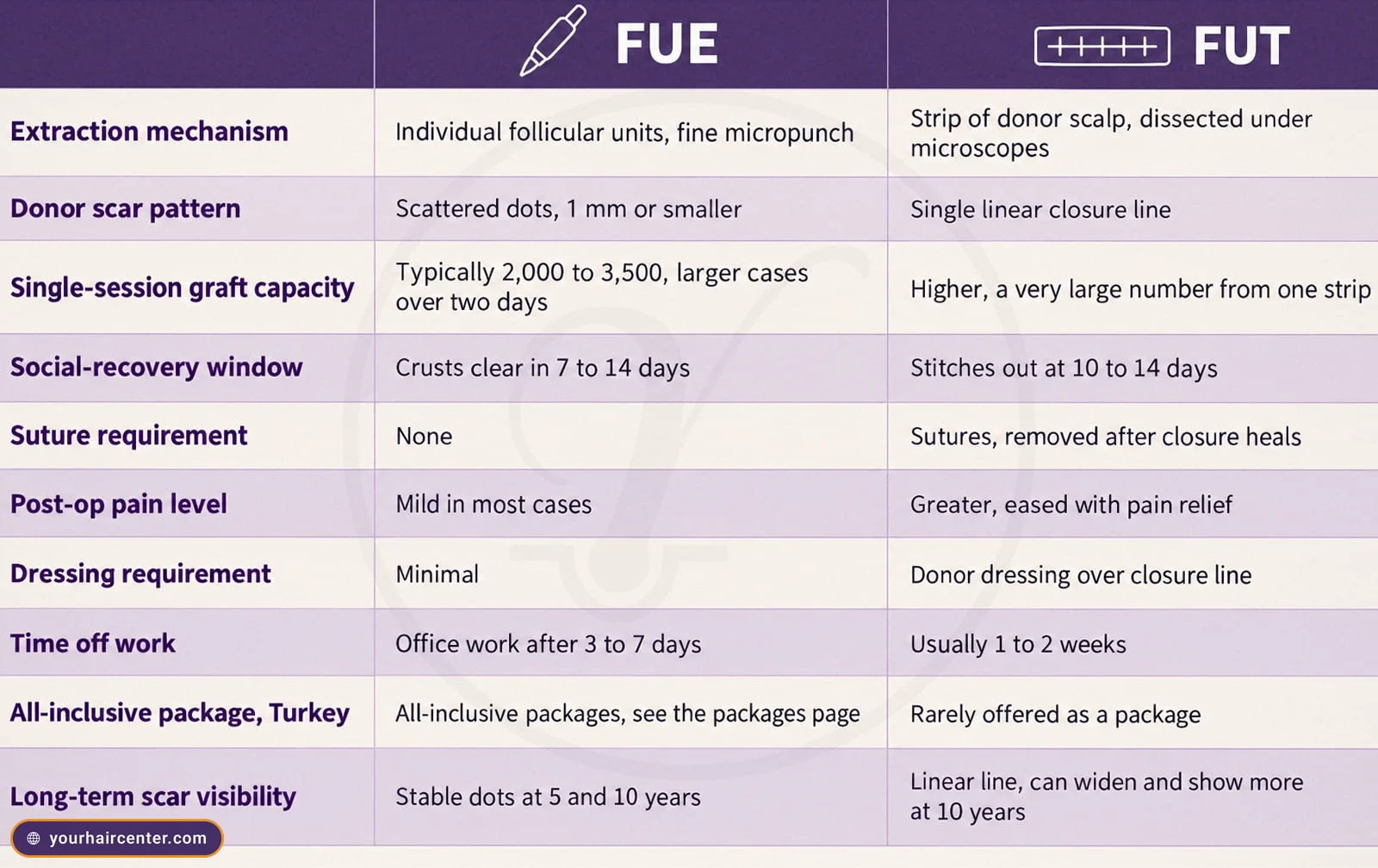
To keep the two methods concrete rather than generic, the table below anchors to a representative case, a Norwood 4 head needing 3,000 to 4,000 grafts. Real numbers shift with Norwood stage, donor density, and surgeon time, so treat this as a representative FUE vs FUT comparison, not a personal quote.
| Criterion | FUE | FUT |
|---|---|---|
| Extraction mechanism | Individual follicular units, 0.7-1.2 mm micropunch | Strip of donor scalp, dissected under microscopes |
| Donor scar pattern | Scattered dots, 1 mm or smaller | Single linear closure line |
| Single-session graft capacity | Typically 2,000 to 3,500, up to about 4,000 | Higher, a very large number from one strip |
| Social-recovery window | Crusts clear in 7 to 14 days | Stitches out at 10 to 14 days |
| Suture requirement | None | Sutures, removed after closure heals |
| Post-op pain level | Mild in most cases | Greater, eased with pain relief |
| Dressing requirement | Minimal | Donor dressing over closure line |
| Time off work | Office work after 3 to 7 days | Usually 1 to 2 weeks |
| Single-session price, US | Commonly several US dollars per graft | Often listed below US FUE per graft |
| Single-session price, UK | Broadly comparable to US, currency-adjusted | Often listed below UK FUE per graft |
| All-inclusive package, Turkey | All-inclusive packages, see the packages page | Rarely offered as a package |
| Long-term scar visibility | Stable dots at 5 and 10 years | Linear line, can widen and show more at 10 years |
Run the totals and the pricing row is where the FUE vs FUT comparison turns. US clinics commonly quote several dollars per graft, which can put a large 3,000-graft session in the five-figure range before any add-ons. Our all-inclusive packages in Istanbul run from $1,650 to $4,650 and already bundle the hotel, transfers, and a full year of follow-up. US FUT often lists a lower per-graft figure than US FUE, but it does not compete with the bundled Turkey total.
On success rate, the FUE vs FUT hair transplant comparison is closer than marketing suggests, since both achieve high graft survival in experienced hands, so the survival number is not the deciding factor. The real difference is the scar and how efficiently each method uses a finite donor supply. From the table, the readback is short. Want style flexibility and a fast recovery, choose FUE. Need the absolute maximum single-session yield with confirmed laxity and long hair for life, consider FUT. Unsure, send photos for a free FUE evaluation and let donor measurement settle it. You can also anchor the visual side of the FUE vs FUT comparison in the before-and-after gallery.
Scarring is where the FUE vs FUT difference is most permanent. A healed FUE donor area is a field of tiny circular scars, each 1 mm or smaller, scattered evenly across the back and sides. They are visible only on close inspection or under a number 1 clipper or shorter, and usually hidden at a number 2 and above. A trichophytic FUT closure leaves something structurally different, a fine linear scar roughly the width of the original strip closure, visible at any clipper length the ridge does not cover, and often showing some widening over the first 6 to 12 months as scar maturation finishes.
The 5-year FUE vs FUT scar pattern follows from that biology. FUE dot scars stay stable because the follicular units around them are spread out, not concentrated along a line. FUT linear scars sometimes widen slightly if donor tension was high at closure and sometimes stay tight, but maturation is patient-dependent and no longer surgeon-controllable past the 12-month mark.
The 10-year FUE vs FUT pattern adds one more factor. Native hair around an FUT scar can thin naturally with age, which can make a previously hidden line more visible, even though the scar itself has not changed. FUE dot scars are exposed far less by that thinning because they are not packed along a single line, though thinning or a heavy harvest can still make them show at very short lengths.
This is where lifestyle meets surgery in the FUE vs FUT choice. A buzz, a fade, an undercut, or any short back-and-sides style is usually compatible with a healed FUE donor. FUT permits those styles only if the closure ridge stays consistently covered, which limits style flexibility for the rest of your life. The FUE hair transplant service page walks through the donor-preservation logic in more depth.
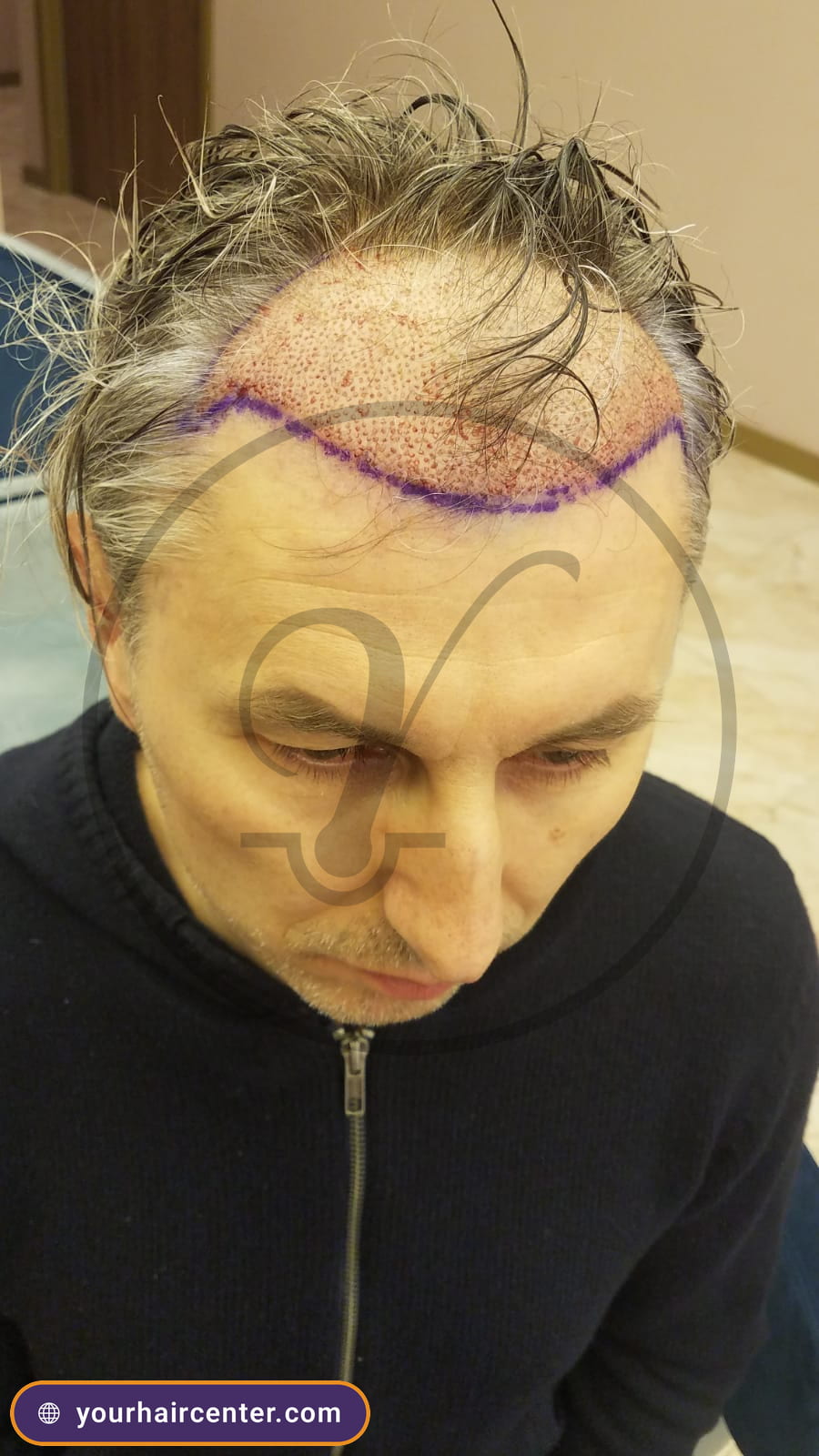
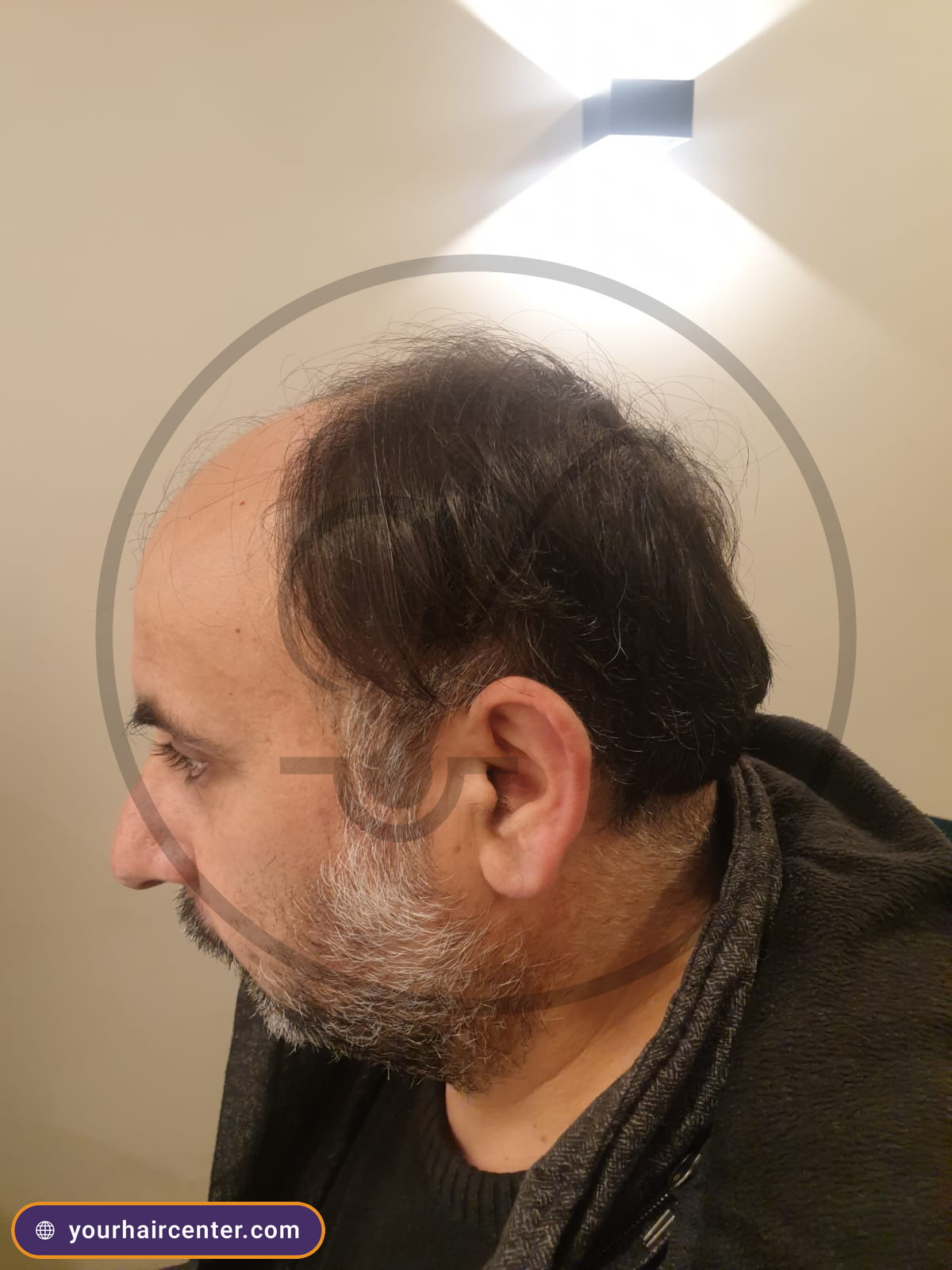
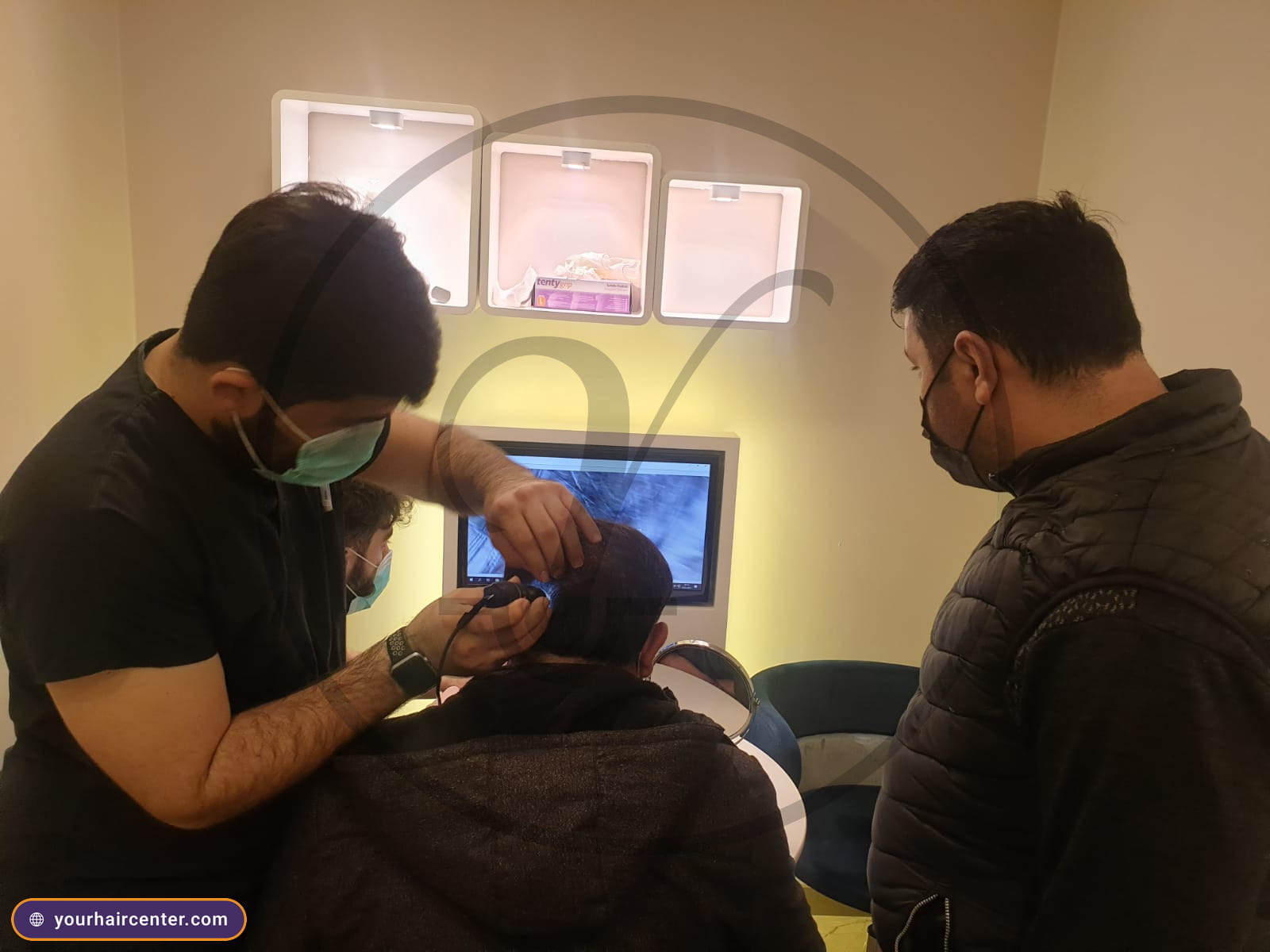
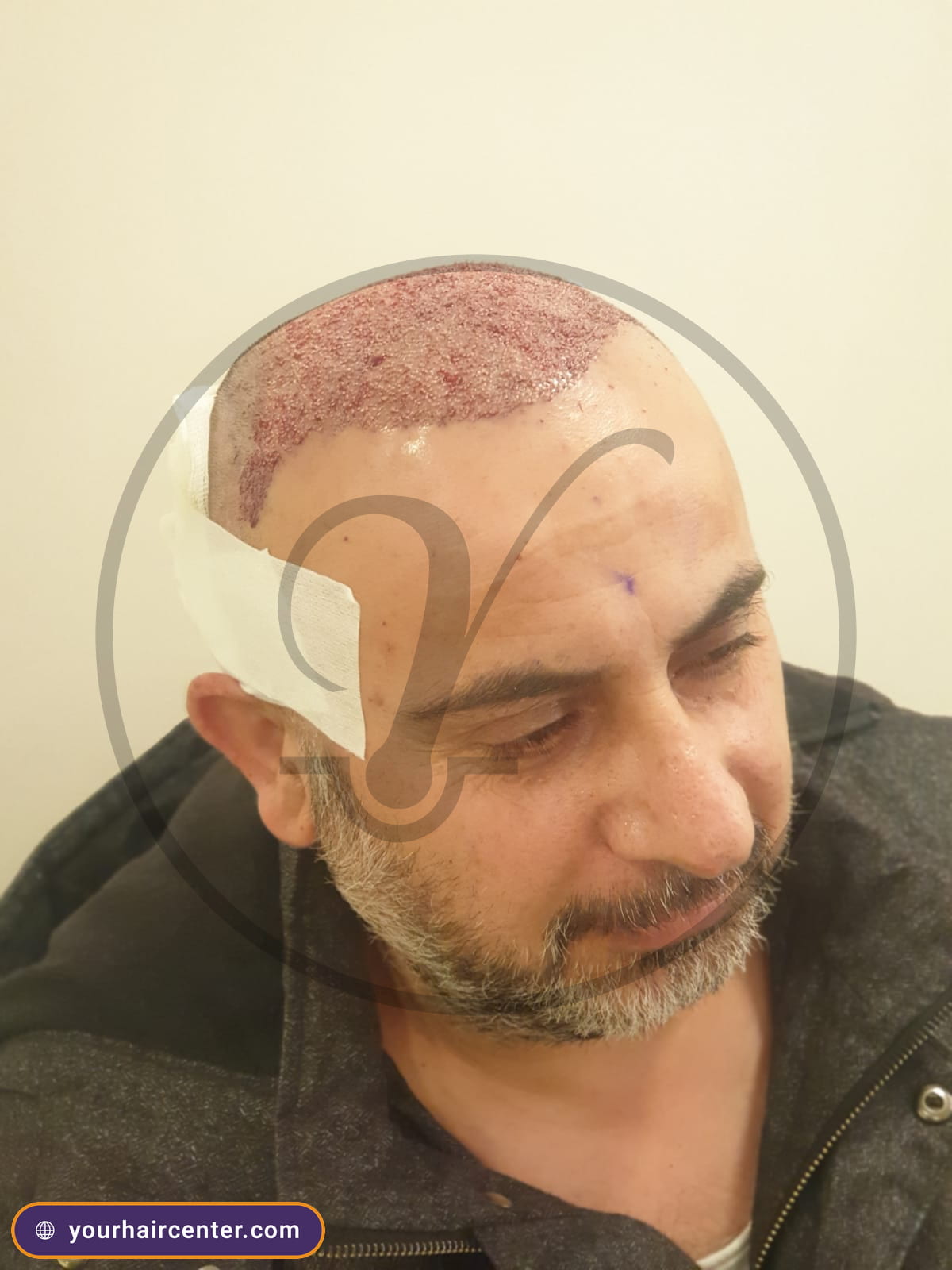
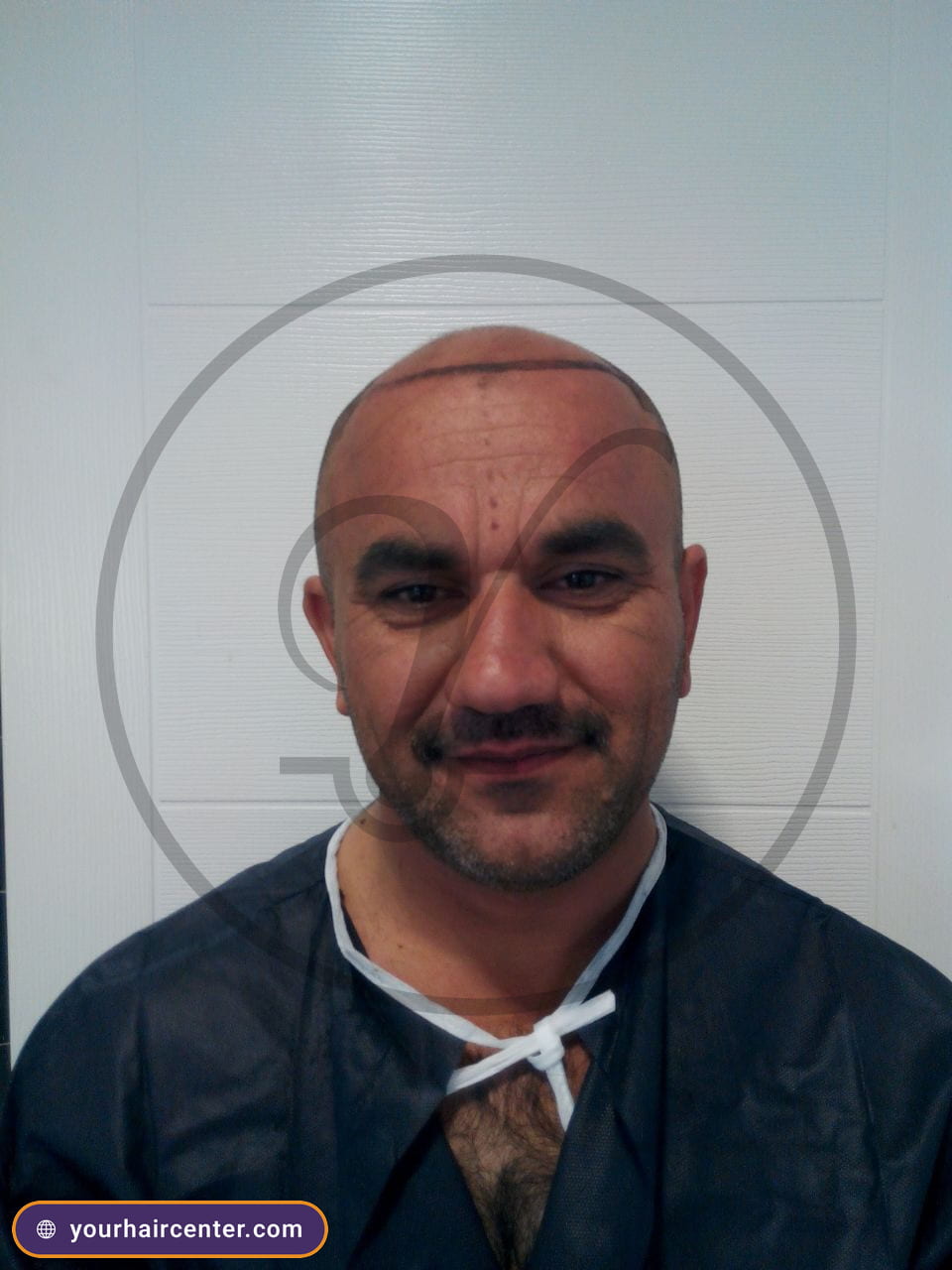
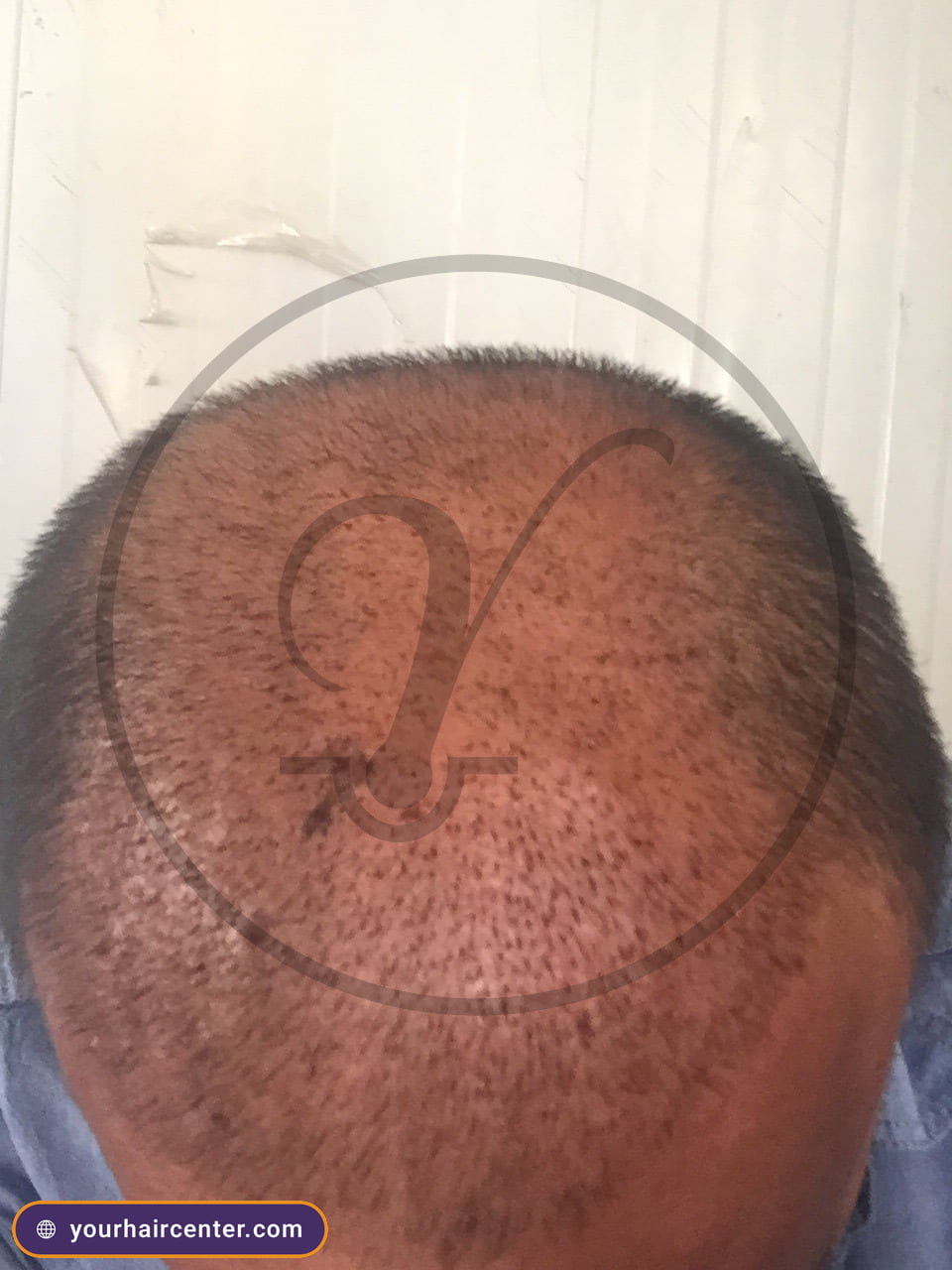
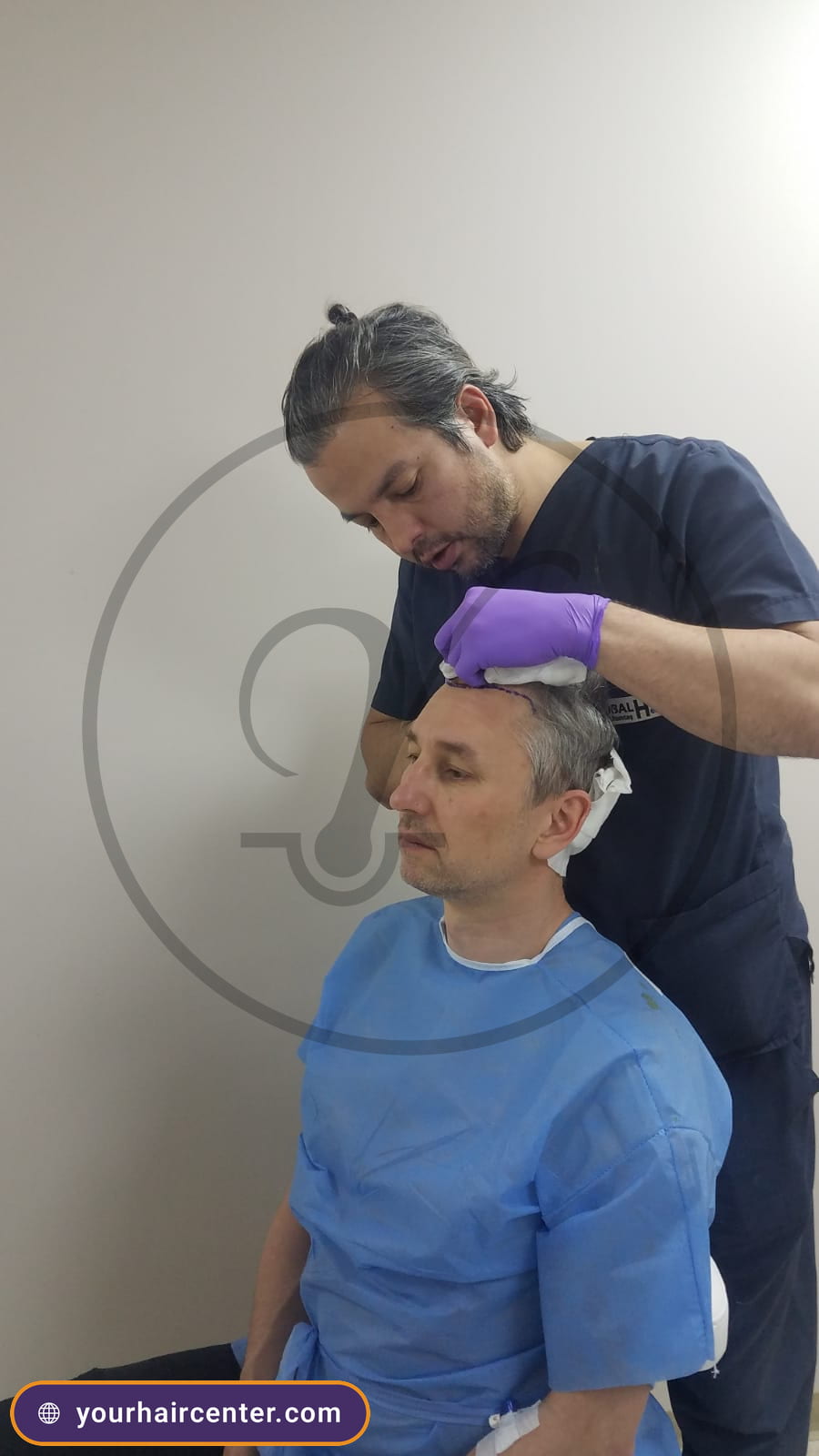
Real results from our patients’ archive. Photos exactly as captured at our accredited partner clinics, with no filters and no retouching. Browse more cases in our photo gallery.
Most readers running this decision land on one of three paths. The first path points to FUE. It fits Norwood 3 to Norwood 5 cases, candidates who want to keep style flexibility with buzzes and fades in rotation, anyone choosing a Turkey medical-tourism package, and candidates whose donor density supports the per-session graft count in one or two FUE sittings. For the large majority of people researching this decision, this is the path.
The second path is the narrow one where FUT still wins the FUE vs FUT decision. It covers the three-criterion candidate from the FUT section, someone with a very high lifetime graft target, confirmed donor laxity, and a lifelong commitment to longer hairstyles. It also covers candidates with prior surgical scarring on the donor that constrains FUE harvest geometry, and the rare candidate whose insurer or financing model only covers in-person US FUT, usually tied to an alopecia diagnosis pathway. If insurance is part of your math, our companion guide on whether insurance covers a hair transplant walks through the coding (ICD-10 L63 and L65) and the cost-offset numbers in full.
The third FUE vs FUT path is "neither, not today." Candidates whose hair loss is still unstable (active alopecia areata, or ongoing male-pattern progression with no stabilizing medication on board), candidates whose donor capacity cannot cover projected lifetime loss, and candidates whose general health makes any surgery higher-risk should route to medical evaluation and stabilization first. A proper hair and scalp analysis is the right starting point there, before any technique question is even on the table.
Whichever FUE vs FUT path you are on, the vetting checklist is the same. Confirm an ISHRS-member surgeon, verify board certification on the surgeon’s name, ask for a published graft-survival figure with sample-size context, look for a named-patient before-and-after archive at 12 months, and insist on written all-inclusive pricing with no on-arrival surprises. Our guide on the signs of a failed hair transplant and your repair options covers what happens when those checks are skipped. For US readers, the cosmetic-versus-reconstructive distinction applies on both sides of the FUE vs FUT choice, an alopecia diagnosis can open limited insurance pathways, and for most self-pay candidates the Turkey cost-offset still beats US financing math.
When patients weigh FUE vs FUT with Your Hair Center, FUE is led by our own specialists at accredited partner clinics and hospitals using fine micropunch tooling, with up to about 4,000 grafts in one session, larger cases planned over two days, and a sapphire-blade implantation upgrade tier for candidates who want it. The operations take place at accredited partner clinics and hospitals in Istanbul, with 5,000+ successful procedures behind the team and patient satisfaction rated 4.8/5.
Our three all-inclusive packages run from $1,650 to $4,650, and each is itemized rather than vague. Essential is classic FUE at $1,650, Premium is sapphire FUE at $2,650, and Royal VIP combines sapphire and DHI at $4,650. Every package bundles pre-op tests, the procedure itself, post-op medications, a hotel stay of 3 to 5 nights by package, airport transfers both ways, and a full year of medical follow-up, while the English-speaking patient coordinator, the aftercare kit and PRP sessions come with Premium and Royal VIP. The reception and accommodation service covers the hotel-and-transfer side, and the medical follow-up service covers the year of remote support after you fly home.
The infrastructure is built for international patients, with English-speaking coordinators and care pathways designed for US, UK, and European medical tourists. Every claim here is checkable before you book. Ask for your surgeon’s name, confirm their board certification, and judge the depth of the before-and-after gallery for yourself. When you are ready, the fastest route is to send your photos on WhatsApp for a case-specific quote, with an English-language reply within 24 hours and no on-arrival surprises in the package price.

For most candidates weighing FUE vs FUT in 2026, FUE is the better choice because it leaves no linear scar and recovers in about a week, even though FUT can move more grafts in one sitting. FUT is better only in a narrow case, a very high lifetime graft requirement with confirmed donor laxity and a commitment to longer hairstyles. For everyone else, FUE wins the FUE vs FUT comparison on scarring, recovery, and style flexibility.
We do not speculate about any individual’s medical history. What we can say is that modern follicular unit extraction, the FUE technique discussed throughout this FUE vs FUT comparison, is now the most widely performed method of surgical hair restoration and produces natural, permanent results when performed by an experienced surgeon. Visible "before and after" change in any public figure is consistent with the kind of result a well-executed FUE procedure delivers.
Roughly speaking, yes, most patients are socially recoverable around 7 days after FUE. Mild swelling tends to appear by day three and clears by day six, and light crusting over the donor area resolves once you begin washing correctly. By day 10 the redness has usually faded enough for normal activity, though the transplanted hairs will shed during the normal shock-loss phase before regrowth begins.
In the USA, FUE commonly runs several US dollars per graft, which can put a 3,000-graft case in the five-figure range before add-ons. By contrast, our all-inclusive packages in Istanbul run from $1,650 to $4,650, already bundling the hotel, transfers, and a full year of follow-up, which is why the cost comparison reshapes the decision.
Both FUE and FUT achieve high graft survival in experienced hands, so the success rate is not what separates them. The meaningful difference is the scar pattern and how efficiently each technique uses a finite donor supply, not the survival figure itself. Surgeon skill and candidate selection move that number far more than the choice of technique does.
A FUT scar can become more visible after 10 years, even though the scar itself has not changed. Native hair around the linear closure line thins naturally with age, which can expose a previously hidden scar. In the FUE vs FUT comparison, an FUE donor area behaves differently, with scattered dot scars that do not concentrate along a line, so thinning exposes them far less than it exposes a line.
The FUE vs FUT hair transplant choice in 2026 is rarely about which technique is "better" in the abstract. It is about which scar pattern, which recovery window, and which pricing reality you can build a decision around. For most readers the math points to FUE, especially once a Turkey all-inclusive package enters the same table as a US single-line FUT quote. The exceptions exist, very high graft counts, exceptional donor laxity, and a lifetime commitment to longer styles, and they deserve the FUT decision rather than the default. Either way, the FUE vs FUT verification checklist stays the same. Send your photos for a free FUE evaluation, or message us on WhatsApp for a same-day quote. The content and sources of this guide were reviewed on 19 October 2026.