Five techniques, one decision. This guide lines up Classic FUE, Sapphire FUE, DHI with the Choi pen, the percutaneous needle technique, and FUT against the criteria that decide the best hair transplant technique for your case, density, scarring, bleeding, recovery, and cost. Density leads here, because reaching 60 to 70 grafts per square centimeter is only safe when no blade opens a channel in the scalp. A clear Norwood-stage decision tree then names a winning technique for every typical profile.
You have read the FUE explainer, the DHI explainer, and the sapphire FUE explainer one at a time, and the more you read, the less you can rank them. Every clinic blog calls its own method the best hair transplant technique. Every comparison post stops at three options, leaves out two more, and none of them lead with the variable that actually decides how your result looks, which is how dense the final hairline will be in grafts per square centimeter. This guide ends the comparison loop. Choosing the best hair transplant technique means lining up the five real options on the market, Classic FUE, Sapphire FUE, DHI with the Choi pen, the percutaneous needle technique, and FUT for reference, against the criteria that matter for the result on your own scalp. We close with a Norwood-stage decision tree that names a winning technique for each profile. The best hair transplant technique is the one that matches your case, and here is how to figure out which case is yours.
The five hair transplant techniques on the market today
The modern hair transplant market in 2026 runs on five techniques. Four belong to one family and one is the older outlier. Classic FUE, Sapphire FUE, DHI with the Choi pen, and percutaneous needle implantation all extract follicles one at a time from the donor area, which is why they are grouped as the FUE family. FUT, the strip technique, removes a band of tissue from the back of the scalp instead, the pre-FUE generation of the procedure.
Inside the FUE family every technique shares the same first step. Follicles are removed with a micro-punch, the identical extraction used across all FUE methods. What separates the four is not extraction at all. It is the channel-opening step, the moment the surgeon makes a place in the recipient scalp for each follicle to sit.
Classic FUE opens those channels with a steel blade. Sapphire FUE swaps the steel for a synthetic sapphire crystal blade. DHI uses the Choi pen, a device that opens the channel and inserts the follicle in one motion. Percutaneous removes the blade entirely and implants directly with a fine needle. That one axis, how the channel is opened or whether it is opened at all, is the hidden structure beneath every comparison you have read, and it is the lens this guide uses to settle which is the best hair transplant technique for a given case.
You can read the dedicated pages for each method through the hair transplant techniques category, or jump straight to FUE, Sapphire FUE, DHI with the Choi pen, or the percutaneous technique.
How the five techniques compare side by side and which is the best hair transplant technique on each measure
Here is the full landscape on one grid, the fastest way to see which is the best hair transplant technique on any single measure. This expands the parent four-technique table to all five and adds the cost dimension, so you see the whole market in one view. Read the density row first, because it is the line the rest of this article hangs off.
| Criterion | Classic FUE | Sapphire FUE | DHI Choi pen | Percutaneous | FUT for reference |
|---|---|---|---|---|---|
| Channel opening | Steel blade | Sapphire blade | Choi pen | None, direct needle | Steel blade |
| Scarring | Visible | Minimal | Minimal | Minimal | Linear donor scar |
| Density, grafts per cm2 | 40 to 50 | 45 to 55 | 50 to 60 | 60 to 70 | Lowest of the five |
| Recovery, days | 3 to 5 | 3 to 5 | 3 to 5 | 3 to 5 | 10 to 14 |
| Natural hair direction | Good | Good | Excellent | Excellent | Good |
| Unshaved option | Difficult | Difficult | Possible | Possible | Not feasible |
| Typical Turkey cost band | Lowest tier | Mid tier | Mid to upper | Upper mid | Varies |
The density numbers for the four FUE techniques come from the published comparison on the percutaneous service page. The general clinical literature sets the floor for a visually full result at roughly 30 to 40 grafts per square centimeter and flags that pushing past about 60 grafts per square centimeter starts to strain the blood supply in the scalp, which can starve grafts of oxygen and harm their survival.[1] That ceiling is the whole reason the density row matters. Reaching 60 to 70 grafts per square centimeter safely is only possible when the channel-opening trauma that limits blood supply is removed, which is what the no-blade needle technique does.
On the cost band, clinics in the Turkey market commonly publish all-inclusive prices in the 2,500 to 4,500 US dollar range for a roughly 3,000-graft package. The Your Hair Center percutaneous package starts at 1,500 dollars, with the final figure set by the number of follicles your case needs.
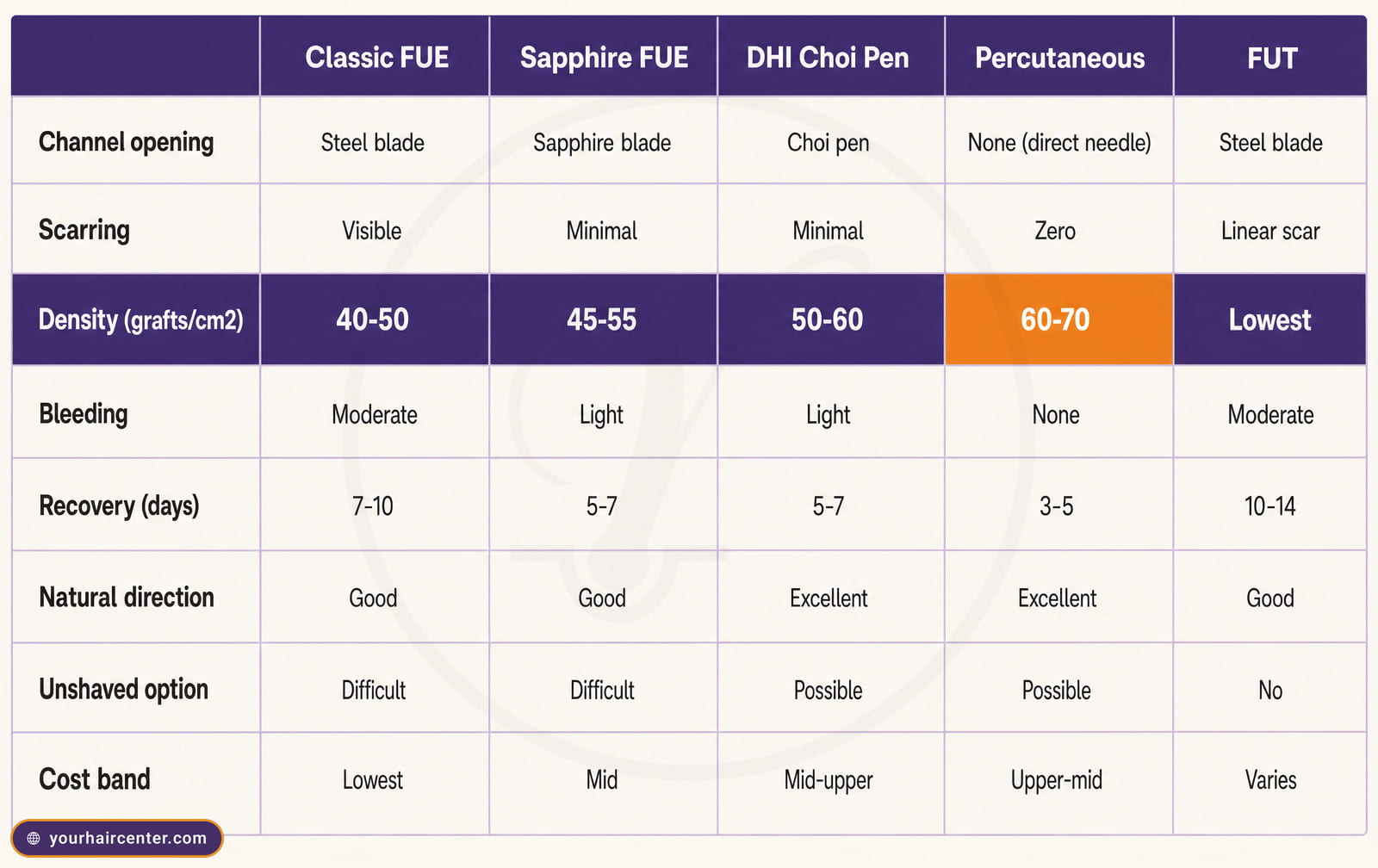
The grid reveals one thing clearly. The techniques separate first on the channel-opening axis, and that axis drives the scarring, bleeding, and density rows downstream. Cost is nearly flat across the FUE family inside the Turkey market. So the best hair transplant technique for you is, in practice, a decision about how the recipient channel is made and which row in this grid matters most for your case.
Classic FUE, when it wins
Classic FUE is the baseline every later technique iterates on, and for one clear profile it is the best hair transplant technique on offer. Follicles are extracted one by one with a micro-punch, the recipient channels are opened with a steel blade, and each follicle is placed by hand into an open channel. It is the method most surgeons trained on through the 1990s and 2000s, and it still does the largest share of procedures worldwide.
The candidate it wins on is the budget-led Norwood 2 to 3 patient looking for 1,500 to 3,000 grafts of hairline reinforcement. At that scale the achievable 40 to 50 grafts per square centimeter delivers a visually full front without premium-density tooling. When price is the deciding constraint and density is not the goal that separates the options, this is the best technique to anchor on.
Its strengths are real. It has the longest published outcome history of any method, the widest surgeon-training base globally, and the lowest all-inclusive package band in the Turkey market.
The honest limitations matter too. The steel blade leaves micro-incisions that take 7 to 10 days to close fully, the density ceiling sits around 50 grafts per square centimeter, bleeding during channel opening is moderate, and the unshaved option is difficult because the blade work needs a clear recipient field. So Classic FUE is the best hair transplant technique only when budget leads and density does not. For most researchers it is the option you price first before deciding whether to upgrade. See outcomes in the photo gallery or read the full FUE method page, which sits under the techniques category.
Sapphire FUE, when it wins
Sapphire FUE changes one thing about Classic FUE, and it is not the structure. Extraction is identical, the recipient channels are still opened before implantation, and the follicles are still placed by hand. The single change is the blade material, a synthetic sapphire crystal blade in place of steel, and that one swap is enough to make it the best hair transplant technique for a specific recovery-led profile.
That swap does real work. A sapphire edge cuts cleaner channels with a smaller wound surface per opening, which means less tissue trauma, while recovery stays the same as Classic FUE, about 3 to 5 days back to daily life. The cleaner channels also preserve more of the blood supply between implanted follicles, which lets density run a little higher, 45 to 55 grafts per square centimeter against Classic FUE’s 40 to 50. It is a marginal gain, not a category leap, but on the front hairline a marginally cleaner channel edge can read as a marginally more natural line.
For the Norwood 3 to 4 patient who prioritizes front-line aesthetics and will pay the mid-tier upcharge, Sapphire FUE is the best hair transplant technique.
One claim deserves a correction. Sapphire is sometimes marketed as scarless, and that is not literally accurate. A sapphire blade still cuts, the wound still heals, and the result is a very small scar rather than no scar, which is why the table marks its scarring as minimal rather than zero. The density ceiling is also still set by the blade-channel mechanism, not unlocked from it. The best technique here is a clear recovery upgrade over Classic FUE, but not a density breakthrough. Read the full sapphire method page under the techniques category, or compare results in the photo gallery.
DHI with the Choi pen, when it wins
DHI is the method patients most often confuse with percutaneous when they try to pick the best hair transplant technique, because both are marketed as needle-based and both promise precision. They are not the same thing. The Choi pen is an implanter device loaded with the extracted follicle at one end and fitted with a fine blade at the other. When the surgeon presses the pen against the recipient site, the device opens the channel and inserts the follicle in one motion. The channel-opening step still happens. It simply happens inside the device rather than as a separate pass with a separate blade.
What that delivers is tight control. Because the angle and depth are set in a single motion, density runs to 50 to 60 grafts per square centimeter and the hair direction lands in the excellent tier, since the implantation angle matches the channel angle exactly. The unshaved option is feasible too, because the recipient field stays mostly intact between pen depressions.
For the Norwood 2 to 3 patient working the crown or mid-scalp, where matching the direction of surrounding hair matters most, DHI is the best hair transplant technique. It also suits patients wanting an unshaved partial-area transplant and second-pass procedures that fill in around existing native hair.
The limitations are practical. The Choi pen is slower than separate-step methods, so the graft count per session is lower. The device still carries a blade, so the no-channel marketing claim is technically inaccurate, and the cost band sits in the mid to upper range. DHI is the best technique when the criterion is direction-matching precision in a small, targeted area, for crown work and unshaved partial transplants rather than full-scalp megasessions. See the full DHI and Choi pen method page under the techniques category, or browse the photo gallery.
Percutaneous, the most advanced hair transplant technique, when it wins and why it is the most natural hair transplant technique
Percutaneous changes the structure that every other FUE technique keeps. The extraction step is the same micro-punch harvest. The channel-opening step is gone entirely. A fine cylindrical titanium needle picks up the follicle at one end and implants it directly into the scalp in a single motion, without any blade ever touching the recipient site. In the traditional sequence of extraction, channel opening, and implantation, percutaneous deletes the middle stage.
Work down the criteria from the comparison grid and the case for it as the best hair transplant technique builds row by row. Density reaches 60 to 70 grafts per square centimeter, the highest of the five and a clear step above DHI’s 50 to 60. Scarring is zero, because there is no incision to heal into a scar. Bleeding is none, because the needle does not transect the vascular tissue a blade would. Recovery runs 3 to 5 days against the 5 to 10 the other techniques need. Natural hair direction sits in the excellent tier, and the unshaved option is feasible because the needle leaves no visible recipient field to manage. This combination of minimal dot marks and an exact natural angle is why it reads as the most natural-looking result of the five.
There is a reason the density ceiling is the headline, and it is the strongest single argument for calling percutaneous the best hair transplant technique. The clinical literature warns that forcing more than about 60 grafts per square centimeter through blade-opened channels strains the scalp’s blood supply and risks starving grafts of oxygen.[1:1] Removing the channel trauma is what makes the 60 to 70 range reachable safely rather than recklessly. That is the structural argument behind the number, not a marketing line.
For the Norwood 3 to 5 patient who wants the maximum-density result on the front hairline, the shortest return-to-work window, or the unshaved option without giving up density, the percutaneous needle is the best hair transplant technique by a clear margin. It suits active lifestyles that need fast recovery and female patients working on the front of the scalp, where scarring matters most.
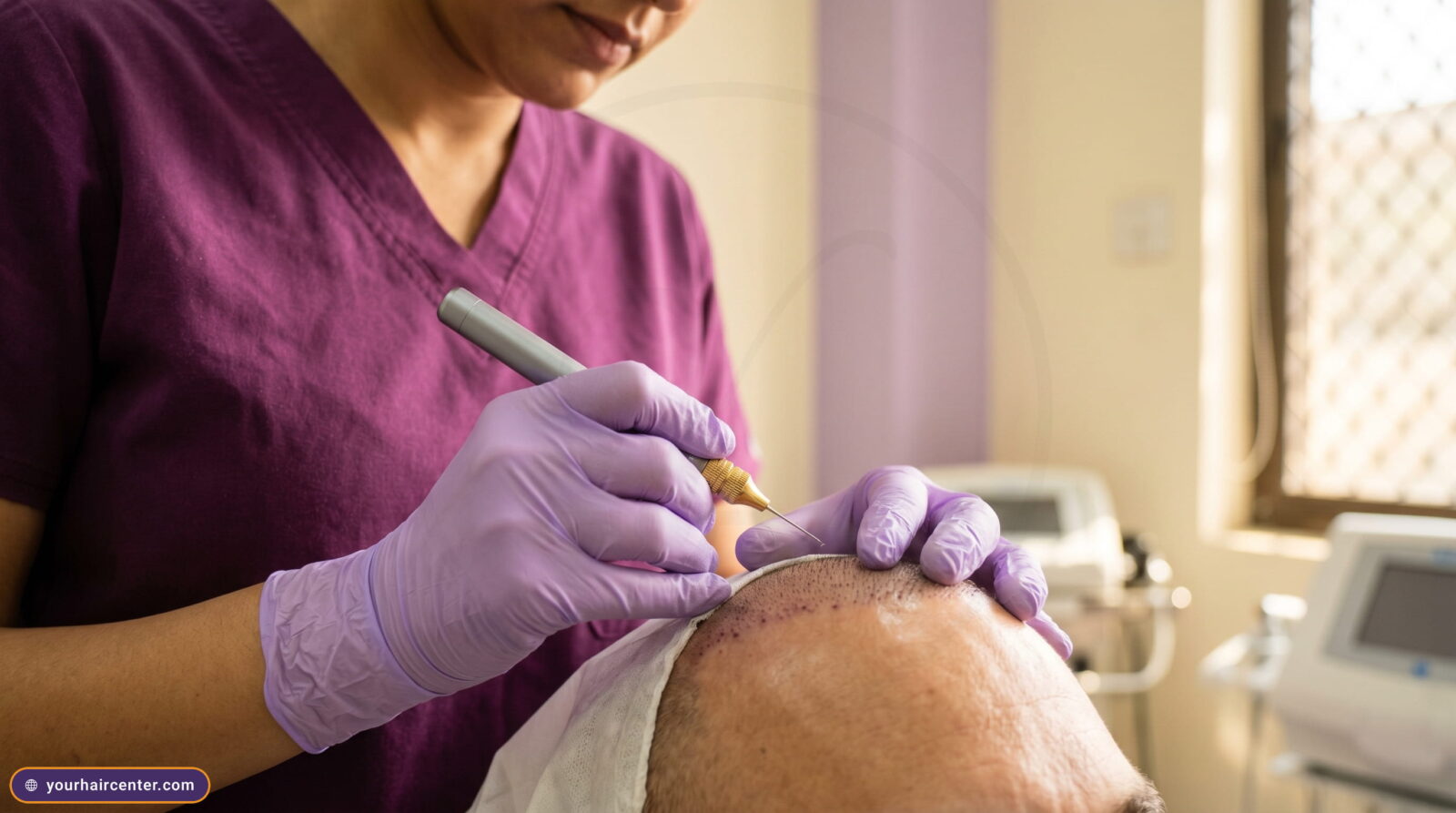
A fair question follows. If this is the best hair transplant technique on so many measures, why does not every clinic do it? The answer is economics. The method demands a high level of surgeon precision and limits the number of grafts per session, so a full case is split across two days to hold that precision tolerance. Clinics built on high-volume, price-led packages do not run two-day sessions, because the volume math does not work for them. Clinics that anchor on the density result do. The trade-off for the patient is a slightly longer stay in Istanbul, around 5 days rather than 4, and a larger case spread across two days regardless of size. The cost band is upper-mid, still inside the Turkey range but not the cheapest line. When the deciding criterion is final density per square centimeter, which for most comparison-phase patients it quietly is, percutaneous is the best technique available. Read the full percutaneous method page under the techniques category, see outcomes in the photo gallery, or start with a hair and scalp analysis.
FUT for reference, when it still has a role
FUT is the pre-FUE generation of hair transplantation, and it stays on this table for completeness rather than as the best hair transplant technique for most cases. The method removes a linear strip of tissue from the donor area, dissects that strip into individual follicular units under a microscope, and then implants them into blade-opened recipient channels.
Why keep it on a 2026 comparison at all? In donor-poor cases, severe Norwood 6 to 7 patients or people with a depleted donor area from prior failed transplants, strip excision can yield more grafts from a constrained donor than FUE extraction can. The microscope dissection recovers follicular units that an FUE punch would miss or transect, which is why the reference literature notes the strip method is more useful for advanced loss because of the large number of grafts a single strip can supply.[2]
That yield comes at a cost. FUT leaves a permanent linear scar across the donor area, visible if the hair is buzzed short, recovery runs 10 to 14 days, and the density ceiling is the lowest of the five because the recipient channels are still blade-opened.[1:2] FUT is the best hair transplant technique only for the donor-constrained patient where FUE yield is mathematically insufficient. For every other case a researcher is likely to be in, an FUE-family method outperforms it, so FUT is here for completeness rather than as the recommendation for the typical Norwood 3 to 5 case. Read more on the FUE alternative or the broader techniques category.
The best hair transplant technique for your Norwood stage, a decision tree
Reading the decision tree for your case
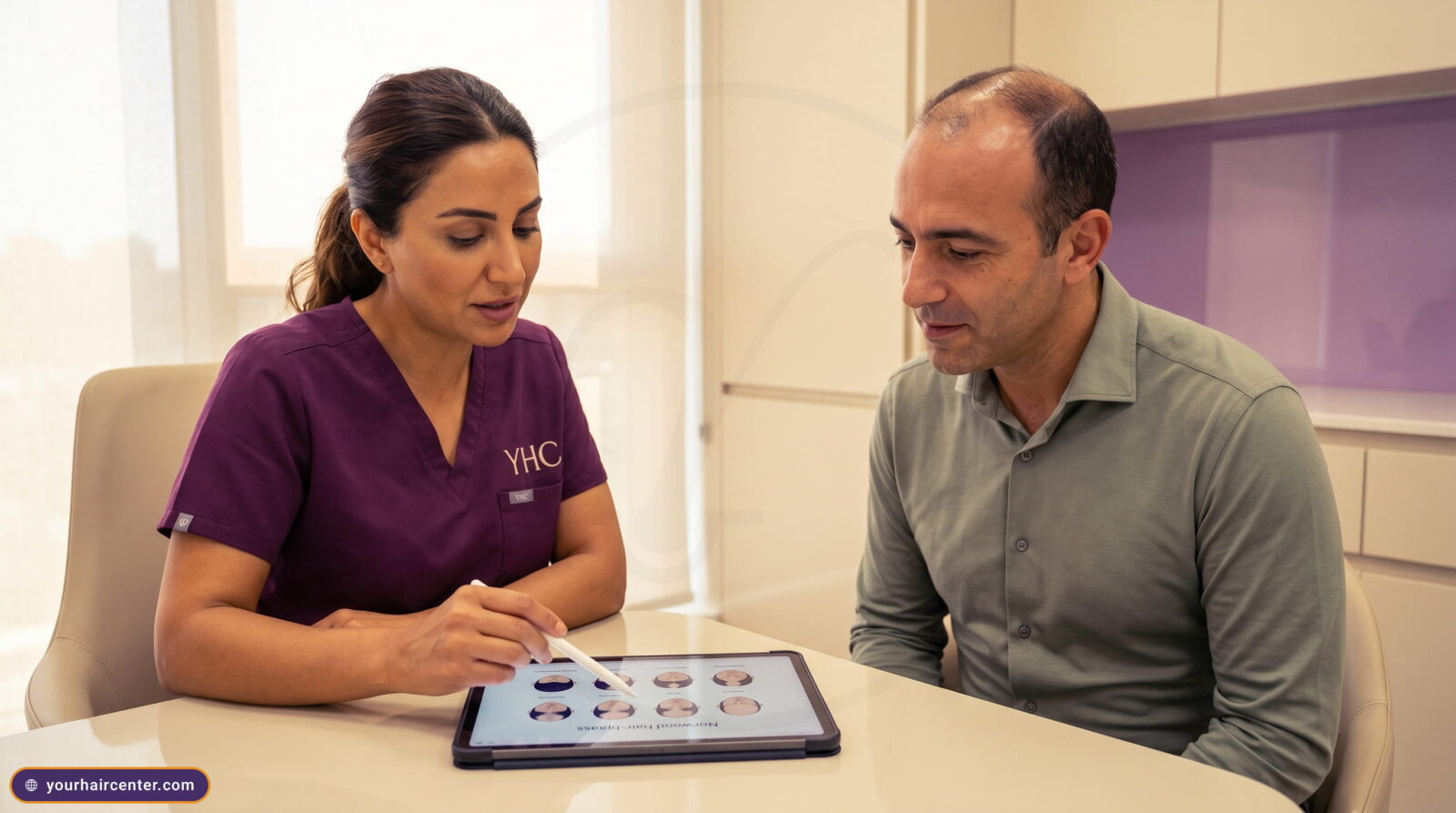
Treat the choice as a function of four inputs. Your Norwood stage, your primary goal, whether that goal is maximum density, maximum coverage, or unshaved discretion, your recovery-window constraint, and your budget band. Run those four through the profiles below and the best hair transplant technique falls out for each typical case.
For a Norwood 2 to 3 patient wanting hairline reinforcement of 1,500 to 3,000 grafts on a budget, the best technique is Classic FUE. For a Norwood 3 patient with a hairline and light crown, an active lifestyle, and recovery time as the priority, it is Sapphire FUE. For a Norwood 2 to 3 patient working a targeted crown or mid-scalp area, or wanting an unshaved partial transplant, it is DHI with the Choi pen. For a Norwood 3 to 5 patient whose primary goal is density and who can do a 5-day Istanbul trip, the best hair transplant technique is percutaneous. For a Norwood 6 to 7 patient with severe loss and a constrained donor, where scar concealability is not critical, FUT is the rare 2026 fit.
One meta-rule sits above all of these. The density target drives the choice harder than any other variable. If your goal is the highest density per square centimeter on the hairline, and for most patients it is, because high density is what visually reads as natural, the no-blade percutaneous needle is the best hair transplant technique on the merits. If your goal is something else, budget, partial-area discretion, or rebuilding a depleted donor, the tree shifts to a different branch.
To go deeper on any branch, the companion article on hair transplant density unpacks the cm2 numbers behind the best hair transplant technique for each goal, the guide on results at 6 months versus 1 year shows what each density looks like at the growth milestones, and the 4000-graft coverage guide does the math on how many grafts your Norwood stage actually needs. The most direct way to place your own case on the tree is a hair and scalp analysis or a percutaneous evaluation.
Frequently asked questions about the best hair transplant technique
What is the most effective hair transplant procedure?
The most effective procedure depends on your Norwood stage and your density goal. For the maximum-density result on the hairline, the percutaneous needle method leads at 60 to 70 grafts per square centimeter. For a budget-led case where density is not the deciding factor, Classic FUE is the dependable baseline. There is no single winner for every patient, only the best match for your case.
How much do 3,000 FUE grafts cost?
Clinics in the Turkey market commonly publish all-inclusive prices in the 2,500 to 4,500 US dollar range for a roughly 3,000-graft package, which typically bundles the procedure, hotel, transfers, and follow-up. The Your Hair Center package starts at 1,500 dollars, with the final figure set by the number of follicles your case requires. Cost comparisons with US and UK clinics, where the same case often runs much higher, are a separate question.
What is the most advanced hair transplant technique today?
Percutaneous is both the most advanced and, on the density measure, the best hair transplant technique of the five in 2026. It removes the blade channel-opening step entirely and implants directly with a fine titanium needle, which is what lets it reach 60 to 70 grafts per square centimeter, with only tiny dot marks.
FUE versus FUT, which is better?
For almost every modern case an FUE-family method is the best hair transplant technique of the two, because it leaves no linear scar, recovers faster, and reaches higher density. FUT keeps a narrow role only for donor-constrained severe loss, where strip excision can yield more grafts from a limited donor than an FUE punch.[2:1] If your donor area is healthy, FUE wins.
What is the most natural-looking hair transplant technique?
Percutaneous produces the most natural-looking result of the five, which is why it is often called the best hair transplant technique for the front hairline. Its natural hair direction sits in the excellent tier, because the needle implants each follicle at its exact natural angle, and its scarring is zero, because no blade ever opens a channel. The absence of both visible scarring and direction mismatch is what makes the result hard to distinguish from native hair.
How are FUE, Sapphire, DHI, and percutaneous actually different from each other?
All four extract follicles the same way, so the difference that decides the best hair transplant technique is entirely in how the recipient channel is made. Classic FUE opens it with a steel blade, Sapphire FUE uses a sapphire blade for cleaner channels, DHI opens and implants in one motion with the Choi pen, and percutaneous skips the channel altogether and implants directly with a needle. That single axis drives the differences in scarring, bleeding, and achievable density.
The bottom line on choosing the best hair transplant technique
There is no one fixed answer. The right choice is the technique that matches your Norwood stage, your density goal, your recovery window, and your budget. For most patients in the comparison phase, the criterion that decides the result is final density per square centimeter, and on that measure the percutaneous needle is the best hair transplant technique on the table at 60 to 70 grafts per square centimeter. The decision tree above maps every other typical profile to its winning technique, so no case is left without an answer. The next step is the simplest one, a physician evaluation of your photos within 24 hours, with no commitment, so the recommendation is built on your actual scalp rather than a generic chart.
Get a percutaneous technique evaluation or send your Norwood photo for a free WhatsApp technique recommendation.
References
-
Recipient Area, in Follicular Unit Transplantation, PMC, NIH. https://pmc.ncbi.nlm.nih.gov/articles/PMC6371721/ (opens in new tab) ︎ ︎ ︎
-
Hair Transplantation, StatPearls, National Center for Biotechnology Information, NIH. https://www.ncbi.nlm.nih.gov/books/NBK547740/ (opens in new tab) ︎ ︎
