4500
grafts
DHI
A 4,000-graft hair transplant is not one fixed outcome. Coverage depends on the density the surgeon implants at. At a standard 40 to 50 grafts per cm2 those grafts span 80 to 100 cm2. At the needle-based percutaneous 60 to 70 grafts per cm2 they concentrate into 57 to 66 cm2 of near-native density. This guide does the math, maps Norwood candidacy, checks the donor supply, and explains why Your Hair Center splits the session across two days for precision.

A hair transplant 4000 grafts session is the most commonly quoted procedure size in international hair restoration, and the person who types that exact number into a search bar is almost never looking for a definition. They are sizing a real decision. Is 4,000 the right number for my scalp, what will it actually cover, and what does it really cost. The honest answer turns on a figure that almost nobody quotes in the same breath as the graft total, the density per square centimeter the surgeon implants at. In a standard hair transplant of 4,000 grafts at 40 to 50 grafts per cm2 those grafts spread across roughly 80 to 100 cm2. At the needle-based percutaneous tier of 60 to 70 grafts per cm2 the same grafts concentrate into 57 to 66 cm2 of far higher-density work. This guide does the explicit math, explains why Your Hair Center splits a 4,000-graft percutaneous session across two days, and lines up the donor-supply, Norwood, and cost questions that come right before a booking decision.
A 4,000-graft session covers about 60 to 100 cm2 of scalp depending on density. At a standard 40 to 50 grafts per cm2 coverage reaches 80 to 100 cm2, and at the percutaneous 60 to 70 grafts per cm2 it concentrates into 57 to 66 cm2. It suits Norwood 4 to 6 candidates, performed as a two-day percutaneous session.
That range is wide for a reason. Density is the multiplier, not the graft count alone. Two clinics can both quote a 4,000-graft hair transplant and deliver outcomes that differ by half again in visual fullness, or half again in the surface area they cover, simply because one packs the grafts tighter than the other. The graft total is only half of the equation. The density tier the surgeon works at is the other half, and it is the half that decides whether the 4,000 grafts of your hair transplant read as a broad, moderate-density rebuild or a smaller patch of near-native fullness.
Coverage is a function of three numbers working together, your Norwood stage, your donor density, and the density tier the surgeon implants at. Those three figures govern whether 4,000 is the right total for a given scalp. This section does not yet touch cost or Norwood candidacy, both of which have dedicated sections further down. The point to carry forward is simpler. When you read a 4,000-graft hair transplant quote, the number on its own does not tell you what you are buying. The density behind it does. The percutaneous hair transplant technique exists specifically to push that density figure higher, and the whole Hair Transplant service category is organized around the technique choices that set it.
One of the most common sources of confusion when pricing a 4,000-graft hair transplant is the gap between grafts and hairs. A graft, properly a follicular unit, is a natural grouping of hair that the surgeon extracts and implants as a single piece. Each follicular unit carries between one and four hair shafts, with a population average that peer-reviewed studies place at roughly two to three shafts per graft in adult scalp donor tissue.[1]
Run that multiplier across a full session. A 4,000-graft hair transplant therefore yields somewhere in the region of 8,000 to 12,000 individual hair shafts once everything has grown in. That is a two-fold to three-fold multiplier sitting on top of the graft count itself, which is why a 4,000-graft session looks far denser than the bare number suggests to someone picturing 4,000 single hairs.
This matters the moment you start comparing quotes. Some clinics advertise a figure like “8,000 hairs moved” when what they mean is a 4,000-graft session. The hair count is technically true, but it is the same procedure most surgeons would simply call a 4,000-graft hair transplant. When you line up two offers, the only honest unit of comparison is grafts, the follicular units, because grafts are what the surgeon actually controls during implantation. Hairs are an output of biology. Grafts are the input the team plans around.
The same logic scales upward. A 5,000-graft session adds roughly 2,000 to 3,000 more hair shafts on top of the 4,000 baseline that a hair transplant of 4000 grafts already delivers, which is meaningful for severe coverage cases but also a real step up in the load placed on the donor zone, a tradeoff the donor-supply section covers in full. The grafts themselves come out through the FUE hair transplant extraction method, the same harvesting step every modern technique shares. For now, hold one rule. Compare grafts to grafts, never hairs to grafts, and you will never be talked into thinking one clinic is offering twice the procedure when it is offering the same one with a different label. You can see how those grafts translate into finished density across real before-and-after results at Your Hair Center.
Here is the math that almost no guide actually shows. Coverage area is just the graft count divided by the density per cm2. The graft total stays fixed at 4,000. Change the density tier and the covered area changes with it. The four density tiers below are the published figures from the technique comparison, follicles per cm2.
| Technique | Density (grafts/cm2) | 4000 grafts / density | Coverage area |
|---|---|---|---|
| Classic FUE | 40 to 50 | 4000 / 40 = 100; 4000 / 50 = 80 | 80 to 100 cm2 |
| Sapphire FUE | 45 to 55 | 4000 / 45 is about 89; 4000 / 55 is about 73 | 73 to 89 cm2 |
| DHI Choi pen | 50 to 60 | 4000 / 50 = 80; 4000 / 60 is about 67 | 67 to 80 cm2 |
| Percutaneous | 60 to 70 | 4000 / 60 is about 67; 4000 / 70 is about 57 | 57 to 67 cm2 |
Read the table top to bottom and the pattern is clear. The looser the packing, the broader the area 4,000 grafts cover, but the thinner each square centimeter reads. The tighter the packing, the smaller the covered area, but the closer it comes to native fullness. At Classic FUE density a 4,000-graft hair transplant spreads across as much as 100 cm2, enough to touch the hairline, the mid-scalp, and part of the crown at moderate density. At percutaneous density the same 4,000 grafts concentrate into 57 to 67 cm2, a smaller zone restored at the density that reads as indistinguishable from native hair under direct light.
To picture the coverage a 4,000-graft hair transplant produces, translate the numbers into patches. A 100 cm2 area is roughly a 10 cm by 10 cm square, about the span of hairline plus mid-scalp plus a light crown touch. A 67 cm2 area is roughly 8 cm by 8.4 cm, the hairline plus the frontal forelock plus the mid-scalp at high density. A 57 cm2 area is roughly 7.5 cm by 7.5 cm, a high-impact hairline and frontal third built to look thick.

The tradeoff fits in one sentence. A 4,000-graft hair transplant at percutaneous density buys a smaller covered area but a more native-looking result, while the same grafts at standard density buy broader coverage at a thinner read. The crucial point for anyone comparing offers is that the math does not change with the clinic. It changes with the technique. Comparing 4,000-graft quotes across clinics is impossible until you ask each one the same question, what density do you implant at, a ceiling the percutaneous technique pushes higher than any other. If you want the underlying framework, the three density tiers and what grafts per cm2 actually means is its own subject, and the broader Hair Transplant service category lays out how each method sets its ceiling.
By this point you have likely accepted that some restoration is needed, and the real question is no longer whether to have a transplant but how to size it. That is exactly where the Norwood scale earns its keep. It maps the pattern and extent of loss to a stage from 2 through 7, and each stage carries a rough graft budget that the coverage math above either fits or strains.
Norwood 2 to 3. Usually over-resourced by a 4,000-graft hair transplant. Frontal hairline restoration commonly fits inside 1,500 to 2,500 grafts at high density, and pushing to 4,000 spends donor reserve a younger patient may need later as loss progresses toward the crown. The bigger number is rarely the better one here.
Norwood 4. The classic candidate for a 4,000-graft hair transplant. Peer-reviewed practice planning places a Norwood 4 case in roughly the 2,500 to 3,000 graft range for solid coverage, with 4,000 grafts giving the room to rebuild the hairline and mid-scalp with moderate crown work at standard density, or a high-density hairline-led result at percutaneous density.[2]
Norwood 5. A 4,000-graft hair transplant can cover the hairline and mid-scalp at standard density, leaving crown work as a second-session decision. Donor density is the deciding factor for whether a slightly larger 4,500 to 5,000 graft plan is the cleaner one-procedure path.
Norwood 6. Typically under-resourced by a 4,000-graft hair transplant. A total of 5,000 to 6,000 grafts, split across one or two sessions, usually fits the coverage need, and 4,000 alone forces hard prioritization between hairline and crown.
Norwood 7. The most extensive pattern. Published planning for a Norwood 7 case runs to roughly 7,000 to 8,000 grafts across multiple sessions, so 4,000 rarely matches the coverage demand, and the donor supply itself may not support the true total.[2:1] At this stage the candidacy question shifts from how many grafts to whether transplant alone is the right path.
The honest summary is the one no self-diagnosis from a forum can give you about sizing a 4,000-graft hair transplant. The right answer is always a function of three numbers, your Norwood stage, your donor density, and the density-tier target. That is a consultation question. You can see real Norwood-stage patient results in the photo gallery to calibrate expectations, read more on the percutaneous hair transplant page, or send your photos for a graft-count estimate before you commit to any number.

The percutaneous service page does not present the two-day split as an option. It states it plainly. “The procedure runs over two days to ensure maximum precision. Percutaneous is a technique that requires meticulous work. For that reason, the implantation is split over two days. One portion on day one and the remaining portion on day two.” A 4,000-graft hair transplant is exactly the kind of case that mandate is built for, and there are three reasons behind it.
Surgical time at this volume. Implanting 4,000 follicles one at a time with a fine percutaneous needle is a long day of focused surgical work even in expert hands. Peer-reviewed reports of operative pace place a realistic single operative day in the region of 1,500 to 1,800 grafts of careful placement.[1:1] A 4,000-graft session simply does not fit inside one such day without rushing, and compressing it means the second half goes in late, by a fatigued team, into tissue that has had little time to settle. Splitting the session is what keeps every graft placed with the same care as the first.
Vascular recovery between sessions. When the first day’s recipient zone is given roughly a day before the next implants land beside it, that area has time to begin re-establishing the microcirculation each new follicle depends on to survive. This is the same blood-supply logic that sets the density ceiling in the first place, now applied across two days rather than across grafts within a single sitting. The grafts placed on day two land next to tissue that is already stabilizing rather than freshly traumatized.
The precision-density tradeoff. Percutaneous reaches 60 to 70 grafts per cm2 because each follicle is placed at its exact natural angle with no separate channel-opening step. Sustaining that precision across a ten-hour-plus single day for a 4,000-graft hair transplant is not realistic. The two-day split is the structural thing that makes the upper density tier physically achievable for a session this large. It is not a scheduling preference. It is part of how the technique delivers the density it promises.
For the trip itself, splitting a 4,000-graft hair transplant costs no extra days. Day 1 is the first implantation half, Day 2 is the remaining half, and Days 3 and 4 are the wash and departure, a five-day Istanbul stay end to end. That is the same footprint as single-day hair transplant quotes that pack 4,000 grafts into one sitting and then add a recovery day. The full structure of the percutaneous hair transplant procedure is built around this split. How it converges on the final look over the following year is its own story, covered in the six-months versus one-year growth timeline, and the two-day approach lands on the same final-result curve.
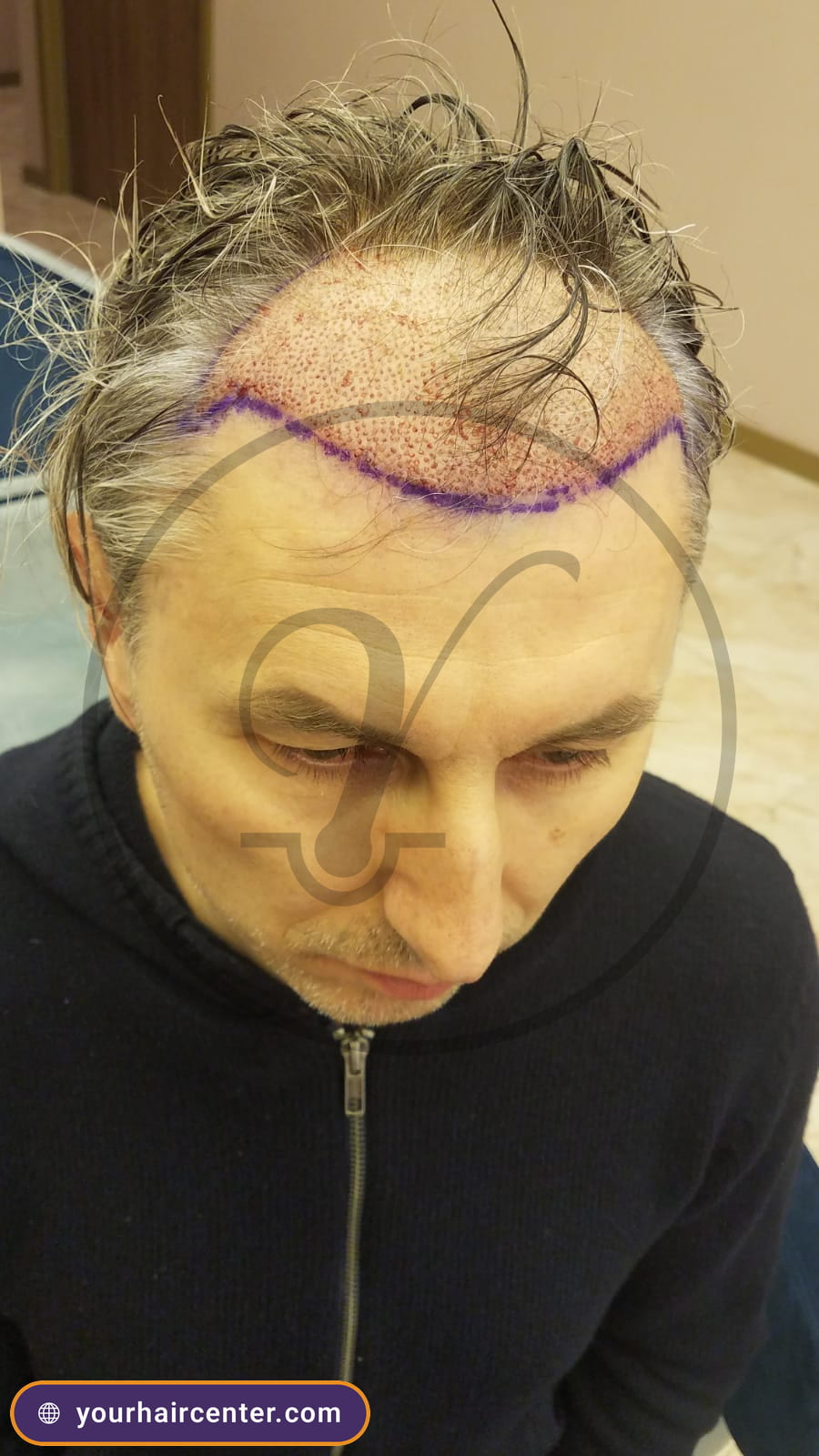
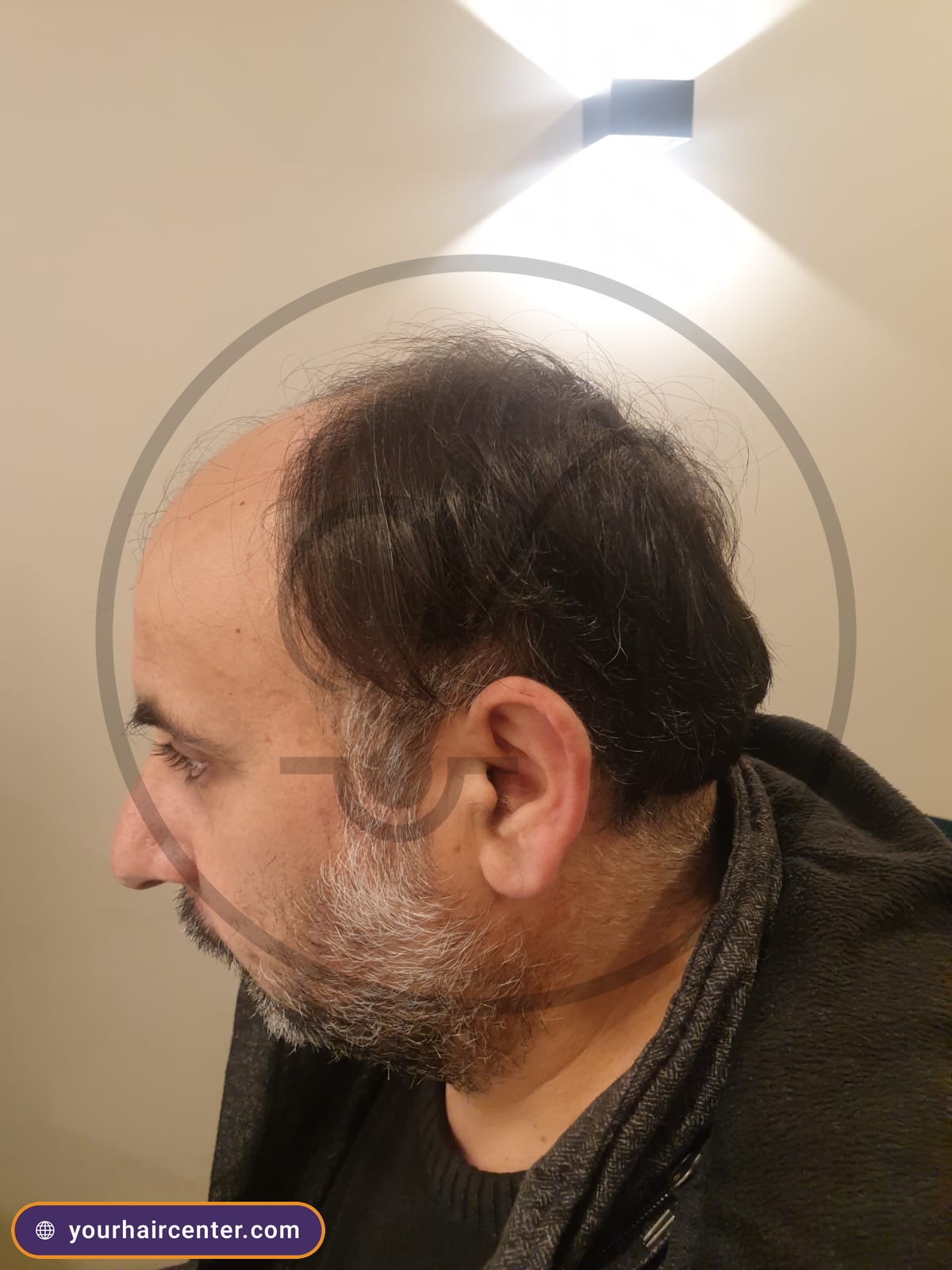
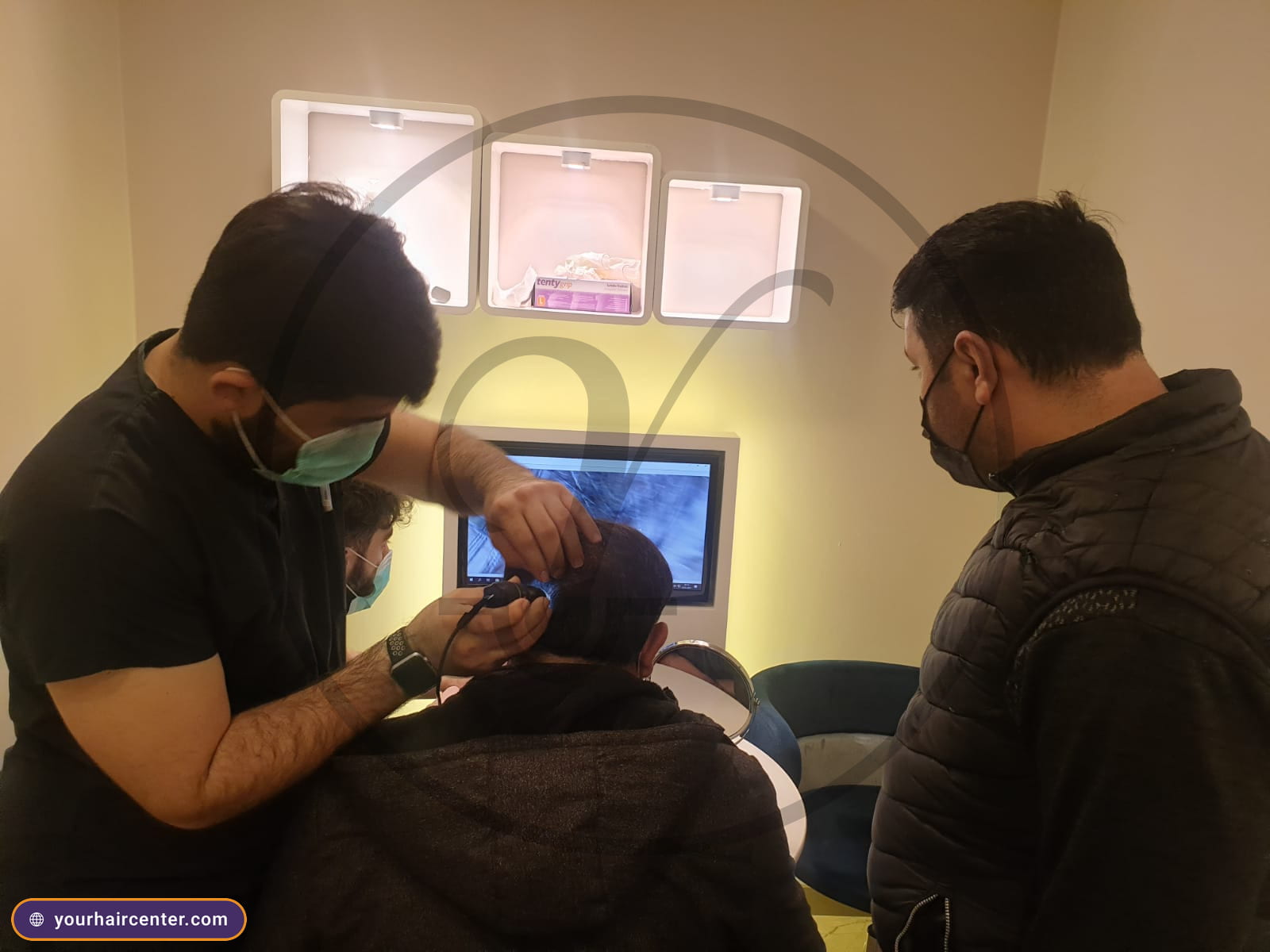
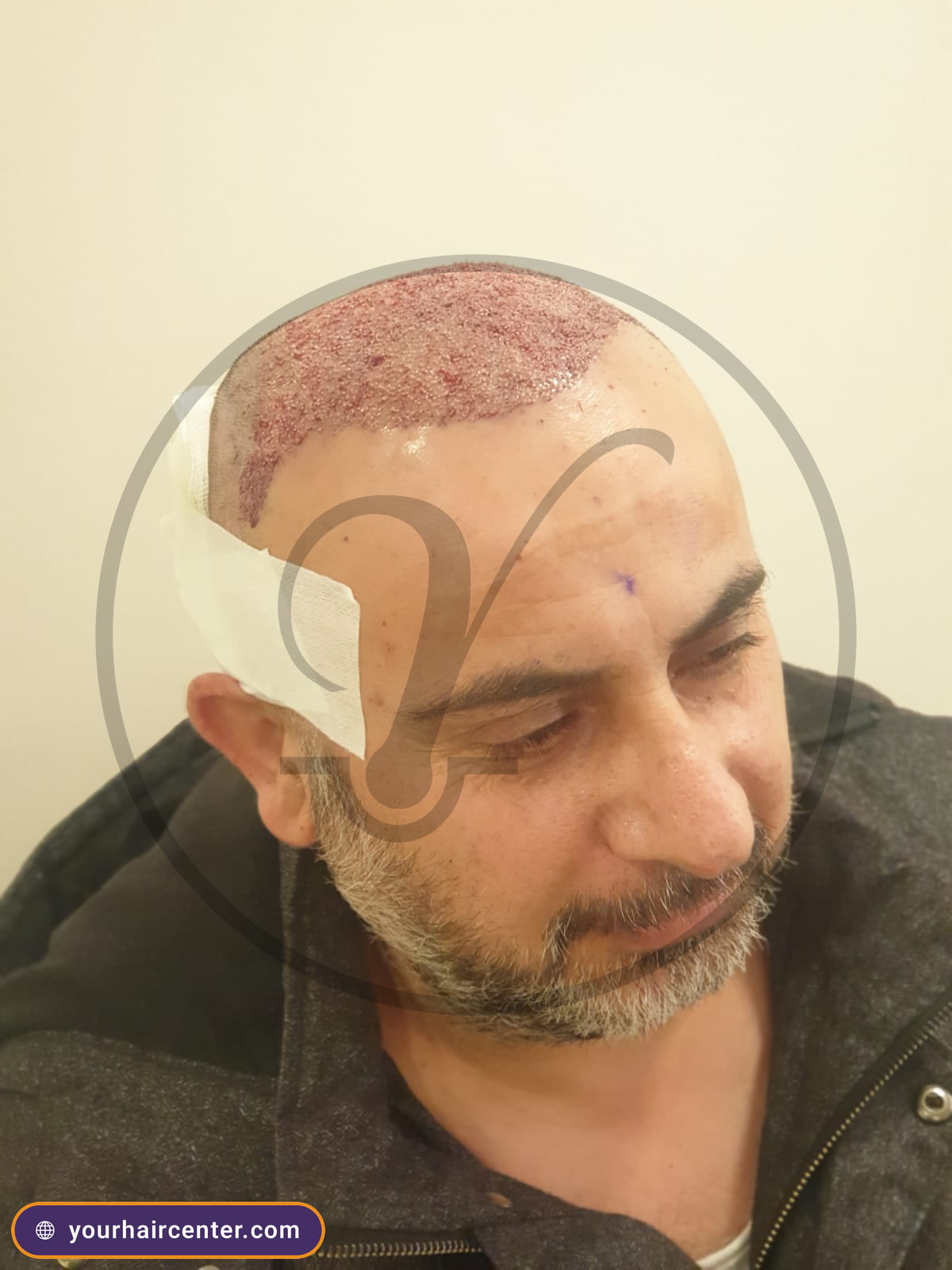
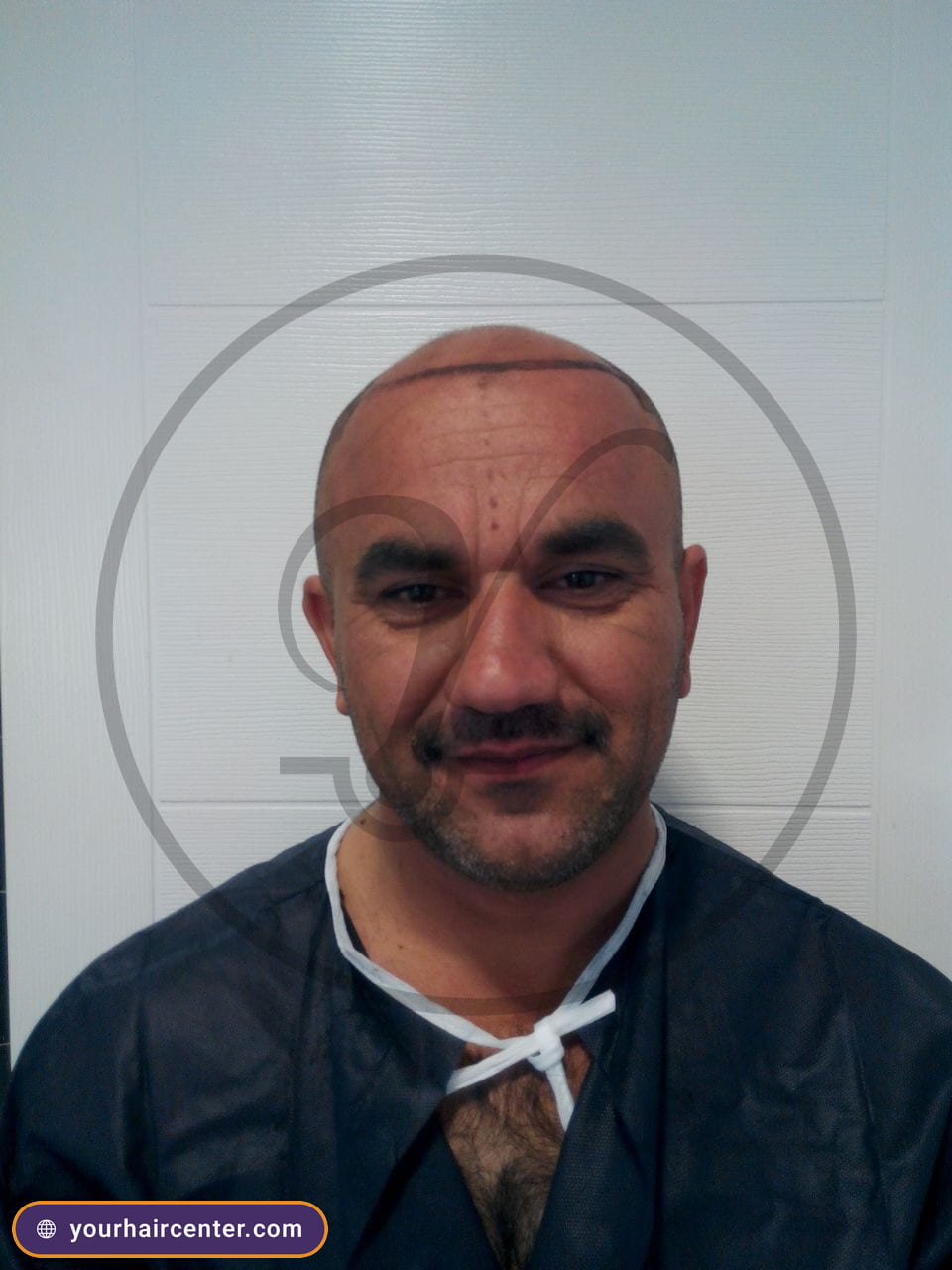
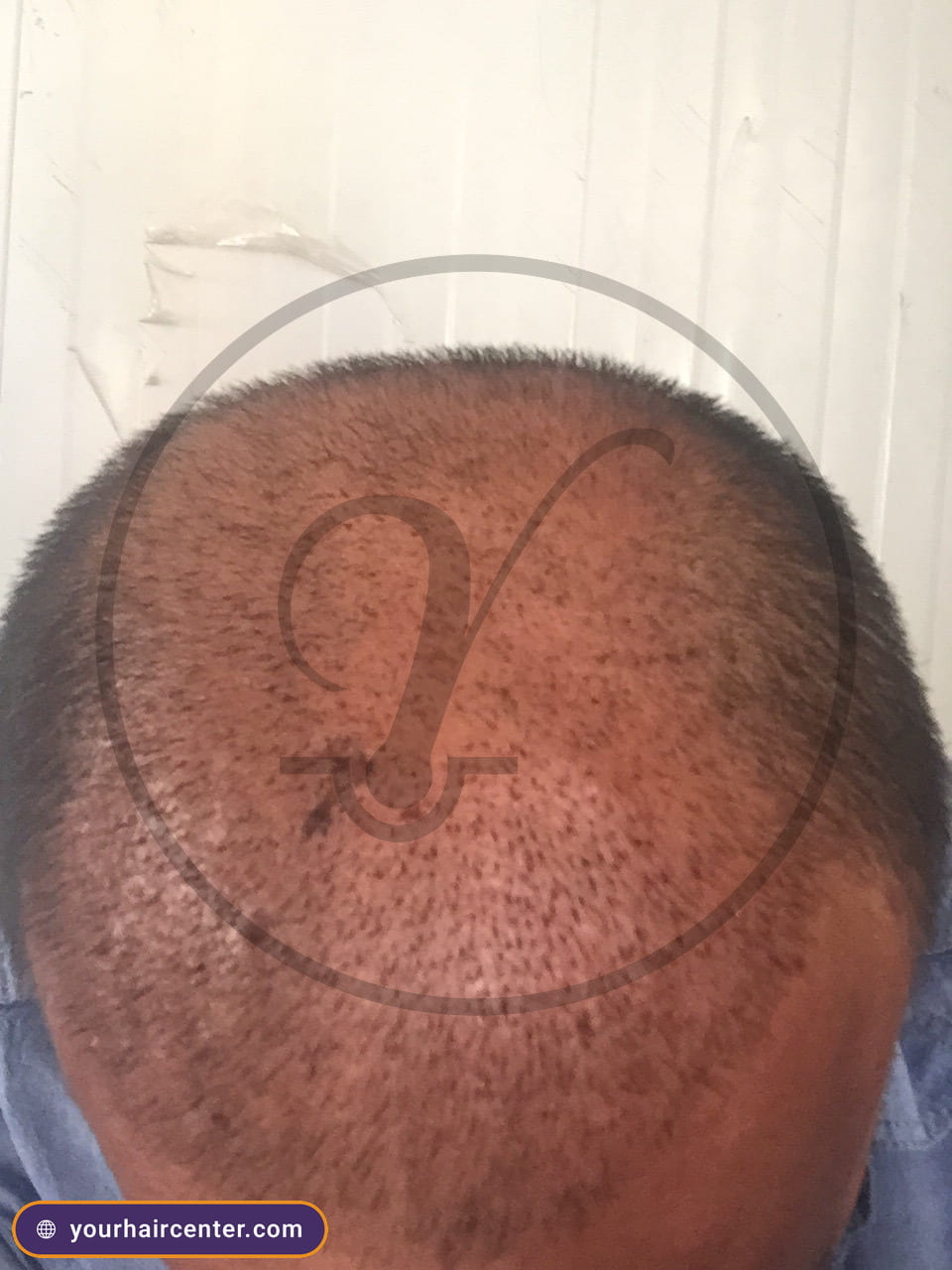
Real results from our patients’ archive. Photos exactly as captured at our accredited partner clinics — no filters, no retouching. Browse more cases in our photo gallery.
Most international quotes cluster around three sizes, with a 4,000-graft hair transplant sitting in the middle, and Patrick-style researchers usually find themselves comparing offers across all three. The coverage math makes the differences concrete.
3,000 grafts. Coverage span of 43 to 75 cm2 depending on density tier, from 3000 / 70 is about 43 cm2 at percutaneous density up to 3000 / 40 = 75 cm2 at standard density. The right size for Norwood 3 to 4 cases focused on the hairline and frontal forelock, or for Norwood 5 cases with limited donor density that need to prioritize the visible front over the crown, sizing below a 4,000-graft hair transplant to protect the donor reserve.
4,000 grafts. Coverage span of 57 to 100 cm2. The canonical mid-size hair transplant of 4,000 grafts, the Norwood 4 default and the Norwood 5 standard one-procedure option. Most international quotes default here because it fits the average male candidate’s coverage need without straining a typical donor zone.
5,000 grafts. Coverage span of 71 to 125 cm2, from 5000 / 70 is about 71 cm2 up to 5000 / 40 = 125 cm2. The right size for Norwood 5 to 6 cases with a healthy donor reserve and the ambition to address hairline, mid-scalp, and crown in a single plan. At percutaneous density this adds a third surgical day at Your Hair Center, because the surgical-time and vascular-recovery reasoning that shapes a 4,000-graft hair transplant scales past that number.
One pricing note that surprises people. Cost scales with grafts but not in a straight line with coverage. A 5,000-graft session is typically only somewhat more than a 4,000-graft hair transplant at the same clinic, not a proportional jump, because part of the price covers fixed costs like anesthesia and day-of-procedure infrastructure that do not rise with each extra graft.
The wrong question is “what is the maximum I can do.” The right question is “what is the smallest graft count that achieves my coverage and density goals while leaving donor reserve for future progression.” That is a consultation answer, and it sits downstream of the technique decision, which the five-technique decision framework works through in full. If you are weighing the standard-density baseline, the Classic FUE hair transplant page sets the 40 to 50 grafts per cm2 reference these comparisons start from. When you read quotes at three sizes, ask every clinic the same three numbers, density per cm2, estimated coverage area, and donor extraction percentage. Without those, the graft total of a 4,000-graft hair transplant alone does not compare across clinics.
The percutaneous all-inclusive package starts at $1,500, and the service page is specific about what that figure buys. It “covers the procedure, a 5-star hotel, all transfers, a dedicated interpreter, medications, a PRP session, a care kit, and a year of follow-up. The final cost depends on the number of follicles required.” A 4,000-graft hair transplant sits above that starting line, and it helps to understand what moves the number and what does not.
What scales with graft count. The procedure floor rises with the number of follicles implanted, because per-graft surgical time, the consumables each implantation uses, and the volume of the supporting PRP cycle all rise with session size. A 4,000-graft hair transplant therefore costs more than the entry figure, and the final quote is delivered only after a photo review, because your Norwood stage and donor density determine the true graft count the plan needs.
What does not scale. The hotel nights, the airport transfers, the dedicated interpreter, and the year of follow-up are fixed package components. They cost the same whether the session is 3,000 grafts or 4,000. This is precisely why moving from 3,000 to 4,000 grafts does not raise the package price by a third. The graft-dependent slice grows, the fixed slice stays put.
The wider market, in context. A 4,000-graft hair transplant in the US and UK commonly ranges from roughly $10,000 to $20,000 or more, with medications, post-op visits, and travel typically itemized as separate line items on top. The all-inclusive structure of an Istanbul package folds those into one figure, which is the structural reason the headline numbers look so different. This article stays scoped to the cost of the 4,000-graft procedure itself, not the broader question of choosing between countries, which is a decision with its own considerations beyond price alone.
One last signal worth naming. The advertising cost-per-click on the hair transplant 4000 grafts query is among the highest in the cluster, which tells you it is a term advertisers compete hardest for, so the quotes that surface in paid placements skew toward the priciest markets. Organic guides like this one are the cheaper read of the real range. The only quote that means anything is the one that follows a photo review, so you can send your photos for a graft-count and price estimate or read the full percutaneous all-inclusive package before you weigh any figure.
The most useful framing of the popular question “is 4,000 grafts too much” is not about the recipient area at all. It is about the donor zone, the back and sides of the scalp that supply every graft, and whether yours can spare the 4,000 grafts a full hair transplant needs without thinning.
Native donor density. The safe donor zone in an adult male typically carries somewhere around 65 to 85 follicular units per cm2, with real individual variation, and peer-reviewed measurements place the mean donor follicular-unit density near the middle of that band.[3]
The safe extraction ceiling. Responsible practice does not harvest the donor zone to exhaustion. Surgical literature recommends keeping extraction to a modest share of donor density, on the order of 10 to 20% per session and no more than roughly 20 to 25% of donor density across the patient’s lifetime of procedures, because pushing beyond that leaves the donor area visibly thinned and constrains any future revision.[3:1]
The lifetime budget. Put those together and the average safe donor capacity for a typical adult male works out to roughly 6,000 grafts in the best donor density, with some surgeons citing higher lifetime totals across multiple staged sessions.[3:2] A single 4,000-graft hair transplant uses a large share of that budget. That is entirely fine when it is the primary, defining procedure, and a problem when a 4,500 to 5,000 graft revision might follow a decade later.
When 4,000 is genuinely too many. Patients with low donor density, in the 50 to 60 follicular unit per cm2 range, or with a physically small safe zone, can be unable to supply the 4,000 grafts a single hair transplant needs without crossing the extraction ceiling. In those cases the right move is to size the transplant down or stage it into a primary plus a later revision, never to push past the donor’s safe budget for the sake of a round number.
The 8,000-graft question. “8,000 grafts hair transplant” appears in related searches, but in practice 8,000 grafts is the upper lifetime total most donor zones can sustain, not a single-session figure. A clinic quoting 8,000 grafts in one sitting is usually either counting hairs rather than grafts, per the multiplier above, or planning a multi-session total that bundles two procedures close in size to a 4,000-graft hair transplant.
The donor zone never grows back. Extracted follicles are permanent in their new home, the donor budget governs every 4,000-graft hair transplant, and the donor area looks intact afterward only because the surrounding hair drapes over the harvest sites, and only if the surgeon stayed under the ceiling. You can see patient donor-zone results in the photo gallery, and the percutaneous hair transplant page details how the needle technique keeps the recipient side efficient with the grafts the donor can safely spare.
A 4,000-graft hair transplant covers between 57 and 100 cm2 of scalp depending on the implantation density. At a standard 40 to 50 grafts per cm2, 4,000 grafts cover 80 to 100 cm2, enough for hairline plus mid-scalp plus partial crown work on a Norwood 4 to 5 candidate. At the needle-based percutaneous 60 to 70 grafts per cm2, the same 4,000 grafts concentrate into 57 to 66 cm2 at higher density, suited to high-impact hairline restoration.
4,000 grafts is not too much for most Norwood 4 to 5 candidates with healthy donor density. The structural ceiling is the donor zone, where responsible practice extracts no more than roughly 20 to 25% of donor density across a lifetime, which lets a typical adult male safely supply on the order of 6,000 grafts.[3:3] A single 4,000-graft hair transplant uses a large share of that budget, so the answer depends on whether revision is anticipated and what the current donor density supports.
Implanting 4,000 grafts is a long day of focused surgical work, which is why Your Hair Center splits the implantation across two days for precision-density results, one portion on day one and the remainder on day two. Compressing a 4,000-graft hair transplant into a single sitting lowers the density the technique can safely achieve. The total Istanbul stay, including arrival, both implantation days, the post-op wash, and departure, is five days.
A 4,000-graft hair transplant produces roughly 8,000 to 12,000 hair shafts once fully grown, because one follicular-unit graft carries two to three hair shafts on average.[1:2] Visible results emerge between months 3 and 6 as new hair grows in from the implanted follicles, with most of the final density visible by month 12. Patient cases at the 6-month, 12-month, and 18-month checkpoints are documented in the Your Hair Center archive and gallery.
The all-inclusive percutaneous package starts at $1,500 and covers the procedure, a 5-star hotel, all transfers, an interpreter, medications, a PRP session, a post-operative care kit, and a year of follow-up. The final cost for a 4,000-graft hair transplant sits above the starting figure, because per-graft surgical time and consumables scale with the session size. An accurate quote follows a physician photo review.
A hair transplant 4000 grafts case is not a single product. It is a coverage outcome that depends on the density per cm2 the surgeon delivers, the Norwood stage being addressed, and the donor density that supplies the procedure. At a standard 40 to 50 grafts per cm2, a 4,000-graft hair transplant spreads across 80 to 100 cm2 of moderate-density work. At the needle-based percutaneous 60 to 70 grafts per cm2, the same 4,000 grafts concentrate into 57 to 66 cm2 of high-density work, placed across two days for precision. The right number for your case is a consultation answer, not a search answer, and it starts with a photo review.
Book a percutaneous hair transplant consultation or send your photos for a graft-count estimate for your Norwood stage.